
My name is Arthur Pendelton, and I spent forty-two years fixing diesel motors down at the parish dock in Dulac, Louisiana, where the salt air rots through a galvanized bolt in three summers flat. I know how things wear out. I know the exact sound a five-cylinder Detroit Diesel makes when the oil pump starts starving the bearings, that dry metallic click that tells you the metal is eating itself alive from the inside out. I know how to tear down a transmission on the bench of a damp garage with nothing more than a half-inch socket set and a kerosene rag. But I never figured out how to fix my grandfather’s clock.
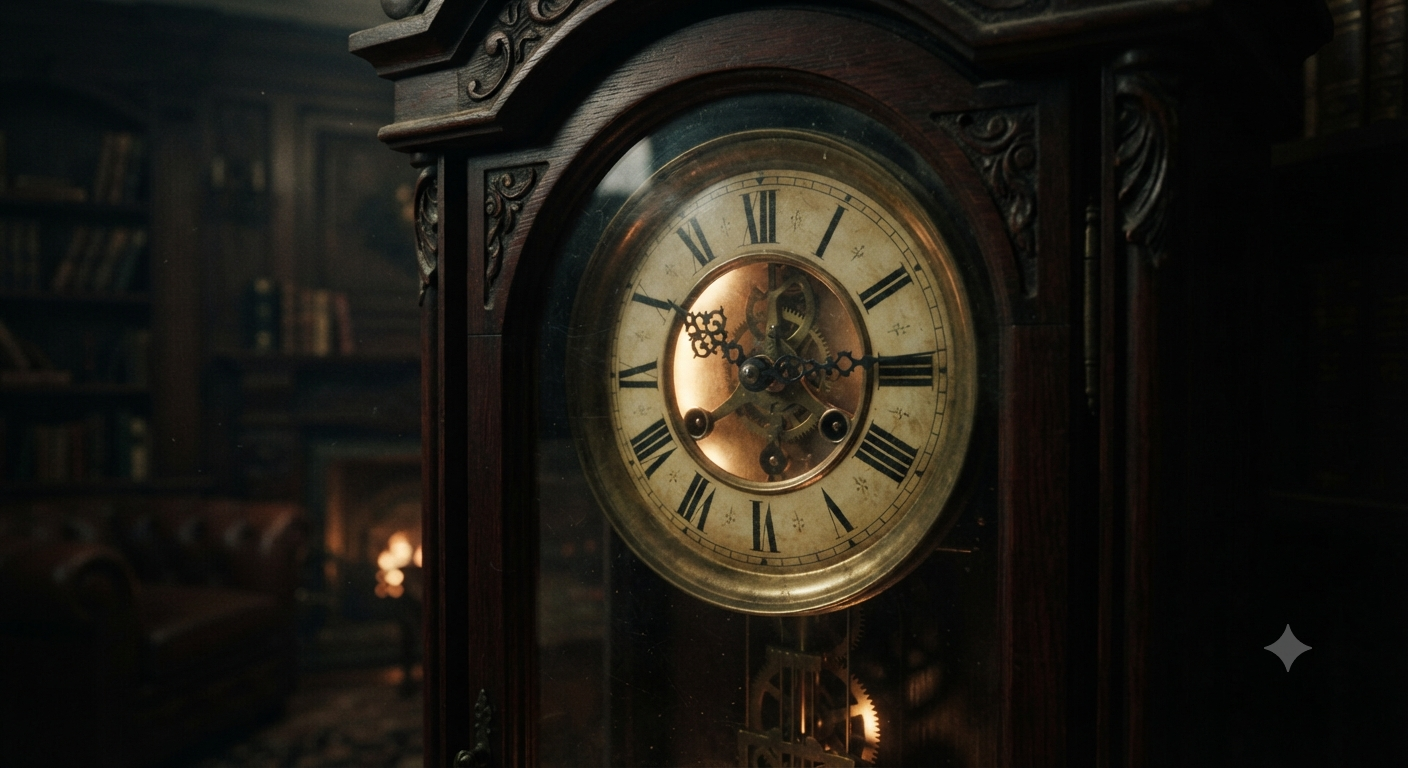
It sat in the corner of our front hallway for as long as I could remember, a seven-foot case of quarter-sawn white oak that my grandfather, old Silas Pendelton, brought down from Mississippi on the bed of a Studebaker flatbed back in nineteen-forty-six. Silas was a carpenter who built churches that still stand down the bayou, but that clock was the one thing he didn’t build himself. He traded two cords of seasoned cypress and a rusted outboard motor for it to a clockmaker passing through Biloxi who had lost his wagon wheel in a ditch. Silas hauled it home, set it against the pine-board wall, and wound the brass weights until the gutline groaned. It ran for three days, chimed a flat, cracked four o’clock that rattled the plaster, and then the pendulum gave one pathetic little shudder and froze dead in the middle of a swing.
The minute hand pointed straight up at the twelve, and the hour hand sat just an eyelash shy of the four. Three forty-seven. Silas tried to oil the escapement with three-in-one oil, but that didn’t do a damn thing. He tapped the pendulum rod with the handle of a wood chisel, and it swung three times before dying back down against the backstop like a fish hauled up into the sun. So he just closed the glass door, turned the brass key in the side latch, and left it there. It became part of the room, like the water-stain on the ceiling or the draft under the front door. By the time the house came down to me after the old man passed in seventy-eight, nobody even looked at the face when they walked by. It was just a heavy wooden box that took up floor space and collected lint on top of the crown molding.
My wife Clara used to dust the top of it with a feathered brush every Saturday morning while the coffee was perking on the stove. Clara was from down around Houma, a small woman with hair the color of river silt and hands that always smelled faintly of lemon verbena and damp soil from her tomato beds. She’d reach up on her tiptoes, give the oak crown a quick swipe, and say, “That old thing is like a stubborn mule, Artie. Won’t move for nobody.”
“Let it stay,” I’d tell her from the kitchen table where I was cleaning my fingernails with a pocketknife. “At least it’s right twice a day.”
Clara would laugh, that quiet little huff through her nose, and go back to her dish towel. We lived an ordinary, hard-working life in that house. We didn’t have much money, but we had a big vegetable garden out back that kept us in butterbeans and okra through the heavy summer heat, and we had each other. When Clara found out she was carrying our little girl in the winter of eighty-two, we didn’t buy any new furniture. We just moved an old wicker rocking chair into the corner of the bedroom and waited for the change in the weather.
The night our daughter came, the rain was hammering the tin roof of Terrebonne General so hard the nurses had to raise their voices when they talked in the hallway. I remember sitting on those plastic orange waiting room chairs until my lower back felt like it was full of dry sand. The clock on the wall above the vending machines read somewhere past midnight, but I wasn’t looking at time anymore. I was just listening to the muffled sounds coming through the swinging doors, the sharp clatter of metal trays and the low, steady murmur of Dr. Landry’s voice.
When Dr. Landry finally pushed through those double doors and wiped his brow with a paper towel, he didn’t look tired. He looked relieved. He walked right over to me, wiped his hands on his trousers, and gave me a nod that made my chest loosen up for the first time in ten hours. “You’ve got a healthy girl, Artie,” he said, and his voice was flat and professional the way doctors get when they’ve delivered four hundred babies that month. “Little thing gave us a bit of a scare with her cord, but she pulled right through.”
“Clara?” I asked, my voice scraping like gravel.
“She’s resting. Go on in.”
I went in through the swinging doors and found Clara propped up against two flat pillows, her hair plastered to her forehead with sweat, looking smaller than I’d ever seen her. She was holding a little red bundle wrapped in a blue flannel blanket against her chest. She looked up at me with those tired silt-colored eyes and gave me a weak, crooked grin. “She’s a fighter,” Clara whispered, her voice barely louder than the hum of the wall heater. “We need to name her after my mother. Rose.”
I leaned over the metal rails of the hospital bed, kissed Clara’s forehead, and then looked down at the plastic wall clock mounted right above the door. The second hand was sweeping around, but my eyes caught the hour and minute hands. They were resting right there, clear as day. Three forty-seven.
“Look at that,” I murmured, pointing a thumb up toward the face.
Clara glanced up, squinted through her exhaustion, and then let out a soft breath that sounded like a sigh. “Must be some kind of sign,” she said.
“Sign of what?”
“I don’t know,” she said, pulling the blue blanket tighter around the baby’s face. “Just means she’s ours, I guess.”
We named her Rose, and we brought her home to that old house with the grandfather clock in the hall. We put her crib in the small spare room right off the kitchen, where she could hear the screen door rattling in the spring breeze and the cicadas screaming in the live oaks out front. Life didn’t stop for us because of a coincidence on a hospital wall. We went back to the dock, back to the garden, back to the long, humid summers where the air felt like a warm wet rag held over your mouth.
Rose grew up fast, the way kids do when you’re busy working six days a week down by the channel. She had Clara’s quiet way about her, never one to raise a fuss, but she had my stubborn streak right down in her jawline. By the time she was seventeen, she was helping me scrape the bottom of the shrimp boats with a putty knife and arguing with me about carburetor jets like she’d been turning wrenches since she was five. She’d stand there on the dock with grease smeared across her cheekbone, holding a crescent wrench in her small hand, looking so much like her mother it used to make my throat tighten up if I looked at her too long in the direct sun.
Then Clara got sick. It didn’t happen all at once, the way it does in stories where people take to their beds and look like saints. It started with a persistent cough that wouldn’t clear up after the cane burning season ended in January. By April, she wasn’t walking down to the garden anymore. By July, she was spending her days in the downstairs bedroom we rigged up for her so she didn’t have to climb the cypress stairs.
I stayed home from the dock as much as I could, sitting by her bed with a cup of black coffee that went cold while I watched the rise and fall of her thin chest under the quilt. Rose was twenty-one then, working part-time down at the parish tax office and coming home every evening to cook red beans and rice that Clara could barely manage two spoonfuls of. We didn’t talk much about what was coming. People down the bayou don’t talk about death while it’s sitting in the front room; we just keep the floor swept and the water boiling and wait for the turn of the tide.
The afternoon Clara passed away, the sky outside had that heavy, bruised-purple look it gets right before a tropical squall blows in from the Gulf. The power had flickered out twice, and the hum of the refrigerator was the only mechanical sound left in the house besides the labored rattle of Clara’s breathing. Rose was out at the pharmacy picking up a fresh bottle of liquid morphine, and I was sitting alone in the low cane-bottom chair right beside the bed, holding Clara’s dry, cool hand in my big calloused palm.
Her breathing had been shallow for hours, coming in those short, hitching gasps that make you hold your breath waiting for the next one. I watched the second hand on my Timex watch crawl around the dial. The house was dead quiet except for the wind starting to hiss through the screen of the back porch. I looked up toward the hallway, where that old oak grandfather clock stood in the gloom, its frozen hands still pointing straight up at twelve and shy of four.
Clara’s hand twitched in mine. Just a little flutter of her fingers, like a moth hitting a window screen. Her eyes opened, those silt-colored eyes that had watched me build a life and watch it grow old, and she looked past me toward the ceiling. Her lips moved, but I couldn’t catch the words over the rising shriek of the wind outside. I leaned down until my ear was right against her mouth.
“Artie,” she whispered, her voice dry as corn husks. “Look at the time.”
I didn’t turn around because I didn’t need to. I knew what the clock in the hall was doing, or what I imagined it was doing in my head. But when I looked back down at my wrist, the second hand on my Timex had just clicked over. Three forty-five. Three forty-six. Three forty-seven.
And then Clara’s hand went completely limp in mine, her fingers sliding out from my palm like water slipping through an open fist.
I sat there in that dim room for a long time before Rose came through the back door with the brown paper bag from the pharmacy clutched against her chest. She took one look at my face in the gray light coming through the sheer curtains, dropped the paper bag on the linoleum floor where the plastic bottle rolled out with a hollow clatter, and ran to the side of the bed. She didn’t scream. Rose never screamed. She just buried her face in the hollow of Clara’s neck and let out one long, ragged sob that shook her whole frame.
“She’s gone, honey,” I told her, my voice sounding like it belonged to some stranger standing behind me in the room. “She’s gone.”
We buried Clara out behind the little Methodist church in Dulac, right under the shade of a water oak that dropped Spanish moss down onto the granite headstone like old lace. The weeks after that were quiet in a way that felt heavy, like a house with all the windows nailed shut before a hurricane. Rose stayed with me in the big house for another three years, keeping the kitchen clean and making sure I ate something besides cold canned mackerel and soda crackers. But you could see she was restless, the same way I had been forty years before when the salt air first started getting into my blood. She wanted to see what was up north, past the bridge, past the parish line where the land stopped being flat and watery.
When she finally packed her rusted Toyota Corolla and headed up toward Baton Rouge for a job with the state department, the house felt twice as big and half as warm. I’d sit in the kitchen alone at night with a mug of chicory coffee, listening to the silence settle into the floor joists. That was when I started noticing the clock again.
It had been sitting there in the dark hallway for nearly thirty years, frozen at three forty-seven. I’d walk past it twenty times a day on my way to the back porch or the bathroom, my shoulder almost brushing the heavy oak case. One evening in late October, after the humidity had finally broken and the air outside had that crisp, iron-tasting edge to it, I stopped dead in front of the door. The house was too quiet. The kind of quiet where you can hear the blood moving in your own ears.
I went to the utility drawer in the kitchen and pulled out the old flat-head screwdriver I used for scraping gaskets, the one with the cracked amber handle wrapped in electrical tape. I walked back out to the hallway, dropped down on one knee on the bare pine floorboards, and slid the tip of the driver into the small brass keyhole on the side of the clock’s waist door.
The lock didn’t even put up a fight. The brass mechanism was so worn down with age that the latch just slipped back with a dry click.
I pulled the heavy glass-and-oak door open for the first time since my grandfather had brought the thing down from Mississippi in forty-six. The smell inside was like an old trunk that hadn’t been opened since the war, dry cedar and aged brass and thirty years of accumulated dust that rose up and made me cough into my shirtsleeve. I reached my hand inside the narrow cavity, past the rusted iron weights that hung on their frayed hemp cords, feeling around the backboards where the wood was dark and stained with age.
My fingers brushed against something tucked deep into the corner behind the pendulum rod, wedged tightly into a mortise joint in the oak frame. It wasn’t metal. It felt like paper, thick and stiff and folded over twice.
I hooked my index finger under the edge of it and worked it out into the dim hallway light.
It was an old envelope, yellowed around the edges until it looked like parchment, addressed in my grandfather Silas’s blocky, carpenter’s handwriting to *Arthur Pendelton – Or Whoever Finds This When The Time Comes*. The ink was purple fountain pen ink that had faded to the color of a bruised plum.
My hands were shaking a little bit, not from fear, but from the sudden draft coming up through the floorboards. I unfolded the heavy paper on my knee. There was no letter inside, no long explanation or family history. There was just a small, neatly cut photograph of a young woman I had never seen before in my life, standing on the deck of a river steamer with the Mississippi River behind her, and on the back of it, written in that same purple ink, were three lines.
*She died at 3:47 in Natchez, fifty miles from home, and I couldn’t be there to turn the hands back.*
*I stopped it so I wouldn’t have to watch every other minute slip away without her.*
*Some clocks measure more than time.*
I sat there on my knees on the cold floorboards for a long time, the paper held loosely in my fingers, staring up at the white enamel face of the clock where the minute hand rested eternally just an eyelash shy of the four. I didn’t get up to wind the weights. I didn’t try to force the brass gears to turn. I just closed the wooden door, heard the latch click home, and left the hands right where they were.