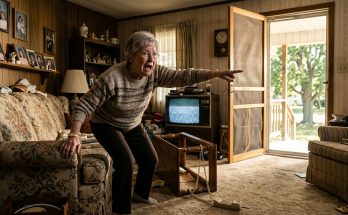
Why did I think that thirty seconds was enough time to let the water reach a boil? That is the question I ask myself every single morning before the sun even touches the horizon. It has been four years, three months, and twelve days since Leo went missing from our porch in Dulac, and yet the math of that day is the only thing my brain seems capable of doing. I tell myself that if I had just stayed in the living room, if I had just ignored the kettle whistling like a dying bird, things would be different. But the truth is, I wanted a cup of tea. I wanted a moment of quiet before the evening rush. That selfish, tiny desire is the anchor that keeps me drowning in the same pool of water every single day.
Back then, life felt predictable in a way that I didn’t appreciate. Leo was four, all knees and elbows and an endless curiosity about the marsh behind our house. He loved the way the egrets looked when they took flight, and he spent half his day pointing at the sky. I was his grandmother, the one who took over after my daughter decided that the city life in New Orleans was more important than raising a boy near the water. I didn’t mind. I loved the smell of the bayou on his skin, that mix of salt and mud and sunshine. We had a rhythm. Breakfast at 7:00, outside play until 11:00, a nap that he fought with every fiber of his being, and then the afternoon exploration. It was a good life. It was a safe life, or so I kept telling myself while I scrubbed the floors and watched him from the kitchen window.
It started at 4:12 PM, or that is what the clock on the wall said when I stepped away. Leo was sitting on the front porch with his plastic trucks, making little vrooming sounds that traveled through the screen door. I told him, “Stay right there, Leo, I am just grabbing a tea bag.” He didn’t even look up. He just hummed a little song and shoved a truck into the dirt. I walked into the kitchen and turned the burner on. I watched the water ripple, thinking about how tired I felt, how the humidity always made my bones ache. Then the kettle started its high-pitched scream. I spent maybe forty seconds getting the cup ready, grabbing the sugar, and finding a spoon. When I turned back around, the silence hit me like a physical blow.
Nobody was humming. No trucks were vrooming. I walked back to the screen door, wiping my hands on my apron, feeling a strange flutter in my chest that I dismissed as caffeine jitters. “Leo?” I called out. Nothing. Just the sound of the marsh grass rustling in the wind. I stepped onto the porch. His trucks were exactly where he had left them, lined up in a neat row, but he was gone. My heart did that weird, skipping thing, but I still didn’t panic. I thought he had just wandered around to the side of the house to look at the blue heron that visited the pond. “Leo, stop playing,” I said, my voice sharper than I intended. I walked around the side, looking at the tall grass, waiting for that little laugh he always gave when he was hiding.
I walked to the edge of the property line, calling his name again, but the swamp was just too quiet. That is when I saw Mrs. Thibodeaux standing by her garden fence. She was holding a trowel, her face looking all pinched and pale. I ran over, my breath coming in jagged little gasps. “Have you seen Leo?” I shouted before I even reached the fence. She dropped the trowel, the metal hitting the dirt with a dull thud that I can still hear in my dreams. She didn’t say a word. She just pointed toward the water. “He’s not here, Sylvia,” she finally said, her voice shaking so hard it sounded like she was crying. I didn’t wait for her to explain. I just started running.
The next hour was a blur of adrenaline and pure, unadulterated terror. I remember the way the air felt, thick and wet, sticking to my clothes as I sprinted toward the canal. I remember the way my lungs felt like they were full of broken glass. I found his little blue sneaker floating near the reeds about fifty yards from the dock. I picked it up and held it against my chest, and for a second, I couldn’t move. I just stood there, staring at the brown water, praying to a God I hadn’t talked to in years. I kept thinking, how could he have moved that fast? He was just a baby. He didn’t know the dangers of the currents. I started screaming his name, but the marsh just swallowed the sound.
The police arrived about twenty minutes later. They were professional and kind, but their faces told me everything I needed to know. A young officer named Miller put a hand on my shoulder and tried to sit me down on the back of his cruiser. “Ma’am, we need you to stay here while we search the area,” he told me. I looked at him, feeling like I was outside of my own body, watching some sad old woman tremble in the heat. “Find him,” I said, my voice sounding like gravel. I didn’t care about anything else. I didn’t care about the house, the dinner, or the life I had built. I just wanted my boy back. I wanted to see his hair matted with swamp mud and hear him complain about being hungry.
They searched for three days. The community came out in droves, people I barely knew showing up with flashlights and nets, walking the edges of the bayou until their boots were caked in thick, black muck. I sat on my front porch the whole time, watching the driveway, waiting for a car to pull up and deliver him back to me. Every time a car slowed down, my heart would stop for a heartbeat, hoping against hope. But the cars always kept moving. Nobody came up the path. I didn’t eat. I didn’t sleep. I just stared at the spot where he had been playing with his trucks, feeling the weight of my own negligence pressing down on me like a boulder.
On the fourth day, they found him. It wasn’t the way anyone wanted, but it brought an end to the guessing. When the sheriff came to the door, I didn’t even let him finish his sentence. “I know,” I told him. He looked at the floor, his hat held tightly in his hands. “I am so sorry, Sylvia,” he said, his voice barely a whisper. I didn’t cry. I think I had used up every tear I had in the first twelve hours. I just nodded and closed the door. I didn’t want to hear the details. I didn’t want to know how far he had gone or how he had tripped. I just wanted the silence back, but even the silence felt different now.
The house became a tomb. I kept his room exactly the way it was, his little bed made, his books lined up on the shelf. I spent months just sitting in that chair, listening to the wind hit the house, waiting for a sound that never came. My daughter came down from New Orleans once, but she couldn’t even look at me. We sat at the kitchen table for three hours without saying a word. Finally, she stood up and walked to the door. “You were supposed to watch him,” she said, her voice dripping with a cold, sharp anger that cut deeper than any knife. She was right. I was supposed to watch him. That was my only job, and I failed.
I still live in the same house. People tell me I should move, that the place is filled with ghosts, but I think I deserve to stay here. I deserve to hear the creak of the floorboards where he used to run. I deserve to see the spot on the porch where he played his last game. I have learned that the world doesn’t care about your intentions. You can be the most loving person on earth, you can try your hardest, but if you blink for one second, the world will take everything you love. I teach safety now, at the local community center, telling young mothers to watch their kids every single second. I tell them that it only takes thirty seconds for a life to end.
Sometimes, when the wind blows just right, I think I hear him calling for me. I’ll stand up and walk to the porch, checking the driveway one more time, just in case. The trucks are gone, of course. I put them away in a box under my bed. But I can still see the little indentations they made in the dirt. I see them every time I go to check the mail. I don’t think I will ever leave this place, because leaving would mean admitting he is truly gone, and I am not ready for that. I am just a woman sitting in a house full of memories, waiting for a tea that went cold four years ago.
I know what people say behind my back. They say I was careless. They say I was too old to be watching a rambunctious boy. Maybe they are right. I look at my reflection in the window and I see a stranger, a woman with hollow eyes and a permanent slump in her shoulders. I used to be a person who laughed, who sang, who enjoyed the simple things. Now, I am just a monument to a single mistake. I don’t blame them for judging me. I judge myself every single hour of the day. There is no amount of prayer or penance that can change the fact that I walked into the kitchen for a cup of tea and never came back the same.
The marsh is still there, moving and breathing like it always does. It doesn’t care about my grief. It just keeps on growing, swallowing everything that falls into its reach. I watch the birds fly over it, the egrets he loved so much, and I wonder if he is up there somewhere, watching me back. I wonder if he knows how much I miss him. I wonder if he knows that I would trade every single day I have left just to go back to that afternoon. I would let the tea burn. I would let the house burn. I would do anything just to be back on that porch.
But that is not how life works. Life is a series of moments, and some of those moments are poison. You drink them, and you keep drinking them, and you wait for the end to arrive. I am still here, and the sun is still setting over the bayou, casting long, dark shadows across the porch. I am going to walk out there now and sit in the chair where he sat. I am going to watch the water until it gets too dark to see. It is all I have left. It is all I deserve. I am not a hero. I am not a martyr. I am just a grandmother who turned her back for thirty seconds, and I will carry that weight until my own heart finally stops beating.