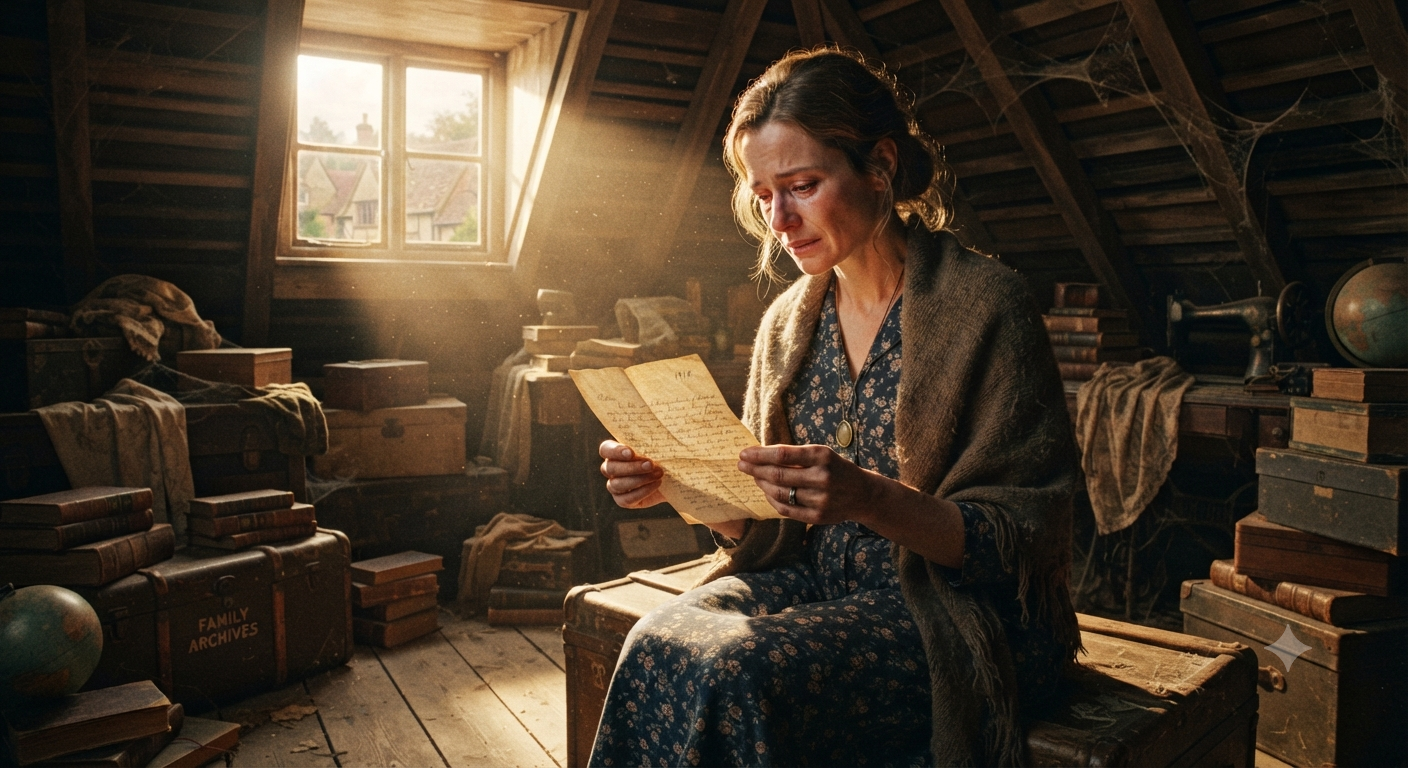
The heat up in Mama Verna’s attic was the kind that sat on your chest like a wet wool blanket and wouldn’t let you draw a full breath. I had three black trash bags sitting by my knees and a roll of gray duct tape tucked into the back pocket of my denim shorts, but I hadn’t actually put anything in a bag for twenty minutes. I was sitting right there on the rough pine floorboards with my back against the brick chimney, staring at a little tin biscuit box I’d pulled out from behind the chimney base. My grandmother Verna had been gone three weeks, and my uncle Ray had already put her small house on the market over in West Plains. He told me to clear out the Christmas ornaments and the quilt scraps and just pitch the rest into the dumpster down by the driveway. He didn’t want to mess with it. He said old people accumulate too much junk that nobody cares about once they are gone.
I didn’t care much about the quilt scraps either, but that tin box had a heavy brass latch that caught my eye when the sun hit the gable vent just right. Inside wasn’t costume jewelry or old ration books. It was a neat stack of envelopes tied together with a length of faded blue ribbon that had gone stiff and brittle at the edges. Every single one of them was addressed in a sharp, slanted ink handwriting to a Mr. Julian Vance at an address in the Seventh Arrondissement of Paris, France. I turned the top envelope over and saw the canceled postage stamp from the summer of nineteen-forty-one. Mama Verna had never been to France in her life, or at least that was what she told everybody in Howell County from the day I was born to the day they lowered her oak casket into the red dirt behind the Baptist church. She told us she grew up right here on the Current River and never crossed the Mississippi until her honeymoon with my grandfather, Arthur.
I remember Verna sitting on her screened-in porch shelling butter beans into an enamel bowl while the radio played some old scratchy gospel songs. “A woman’s past is her own business until she gives it away,” she used to tell me whenever I asked why there weren’t many pictures of her before she married Arthur. She had these pale blue eyes that could look right through you if you asked one question too many. I figured she just had a boring girlhood like everybody else out here in the Ozarks, farming corn and canning tomatoes and waiting for the boys to come back from the war. I picked up the topmost envelope and slipped my thumb under the flap because the glue had long since dried up into white dust. I told myself I was just seeing if there were any valuable stamps on them for Uncle Ray to sell down at the coin shop in Springfield. That was the lie I told my own conscience while I pulled the folded sheets of onionskin paper out into the dim attic light.
The ink was black fountain pen, faded to the color of strong tea, but the handwriting was unmistakably Verna’s when she was young and had a steady hand. “My dearest Julian,” it started, right there in the middle of a hot Missouri August while the world was burning across the Atlantic Ocean. She wrote about the county fair and the way the dust tasted in her teeth, but then the sentences got short and jagged toward the bottom of the second page. “I cannot tell my father about this because he would take the shotgun down from the pegs and go looking for trouble before the sun went down. You have to send word from Paris by the first ship or I don’t know what I am going to do with myself in this town.” I read those lines three times while the sweat ran down the back of my neck and soaked into the collar of my shirt. I didn’t want it to mean what it plainly said, but the words were right there on the thin paper, written in my own grandmother’s confident, sharp strokes.
The next letter in the stack was dated two months later, and her tone had changed from scared to something cold and flat that I never heard in her voice when she was alive. “Arthur says he will marry me before the first frost so nobody has to ask questions about the timing,” she wrote to that man in Paris who was three thousand miles away across an ocean of water and war. “He isn’t bright enough to figure out the calendar, and he is decent enough to put his name on whatever needs a name. You took too long to write back, Julian. By the time your letter gets to the post office here, I will already be Mrs. Arthur Gable.” I sat there on those hot attic boards and my breath went shallow and fast. My grandfather Arthur had passed away back when I was ten years old, and everyone in the family always talked about what a saint he was for taking on a young wife right when the town was full of gossips. They said he had a heart of gold. They said he was the kind of steady, solid man they don’t make anymore.
“Hey! You almost done up there?” Uncle Ray yelled from the bottom of the stairs, his voice echoing off the plaster walls in the hallway below. “The truck from the salvage yard is turning down the gravel road right now, and I want to get this front room cleared before dark!” I didn’t answer him. I couldn’t get my vocal cords to work right because my mind was racing backward through every Thanksgiving dinner and every Sunday afternoon spent at that little laminate kitchen table. I looked down at my own hands resting on my knees, hands that had Verna’s long fingers and Arthur’s square knuckles. Except Arthur didn’t have any knuckles to pass down to anybody. Everyone in the family knew the story about why Uncle Ray and my mother were the only two kids, and why Arthur had walked with a stiff, heavy limp ever since the winter of forty-two. He hadn’t been wounded in France like the church ladies whispered over coffee after services.
I remembered my mother talking about it in the kitchen years ago while we were washing dishes together after my father’s funeral. “Your grandfather Arthur never could have children of his own after the logging accident down at the mill,” she had said, scrubbing a skillet until the aluminum shone dull and gray under the fluorescent light. “The doctor told him right after they got hitched that he was firing blanks, but he just smiled and told Verna it didn’t matter a bit because family is what you build with your own two hands.” We always thought that was the sweetest story in the world. We used it to prove that love was thicker than blood and that good men like Arthur were worth waiting for in a world full of hard-headed fools. I sat there in the rising heat of that attic with the smell of old cedar and mouse droppings filling my nose, and the whole foundation of my life cracked right down the middle like dry clay in July.
Arthur knew. That was the terrible part that wouldn’t let me breathe. He knew Verna was carrying another man’s child when he walked down the aisle of the little white church with her on a crisp October afternoon. He married her anyway, and he raised my mother as his own flesh and blood, and he took that secret down into the gravelly earth of the cemetery without ever letting a single person in this county know he had been played for a fool or had chosen to play along out of some quiet, stubborn pride. I looked back down at the tin box, and there were still four more letters tied with that blue ribbon that I hadn’t even unfolded yet. Ray’s heavy work boots hit the bottom step of the attic stairs, and I heard him grunting as he started hauling his weight up toward the landing. I didn’t put the letters back in the box. I just shoved them down inside the front of my shirt right against my skin where he couldn’t see them if he poked his head through the door.
“What are you doing just sitting there in the dark?” Ray asked, his red face appearing over the top of the floorboards as he wiped his forehead with a greasy shop rag. “The guys are outside waiting on those boxes. Hand me that trash bag so we can get moving.” I looked up at my uncle, seeing the shape of his jaw for the first time not as something inherited from old Arthur, but as something else entirely, something that belonged to a man named Julian Vance who probably died in some bombed-out street in Europe sixty years ago. “I found some old papers,” I said, and my voice sounded thin and strange to my own ears. Ray didn’t even look down at the floor. He just reached out a calloused hand and grabbed the nearest cardboard box of Christmas tinsel. “Just pitch it all in the bin,” he muttered, turning his back and heading back down the stairs into the cool gloom of the house. I stayed there on my knees for a long minute, feeling the sharp corners of those folded French letters pressing right against my ribs. I stood up slowly, brushed the dust off my knees, and walked down the stairs into a house that didn’t belong to any of us anymore.