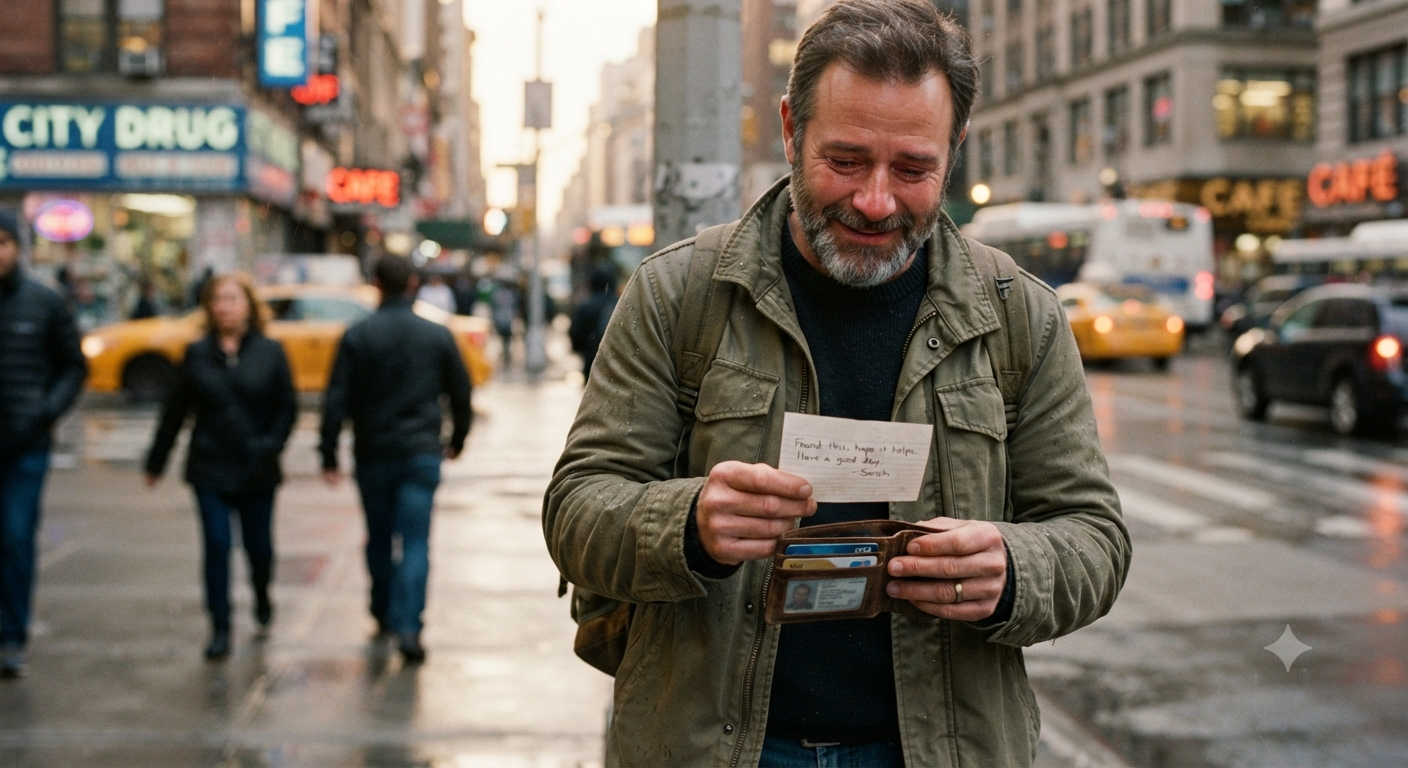
The cold slate air of Manhattan always smelled of roasted peanuts and wet asphalt. I had just come out of the hardware supply office on Forty-Second Street when the shove came from my blind side. It wasn’t a violent slam, just a neat, practiced bump that spun me around while a young fellow in a gray hoodie vanished into the crowd. My right hand went straight to my jacket pocket. The leather billfold my daughter gave me for my sixtieth birthday was gone.
Inside that old worn calfskin sat three hundred and forty dollars in cash, my driver’s license, my union card, and the only good color photo I had of my late wife Martha smiling on our porch in Maine. I stood on the crowded sidewalk for a full minute, watching yellow cabs splash gray slush over the curb, feeling a cold kind of anger start to settle deep in my ribs. I filed the police report at the precinct two blocks away, but I knew what every working man knows about a lost wallet in the city. It was gone to the wind.
Seven days later, the mail carrier dropped a brown padded envelope onto the front porch of my house in Millinocket. My name and address were scrawled across the heavy paper in shaky, uneven pencil strokes with no return address in the corner. I cut the tape with my pocketknife and tipped the contents onto the kitchen table. Out slid the brown leather billfold, looking just the way it did the afternoon it was lifted off me.
Every single bill was tucked neatly inside the cash slot. My driver’s license sat behind the plastic window, and my union card was right beside it. But when I snapped the clasp open, a folded piece of lined notebook paper dropped onto the table. I picked it up and held it under the kitchen light. The handwriting was cramped and hurried, written by someone who had clearly spent a long time staring at a blank page before finding the courage to press the lead down.
“I’m sorry,” the note read in uneven block letters. “I was desperate. I saw your family photo and couldn’t keep it. I’m trying to get clean. You reminded me of my own dad.”
I sat down at that old pine table and read those four sentences three times. The anger I had carried all the way back from New York didn’t vanish all at once, but it shifted into something heavier, something that felt a lot like a weight settling onto my chest. I turned the note over, but the other side was completely blank. That was the whole confession.
“Who sent it, Dale?” Sarah asked from the doorway, her hands wrapped around her coffee mug. She had seen the mailer sitting by the door.
“Some kid down in the city,” I said, sliding the note across the wood toward her. “He gave it all back.”
She read it once, her eyebrows drawing together in that familiar quiet look she had whenever things didn’t add up cleanly in her head. “Well. That’s something you don’t see every day.”
It was something, alright. But three days later, I found myself sitting in my pickup truck outside a public library branch in downtown Portland, staring at the return zip code stamped faintly on the shipping label. The paper envelope had been mailed from a designated drop box right next to a city shelter on Park Avenue. I didn’t plan on making the trip, but Tuesday morning came around and I found my boots on the pedals anyway, driving six hours south down Interstate 95 with Martha’s face sitting quietly in my pocket.
Finding the shelter wasn’t hard once I asked the fellow running the front desk. The place smelled of bleach, old wool, and boiled cabbage. They pointed me toward the back alley where a crew of young men was unloading a delivery truck of donated canned goods into the basement storage doors.
He was there, hauling crates of crushed tomatoes with his shoulders hunched up against the autumn chill. He looked younger in the gray daylight than he probably was, maybe twenty-two, with dark circles under his eyes and a nervous habit of wiping his palms on his jeans every time he set a box down. I walked up behind him while he was catching his breath against the brick wall.
“You drop this off at the post office last week?” I asked, holding the lined paper out between two fingers.
The kid spun around so fast he nearly dropped the crate he was holding against his shins. His face went entirely blank for a second, then drained of color until his freckles stood out like dark dirt spots on his cheeks. He looked at my face, then down at my boots, and his whole posture collapsed inward like he was waiting for a fist to land.
“I mailed it,” he whispered, his voice cracking right in the middle of the word. “I swear I put every dollar back. I didn’t spend a cent of it. Check it if you want.”
“I checked it already,” I said, keeping my voice level. “Every bill was there. Even the two-dollar bill my uncle gave me back in ninety-four.”
He swallowed hard, his Adam’s apple bobbing sharply under his thin cotton collar. “I saw the picture. Of your wife. My old man had that exact same smile before he… before things went bad at the house. I couldn’t keep it. It felt wrong looking at her every time I opened it to buy something.”
“What’s your name, son?” I asked.
“Lucas,” he said, staring down at the gravel between my boots.
“Well, Lucas, you’ve got a steady arm for lifting crates,” I told him, looking over at the half-unloaded truck behind him. “And you know how to follow through on a promise, even if you started off on the wrong foot.”
He looked up, his eyes wide and suspicious, searching my face for the trick or the punchline that usually came next in his life. “What do you mean?”
“I mean my back isn’t what it used to be down at the lumber yard, and the boss has been looking for someone who can show up on time and keep his hands to himself,” I said, pulling my keys out of my pocket and jingling them once against my thumb. “Pays twenty-four an hour. Full union benefits after ninety days. There’s a spare room above my garage with a good heater and a cot that doesn’t sag too bad.”
Lucas stood there for a long time, right by that brick wall in the alley, watching the traffic go by on the street beyond. The wind blew a stray piece of newspaper past our feet, and I could see the muscles in his jaw working while he tried to figure out what to do with an offer that didn’t come with a catch.
“You’re not calling the cops?” he finally asked, his voice shaking just enough to let me hear how thin his rope really was.
“The police already have my report on file, and the wallet’s back in my pocket,” I said, turning toward the driver’s side of my truck. “Whether you get in this truck or stay here hauling canned tomatoes for free is entirely up to you. But I’m leaving in five minutes either way.”
I walked back to the cab, climbed up into the driver’s seat, and pulled the door shut with a heavy solid thud. Through the windshield, I watched him stand by the back of the delivery truck for three long minutes, looking down at his worn-out sneakers, then over at the passenger door of my rig. He didn’t say goodbye to the fellow running the loading dock. He just turned around, walked over to the truck, pulled the handle down, and climbed in beside me without saying a single word.