I was wrong about Clara, and I have carried that weight in my chest every single day for the last eight years, eleven months, and twelve days.
If I had just swallowed my pride when the county assessor tacked an extra $4,200 onto our property tax bill back in the autumn of 2014, she would never have packed her battered leather suitcase and caught the midnight Greyhound out of town. I told her she was throwing her music away for a pipe dream in Portland. I told her that people who play Chopin in hotel lobbies end up broke and forgotten.
Bless my soul, I was the one who ended up forgotten, sitting on a folding stool right here in the drafty brick transit hub on the Oregon coast, hammering away at an old upright piano that the stationmaster let me drag in off the loading dock.
My fingers have grown stiff over the winters, and the joints in my right thumb click like a dry hinge whenever the salt air rolls in off the harbor.
The station smells of diesel exhaust, stale black coffee from the vending machine by the ticket booth, and the wet cedar smell of the timber trucks rumbling down Highway 30 toward the mills.
I reckon most folks just take me for another one of the harmless old codgers who haunt the depot waiting rooms to dodge the damp chill. They drop a stray quarter or a bent paperclip into my open tin box, but mostly they just walk right on by without looking me in the eye.
The stationmaster, a broad-shouldered fellow named Arthur who has worked these platforms since the Johnson administration, likes to lean against the tile wall with his arms crossed over his high-vis vest and watch me struggle through the second movement of that old Nocturne.
“You’re wasting your breath on wood and wire, Silas,” Arthur told me just last Tuesday, shaking his bald head as a westbound freight rumbled past on the outer track. “She’s up in Seattle or down in San Francisco by now. She ain’t coming back through these turnstiles.”
I didn’t say nothing to him because I knew he was probably right in his head, even if my stubborn old heart refused to listen.
I keep playing because the silence when I stop is a heavy, suffocating thing that makes the walls of my small trailer down by the marina feel like they are closing in around my ears.
The routine never changes much from dawn until the last commuter train clears the trestle at 8:15 in the evening.
I arrive just before the morning fog lifts off the mudflats, hauling my damp wool coat tight against my collar and wiping the salt spray off the piano keys with an old handkerchief that smells faintly of peppermint.
The piano is missing the middle C hammer, so I have to fudge the melody of Clara’s favorite lullaby every time I cycle back through it, sliding my left hand over to cover the gap.
People hurry past with their heads ducked down against the drizzle, their sensible rubber boots squeaking against the wet linoleum floor of the waiting room.
Nobody stops to listen for more than three seconds, just long enough to check the digital departure board above the turnstiles or complain about the delay on the coastal flyer.
I reckon that is the way of things in a dying timber town where everyone is either trying to sell a boat or figure out how to pay for their winter heating oil.
Yesterday started out just like any other Tuesday, with a freezing mist blowing sideways off the Columbia River and coating the depot windows in a thick layer of grey grime.
My fingers were so stiff from the unheated waiting room that I could barely hit the right chords on the opening bars of the piece, my knuckles swollen and purple from the damp.
A young woman walked through the side glass doors around 4:38 in the afternoon, carrying a faded canvas backpack with a broken zipper that kept catching on her heavy wool sweater.
She didn’t look like the usual commuters or the tourists who get lost on their way down to the cannon beach seafood shacks.
She had that pale, hollow-eyed look of somebody who had been sleeping in cheap motels or riding the rails for three days straight without a hot meal inside her.
She stopped dead in her tracks about six feet from my bench, her boots planted firmly on the worn tile as if she had been yanked backward by a towline.
I kept my eyes down on the keys, working my way through the chorus of that old song, my shoulders aching with every reach.
The waiting room grew suddenly quiet around us, the low murmur of the ticket line fading away as if someone had pulled a heavy velvet curtain across the room.
She stood there without moving a single muscle for the entire duration of the measure, her fingers clutching the frayed straps of her backpack so tight her knuckles turned the color of chalk.
When I hit the missing middle C note and had to improvise the dip in the melody, I heard a sharp, ragged intake of breath from the floor right in front of me.
I stopped playing then, letting my hands drop heavily into my lap where the skin was dry and spotted with age.
“That was my dad’s favorite song,” she said, her voice shaking so hard the words barely made it across the space between us.
She didn’t sound like a local girl, and she certainly didn’t sound like someone who had just stepped off a Greyhound from Portland.
I looked up slowly, my old eyes straining against the harsh fluorescent glare overhead to make out the shape of her face beneath the damp fringe of dark hair.
“I played this for my daughter every single day before I lost her,” I told her, my own voice cracking right down the middle like dry pine. “I’m not playing for tips, miss. I’m just sitting here trying to see if she’ll come back through that door.”
The silence in the station after those words dropped between us felt heavier than the freight trains rolling overhead on the iron bridge.
She didn’t cry out or run away like I half-expected her to do when faced with an old man’s foolish grief.
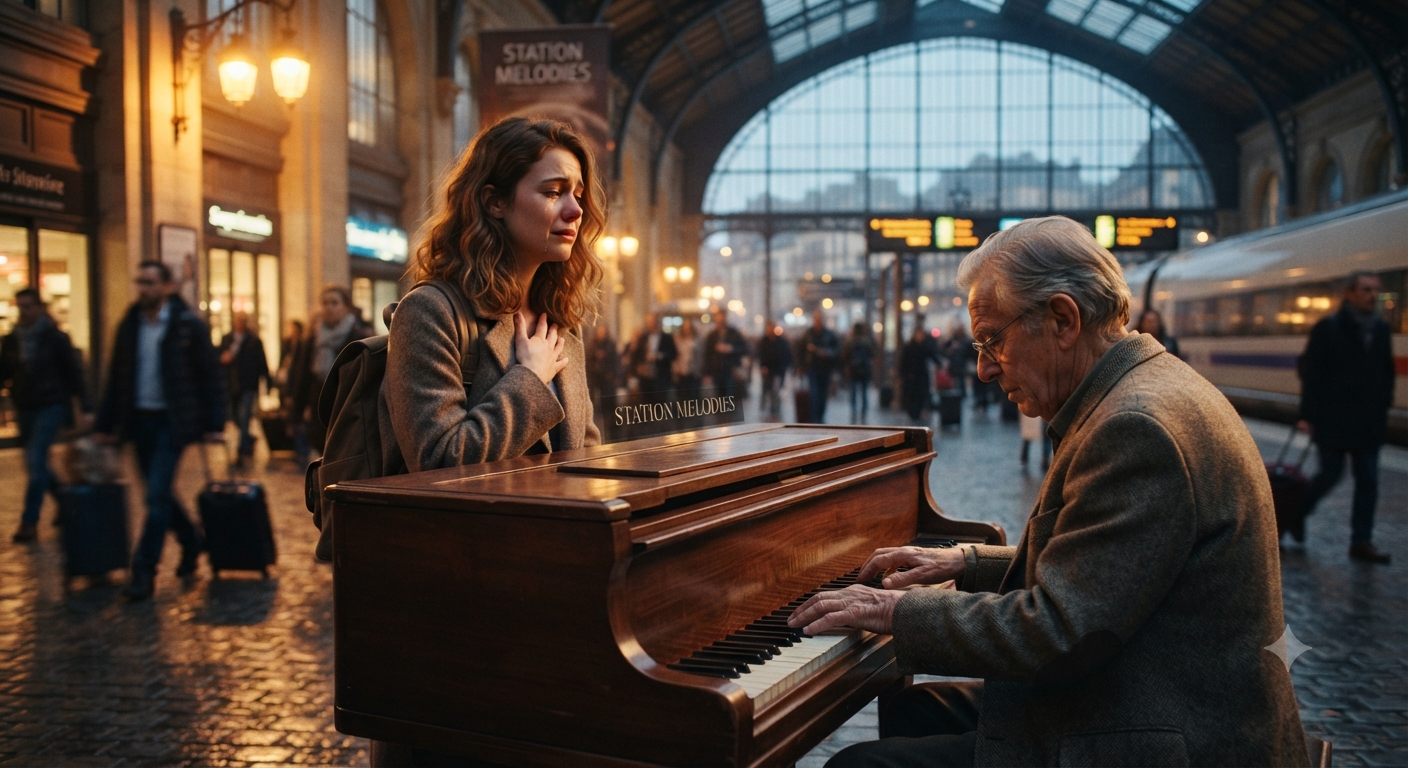
Instead, she took two slow steps forward, dropped her heavy canvas bag right onto the dirty linoleum, and knelt down beside my wooden bench.
She reached out with both hands and wrapped her arms around my stiff, shivering shoulders, burying her face against the rough wool of my coat.
“I’m not her,” she whispered against my chest, her tears soaking right through to my shirt. “But I was lost, too. You found me.”
I sat there on that piano bench with my arms frozen in the air, listening to the muffled sound of her crying against my collar while the afternoon train whistle blew out across the wet timber docks.