The coffee was lukewarm and the subway stairs smelled like wet coal when Leo tugged hard on the sleeve of my coat. I had six dollars and forty-two cents left in my purse until Friday morning, and the rent check for thirty-eight hundred dollars was sitting on the kitchen counter back in Beacon like an unpaid debt waiting to crush us.
We were late for the dental appointment on Forty-Third Street. I told myself that every single morning in the city was just a test of how fast you could walk without making eye contact with the people begging for change by the token booth.
Leo didn’t care about the schedule or the rent or the dental bill that was going to cost us two hundred and fifteen dollars out of pocket. He just stopped dead in his tracks right by a pillar near the lower mezzanine, his sneakers squeaking against the dirty concrete tile.
I kept walking for three paces before I realized my hand was empty. The strap of my canvas tote bag slipped down my shoulder as I turned back to look at him standing there like a statue in the middle of a rushing river of wool coats and briefcases.
“Mom, listen,” Leo said, his voice small against the rumble of an incoming local train.
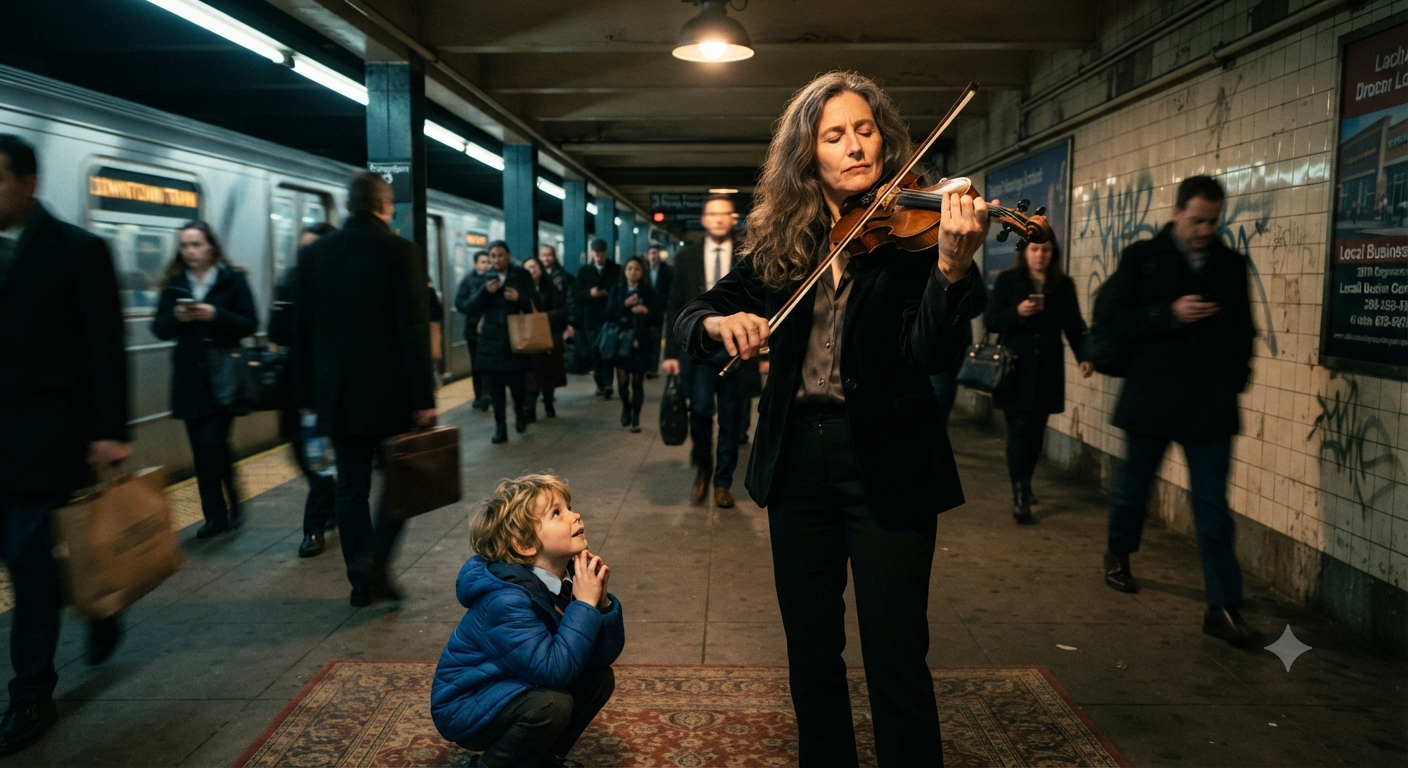
A man with a baseball cap pulled low over his forehead was standing against the damp concrete wall with a battered wooden case open at his feet. He had a battered violin tucked under his chin, and the sound coming out of those four strings didn’t belong in a drafty underground transit hub.
It wasn’t the kind of street music you heard from the guys with broken guitars who wanted enough loose silver for a malt liquor or a sandwich from the deli. This was something else entirely, something that made my chest tighten up because it sounded too clean for a place where people dropped their chewing gum on the floor.
“We are going to miss the bus if we stand here,” I said, taking two steps toward him and reaching for his wrist. “Leo. Come on now.”
The platform was crowded with people carrying black leather briefcases and cheap plastic coffee cups from the cart upstairs. Nobody else even turned their head as they hurried past the man with the violin, their heels clicking a fast, jagged rhythm against the dirty floor.
A woman in a gray trench coat bumped right into Leo’s shoulder without slowing down, muttering something about people letting their kids block the walkway. Leo didn’t even flinch. He stayed planted right there, his mouth slightly open, watching the man’s fingers move up and down the neck of the instrument with an easy grace that looked entirely out of place.
I stood there tapping my foot against the concrete, checking my watch for the third time in forty seconds. The second hand on my watch was ticking off the minutes we didn’t have, and every second felt like money leaking out of a hole in my pocket.
“Two minutes, Leo,” I said, my voice sharp enough to cut glass. “That is all you get.”
The man played a piece that sounded like church bells from a town I had never visited, long and sweet and heavy with a kind of sorrow that made my throat burn. The bow moved across the strings like water over smooth river stones, and for a second the smell of diesel exhaust and old garbage seemed to fade away from the platform.
A man in a sharp navy suit dropped a crumpled five-dollar bill into the open violin case without breaking his stride or looking down once at the musician. The bill fluttered against the side of the case like a dying moth before settling down among a few loose quarters and dimes.
The violinist didn’t blink. He just kept his eyes closed, his bow drawing out a long, high note that hung in the humid air of the station until the train rumbled in and drowned it out with a roar of iron brakes.
The doors slid open with a pneumatic hiss, and three dozen tired commuters pushed their way out onto the platform, cutting right between me and my son. I had to grab the hood of Leo’s jacket to keep him from getting swept backward into the crowd heading for the stairs.
“We have to go right now,” I said, pulling him toward the open doors of the train car.
The man finished the phrase he was playing, letting the last note die away into the dark tunnel behind the tracks. He lowered the violin slowly, resting it against his chest with a gentleness that looked like he was holding something fragile enough to break in his bare hands.
He looked past the line of commuters climbing onto the train and locked eyes directly with Leo. A slow, tired smile crept across his face, the kind of smile you only see on people who have spent their entire lives working alone in quiet rooms.
“That was for you,” the man said, his voice carrying clearly over the hiss of the train doors. “You’re the only one who heard it.”
Leo let go of my hand and took one step closer to the musician, his eyes wide and bright in the dim light of the subway stop. “Are you going to be here tomorrow?” the boy asked.
“Probably not,” the man said, wiping a speck of rosin off the fingerboard with his thumb. “I have places to be.”
“What’s your name?” Leo asked.
The train doors began to slide shut with a mechanical warning beep that made the woman standing next to me curse under her breath. I reached out and grabbed Leo by the collar, dragging him backward into the warm, crowded interior of the car just as the gap between the platform and the metal threshold started to widen.
“I’m Joshua Bell,” the man called out over the rising roar of the engine.
The name didn’t mean anything to me right then. I was too busy trying to find two empty seats near the middle doors where nobody was spilling coffee on my shoes.
“Joshua Bell,” Leo repeated quietly, pressing his palms flat against the cold glass of the train window as the subway car lurched forward into the dark tunnel.
“That’s nice, honey,” I said, digging through my canvas bag for the small slip of paper with the dentist’s address written in blue ballpoint ink. “Sit down and keep your backpack out of the aisle before someone trips over it.”
The train accelerated, rocking from side to side as we sped through the dark toward Forty-Third Street, the sound of the wheels clicking rhythmically against the steel tracks. I sat there staring at the gray linoleum floor between my feet, thinking about the grocery bill and whether the butcher down the street would let me run a tab until the end of the month.
It wasn’t until we were sitting in the pale green waiting room of the dental office twenty minutes later that I saw the small magazine article lying on the corner table between two dog-eared copies of Reader’s Digest.
The glossy page featured a photograph of a man holding a violin that looked remarkably like the one we had just seen by the turnstiles downtown. The headline above the picture talked about an experiment run by a major newspaper, sending one of the world’s finest violinists into a Washington transit station to play a three-million-dollar instrument for spare change during the morning rush hour.
My eyes scanned the paragraphs quickly, skipping from sentence to sentence until I hit the name printed in bold letters near the middle of the page.
Joshua Bell.
The magazine dropped from my fingers and slid across the linoleum floor, stopping against the leg of the plastic chair where Leo was sitting quietly with a comic book open in his lap. He didn’t look up when it hit the floor. He just kept turning the pages, his small fingers tracing the edges of the pictures as if he were still listening to something no one else could hear.
I sat there in that sterile waiting room with the smell of antiseptic in my nose and the thirty-eight-hundred-dollar rent check burning a hole in my pocket, realizing the man we had walked past had been holding a fortune in his hands while I worried about being five minutes late for a teeth cleaning.
Leo looked up at me then, his eyes serious and calm in the harsh fluorescent light of the office. “He played the best part for me, Mom,” he said.
I couldn’t find a single word to say back to him, so I just reached out and took his hand, holding on tight enough to make his fingers hurt while we waited for them to call our name.