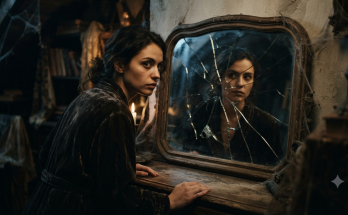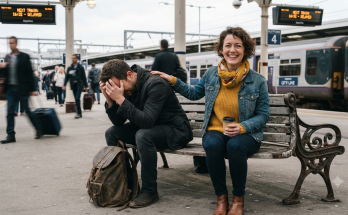
I am the reason she spent twenty years wondering if her father cared enough to stay. I have lived in this town my whole life, and for most of that time, I was the one who kept the truth buried under dust and glue. It wasn’t about malice. I promise you that. It was about a coward’s version of mercy. I thought if I didn’t tell her, she could keep imagining him as a man who was just busy or lost, rather than a man who had run out of time and left her behind with nothing but a library card. I know that sounds twisted, but back then, it felt like I was protecting her.
It was 2004 when the book came across my desk at the library. It was a dog-eared copy of some forgotten travelogue, the kind nobody checks out unless they are looking for a place to hide. I saw the name on the checkout card. It was Roy. He was a man who smelled like stale cigarettes and rain, a man who haunted the back aisles every Saturday morning, just staring at the spines like they held the secrets to the universe. That day, he didn’t come to the desk to check it out. He just left it on the cart.
I picked it up later that afternoon. I saw the card. His name was the only one on it, repeated over and over, dating back to 1999. I felt a weird chill. When I flipped through the pages, the note fell out. It was folded into a small, tight square. I read it, and my breath just hitched in my throat. “If someone finds this, please tell my daughter I never stopped believing she’d love reading someday.” That was all. No address, no apology, just that single, pathetic plea.
I didn’t turn it in. I didn’t call his house. I took the book home that night and put it on my own shelf, hidden behind a row of thicker novels. I told myself it was because I didn’t know which daughter he meant. He had two, and one of them, Bonnie, was already working part-time at the library with me. She was barely nineteen then, a quiet girl with her father’s dark eyes. I watched her every day, shelving books, dusting the history section, waiting for a life to start.
Every time I looked at her, I felt the weight of that folded paper in my house. I thought about giving it to her, but then I would imagine the look on her face. Her father had been a wreck of a man. If I gave her that note, it would cement the memory of a man who spent his final days writing notes to a daughter he couldn’t face. I convinced myself that not knowing was kinder. I chose to stay silent, and for two decades, that silence became the hardest thing I ever had to carry.
The years went by, and Bonnie grew up in that library. She went from being the girl who shelved paperbacks to the woman who managed the front desk. She was good at it, too. She had a way of recommending books that made people feel like they were being understood for the first time. I watched her from my office, and every time she smiled at a patron, I felt like a thief. I was sitting on her inheritance, essentially, but it wasn’t money. It was the only proof she had that he hadn’t just forgotten her.
I kept the book in my closet. It moved with me twice. Every time I packed it, I thought about burning it. That would have been the easy way out. But I couldn’t do it. There was something about his handwriting, that shaky, desperate script, that made me feel like I was holding a ghost. I started to believe that as long as I kept it, I was keeping him alive, even if it meant she was living in the dark. That is the kind of logic you build when you are terrified of doing the right thing.
Then came last Tuesday. I was cleaning out the house, trying to downsize, and I found the book again. It looked smaller than I remembered. I stood there in the living room for a long time, just holding it. I thought about Bonnie. She is forty now, and she still works at the library, still comes in early, still talks about how much she loves the smell of old paper. I realized then that I had been holding her life hostage to my own fear of an awkward conversation.
I took the book back to the library. I didn’t tell anyone what I was doing. I just walked in, found the shelf where the travelogues lived, and tucked it back into its place. It was a stupid, dramatic gesture. I felt like if I put it back where it started, the universe would handle the rest. I walked out of the library feeling like I had finally breathed for the first time in twenty years. But I hadn’t resolved a thing. I had just passed the buck.
Three days later, I was back at the library to pick up a requested biography. I saw a man, a total stranger, at the desk. He was checking out a stack of books. As he walked away, I saw him pull that exact book off the shelf. He looked at the card, frowned at the dates, and opened it. The note fell out. He looked at it, confused, and then he looked up and handed it to Bonnie.
I was standing twenty feet away, frozen. I couldn’t move. I watched her take the paper. I watched her unfold it. I saw her eyes scan the words, and then her hands began to shake. She didn’t scream or cry. She just leaned back against the shelves, her face turning pale. She looked at the signature, then she looked at the shelf, then she looked at me. She knew. She didn’t know how I knew, but she knew that I knew.
I walked over to her. My heart was thumping so hard I thought it would wake the dead. I didn’t say a word. I just stood there, and the air in that library felt heavy, like a storm was trapped inside. Bonnie stared at me, and her eyes were wide, filled with a hurt that was twenty years old. She held the note out toward me, her fingers trembling. “You had this,” she whispered, and it wasn’t a question. “You had this the whole time.”
I didn’t have a defense. I couldn’t lie. I just nodded. I saw her shoulders slump, and the professional mask she wore every day just shattered. She looked down at the note again, reading it for the tenth time. “He came here every Saturday,” she said, her voice cracking like dry wood. “He came here every Saturday, and you watched him, and you watched me, and you didn’t say a word.”
“I was scared,” I finally said. It sounded small and pathetic, even to me. “I was so scared of hurting you.”
She didn’t yell. She didn’t throw the book. She just turned around and started shelving the books she had been holding, one by one, with agonizing precision. She worked in silence for a long time, the only sound the soft thud of hardcovers hitting the wood. I stood there, feeling every single second of the last two decades pressing down on me. I realized then that my protection hadn’t been mercy. It had been a wall I built to keep myself from having to be brave.
She finally turned back. She held the book to her chest, tight, like it was the only thing keeping her upright. “He died thinking I didn’t care about reading,” she said softly. “I didn’t start loving it until he was already gone.” She looked at me, and there was no forgiveness in her eyes, just a hollow, empty exhaustion. “You didn’t protect me,” she said. “You just stole the chance for me to tell him he was wrong.”
I left the library then. I didn’t go back the next day, and I don’t think I can go back for a long time. I have the memory of her face, that look of quiet, total devastation, and I know it’s going to be there every time I close my eyes. I wanted to be the one to reveal the truth, to have some kind of profound moment where we cried and hugged and fixed the past, but that was just another selfish fantasy. The truth didn’t fix anything. It just showed me that I had been keeping a secret that wasn’t mine to hold, and now there’s no way to put it back. I am not the hero of this story, and I am not a victim. I am just a woman who kept a note for twenty years, and in doing so, I made sure that the only person who could have answered the question was already gone. I go to bed every night thinking about that Saturday he stopped coming, and I wonder if he ever knew, in those last, lonely moments, that his daughter would eventually find his words, just a little too late to mean a damn thing.