
I know you are going to hate me when you hear this, and honestly I do not blame you at all because my own brother would not even look me in the eye when I told him what I did with the money. I am the reason that poor girl spent three days crying outside my shop window on 4th Street, holding those little neon pink signs with her grandma’s initials written in black marker. I took that gold for four hundred and twenty dollars cash because the register was short and my supplier was breathing down my neck about an outstanding balance from October. I didn’t care about her tears, and I certainly didn’t care about the laminated flyers she taped to every parking meter from here down to the bus station. Business is business in this town, or at least that is what I kept telling myself while I shoved her family heirloom into the bottom drawer of the safe behind the counter.
The rain was coming down hard against the plate glass window when she first walked in, her boots leaving muddy prints on my freshly mopped linoleum. She was shaking so badly she could barely hold the velvet box open to show me the clasp. “Please,” she had said, her voice cracking right in the middle of the sentence. “It is all I have left of her.” I just looked at the serial number stamped on the back and told her the market value was what it was, take it or leave it. I have been running that downtown shop for fourteen years, and if you let people pull on your heartstrings every time they walk through the door, you will be out of business before the first frost. She left the shop empty-handed that afternoon, clutching her empty velvet box like it was a shield against a world she didn’t understand.
The next few months were quiet, too quiet. The city council started talking about tearing down the old brick block across the street to put in a municipal parking deck, which meant my foot traffic dropped by half almost overnight. I spent my mornings sitting on a tall stool behind the glass display case, watching the second hand drag its way around the face of the electric wall clock while the coffee grew cold and bitter in my mug. I didn’t think about the girl with the pink signs more than once or twice a week, usually right around closing time when I was counting out the drawer and double-checking the receipts against the ledger. You learn how to turn off the part of your brain that feels bad for people, otherwise you don’t last long in the retail trade down here.
Then the letter arrived on a Tuesday morning in November, sitting right on top of a stack of junk mail and past-due utility bills. The envelope was heavy cream-colored paper, addressed in neat, deliberate handwriting that looked like it had been practiced a hundred times before the ink ever touched the page. There was no return address in the corner, just a local postmark from three towns over where the state penitentiary and the rehab clinics share a zip code. My thumb was still smeared with blue ink from the bank deposit slip when I ripped the top edge open with a bone-handled letter opener my uncle gave me back in ninety-four.
“I found your necklace,” the note began, written on a single folded piece of lined notebook paper. “I am a recovering addict, and I was the one who pawned it that afternoon when I was shaking so bad I couldn’t see straight.” I stopped reading right there for a second, my eyes scanning the words while the ceiling fan hummed a low, steady rhythm overhead. “I sold it to you for four hundred and twenty dollars,” the letter continued, the ink slightly smudged near the bottom where her hand must have trembled. “But I am clean now, nineteen months today, and I worked double shifts at the diner until I could buy it back from the broker you sold it to.”
The rest of the letter went on to explain that she had saved every single tip, every overtime hour, every spare dollar until she had enough to redeem the gold piece from the wholesale dealer up in the county seat. “I am sorry for lying to you about where I got it,” she wrote at the very end. “And I am sorry for making you look like a fool in front of your regular customers.” I folded the paper back up and shoved it inside my apron pocket, my heart beating a little too fast against my ribs. I told myself it was just a clever scam, some kind of guilt trip from a junkie looking for a handout or trying to clear her conscience at my expense.
Two days later, the bell above the shop door chimed right around two in the afternoon just as I was wiping down the glass with a crumpled wad of paper towels. I did not even look up from the counter until I heard the distinct click of heels stopping right in front of the register. “You remember me,” she said. Her voice was steady now, clear and bright like a small bell, without any of the desperate shaking it had carried a year ago.
I looked up, and I nearly dropped the bottle of glass cleaner right onto the tile floor. She looked entirely different from the girl who had cried in my shop during the autumn storms. Her skin had color to it, her eyes were bright and focused, and she was wearing a clean denim jacket that actually fit her shoulders properly instead of swallowing her whole. “You’re back,” was all I could manage to get out, my tongue feeling thick and dry behind my teeth.
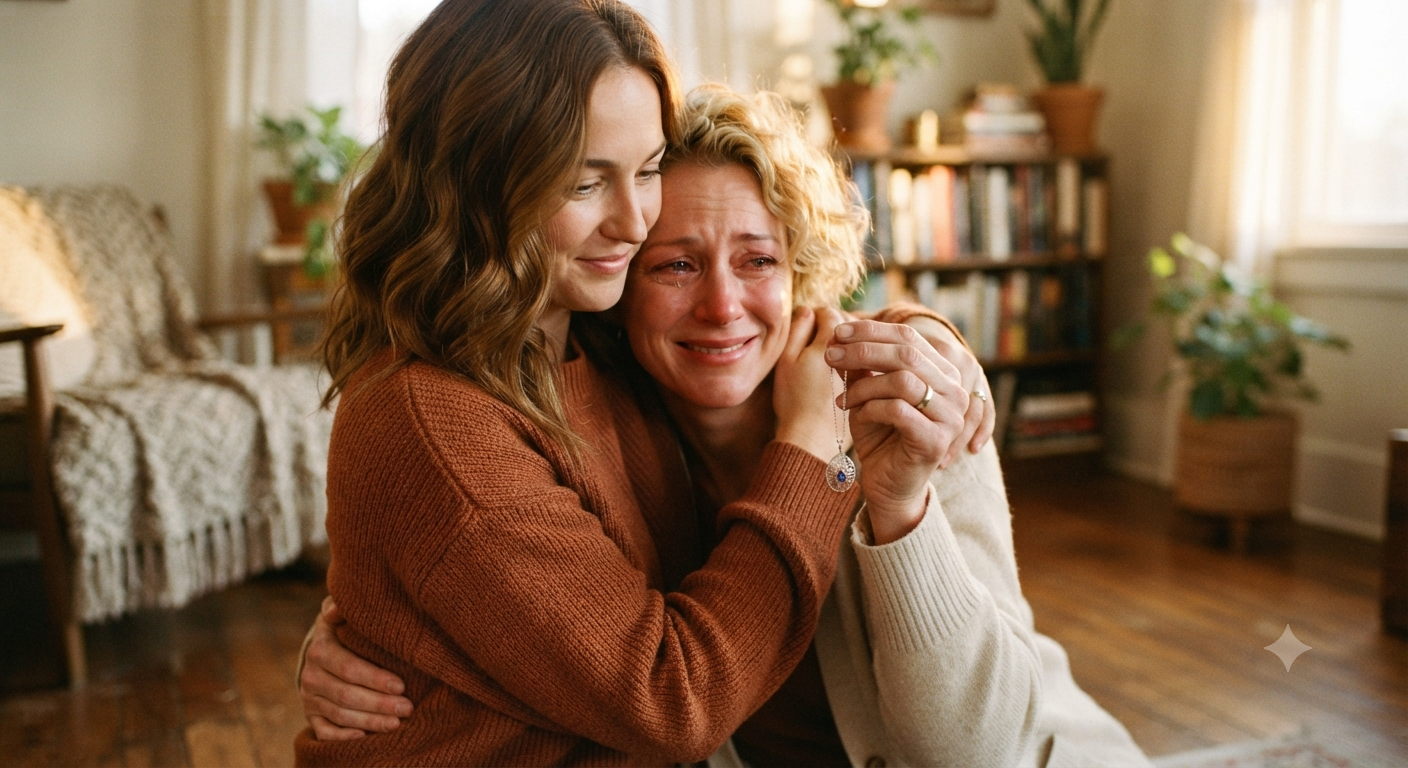
She reached into her coat pocket and pulled out a small leather pouch, setting it down on the glass counter with a soft, heavy thud that sounded like lead dropped on velvet. “I kept it as motivation,” she said, untying the leather drawstring with long, steady fingers that didn’t shake once. “Every time I wanted to give up during the bad weeks, I put that chain on my dresser and looked at it to prove I could do something good with my hands.” She tipped the pouch upside down, and the heavy gold necklace slid out across the display case, catching the fluorescent overhead light and throwing tiny, bright patches of yellow onto the wall behind me.
I stood there behind my counter, my fingers still wrapped around the bottle of cleaner, realizing the terrible symmetry of the whole thing. She hadn’t come back to yell at me or demand an apology for being cold that day. She had come back to show me that while I was sitting in my shop counting other people’s discarded silver just to keep the lights on, she had somehow managed to reclaim her entire life out of the dirt. Some treasures heal more than one person, I guess, but looking at her standing there so clean and whole made me feel like the cheapest thing in the entire room. She didn’t say another word, just turned around and walked out the door without looking back once, leaving me alone with my ledger and her gold.