The smell of damp mortar and cut lime always brings me right back to the summer Cal decided our backyard needed a monument. It started with a pallet of red clay bricks dropped right in the middle of our overgrown fescue by a flatbed truck that tore up the grass. Cal stood there wiping sweat off his forehead with a blue shop rag, looking at that stack like a kid on Christmas morning. I told him right then that we had bills to pay and a roof that needed flashing, but he just shook his head and laughed that quiet laugh of his. He said a man needs a project, and honestly, I figured it was just another one of his phases that would end when his back started hurting.
Every evening after clocking out at the parish dock, he was out there mixing mortar in a yellow plastic tub. Scrape, slap, level, tap. That rhythm went on for weeks while the sun dropped low behind the live oaks and the mosquitoes got thick enough to chew. By August he had laid a solid double-wythe wall right across our yard, cutting our small patch of green in half and blocking the view of the creek. It was ugly, heavy, and completely out of place against the weathered siding of our house. When I brought him a glass of iced tea and asked him what in the world we were supposed to do with a six-foot red brick barrier dividing our own property, he just took a long swallow and pointed his thumb at the grey cinder blocks.
“It’s just a wall,” I told him, wiping the sweat off my own neck. “It’s dividing us right down the middle.”
He smiled, his teeth very white against his sunburned face. “No. It’s a canvas. I’m building you a mural.”
I didn’t believe him, of course, because Cal was never artistic a day in his life. He couldn’t even draw a straight line on a piece of plywood with a carpenter’s pencil without messing up the measurements. But the very next weekend he hauled out half a dozen gallon cans of exterior latex paint from the trunk of his sedan. Cobalt blue, titanium white, cadmium red, and a heavy tub of black primer. He spent three days priming those red bricks until they were as smooth and stark as a fresh sheet of drawing paper. I watched him from the kitchen window through the screen, his brush strokes methodical and slow, covering up every trace of rough clay with flat, opaque color.
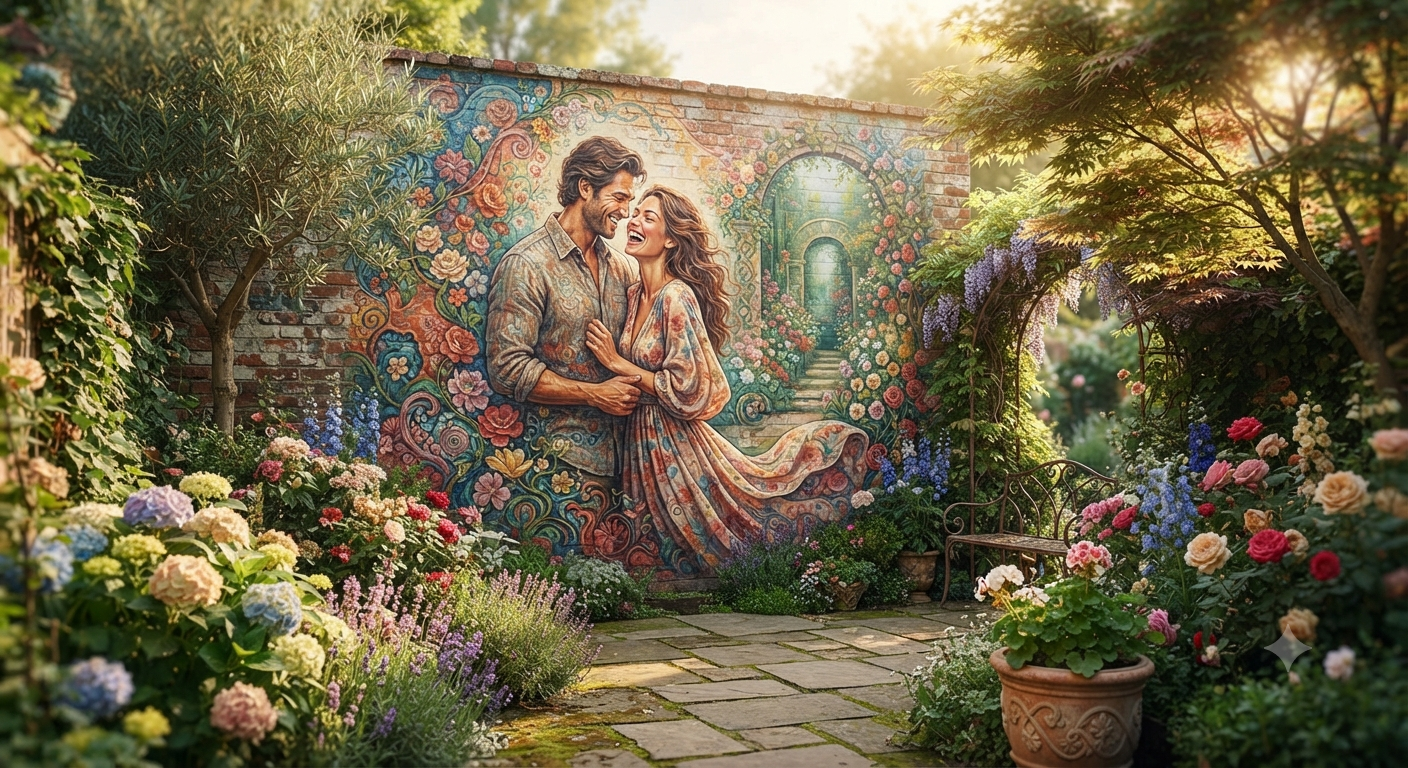
By the following Friday evening, the back wall didn’t look like brick anymore. It looked like a window looking out onto a day I thought we had both left behind in nineteen-ninety-four. It was us on our wedding day standing outside the parish hall under the string lights, me in my mother’s lace-trimmed dress holding that bunch of half-dead white carnations, and Cal in his rented gray suit with his tie crooked. He had captured the exact way my hair caught the late afternoon sun, and the way he was leaning in close like he had a secret only I was allowed to hear. When I walked out onto the patio with my coffee and saw it for the first time, my breath caught in my throat so hard I had to grab the iron railing for balance.
Tears came down my cheeks before I could even stop them, because nobody had ever looked at me hard enough to paint me like that. Cal was standing near the edge of the patio with his hands behind his back, watching me sideways with a grin that reached all the way to his eyes. I turned to him, my voice shaking and thick with things I didn’t yet have names for.
“Why didn’t you tell me?” I whispered, staring up at the painted version of my twenty-two-year-old self.
He stepped closer and wiped a stray drop of moisture off my cheek with his thumb, his skin smelling faintly of linseed oil and turpentine. “Because,” he said, and his voice dropped to that low, steady register he used when he wanted me to feel completely safe, “surprises are the best part of love.”
For a long time after that, the wall became the center of everything we did. The neighbors on either side of our fence would slow down when they walked their dogs, craning their necks to see what Cal was adding next. Every year on our anniversary, he would paint a new scene over the old one or expand out along the bricks, layering our life like an archive of yellowed photographs rendered in heavy oils and flat latex. He painted our little beagle Max who died back in ninety-eight, his paws tucked neatly under his chest right near the bottom corner where the weeds grew tall. He painted the kitchen table during the winter we almost lost the house, with two cups of black coffee and a stack of past-due utility notices glowing under a single pendant light. He painted us sitting on the tailgate of his old Ford pickup down by the bayou, watching the red sun drop into the marsh grass while the tide pulled away from the pilings.
It should have felt like a blessing, having a man who remembered every single moment of our marriage so clearly he could recreate it brushstroke by brushstroke on a wall of solid masonry. But around the fifth year, something in the rhythm of it started to shift, though I couldn’t put my finger on it while I was living inside it. Cal wasn’t just recording our life anymore; he was editing it, smoothing out the rough edges and sharpening the colors until the painted version of us looked cleaner and happier than the tired people walking around the kitchen in grease-stained pajamas. Whenever we had a real fight, the kind where dishes sat unwashed in the sink for two days and nobody spoke across the supper table, Cal would just go out to the garage at dawn and mix his paints. By the time I came out to sweep the back porch, he’d have painted over our latest argument with a bright, sunlit scene of us laughing on a beach we had never actually visited.
It was a slow kind of poison, watching my real history get buried under layers of his bright, stubborn acrylics. I tried to tell him once that we needed to leave some blank space, that not every year was worth framing in high-gloss color, but he just laughed and told me I worried too much about the bad days. He said the bad days didn’t matter as long as the canvas ended up looking like something you’d want to hang in a gallery. I started avoiding the backyard altogether, keeping the kitchen blinds drawn tight so I wouldn’t have to look at our younger selves frozen in eternal sunshine while the actual house around us fell quietly into disrepair. The roof really did need flashing by then, and the back porch steps were rotting through at the corners, but Cal didn’t care about lumber or nails anymore because all his spare money and every free hour went into buying artist’s brushes and imported pigments.
The real break came on a Tuesday morning in late October when the humidity finally broke and the air turned crisp enough to smell woodsmoke from the neighbor’s burn barrel. Cal had been working on the far right end of the wall for nearly three weeks, keeping a large blue tarp draped over it so I couldn’t see what he was building. He had been staying out there until midnight with a drop light plugged into the porch outlet, humming old hymns under his breath and scraping his palette knife against the brick. I told myself it was just another anniversary scene, maybe our trip to Biloxi back when we still had the boat, and I tried to muster up the old feeling of wonder I used to have when he pulled back the cover.
When he finally called me out to the yard at ten in the morning, the sun was bright enough to make me squint against the glare off the freshly painted surface. Cal stood off to the side, his hands wiped clean on his overalls, watching me with that same expectant grin he had worn the very first day. He didn’t say a word, just reached out and hooked his finger into the grommet of the blue tarp, pulling it down in one quick, practiced motion that let it pool at his feet like a dropped sail.
I didn’t scream or drop my coffee cup because my body just stopped working right all at once. There wasn’t any beach or any wedding dress or any happy memory on that section of the brick at all. It was a painting of our kitchen table from three months prior during the worst night of our lives, the night I finally told him I couldn’t live like this anymore and reached for my car keys to drive out to my sister’s place in Thibodaux. He had painted my face twisted in anger, my mouth open mid-sentence, looking hateful and small under the overhead light, while his own painted figure sat across from me with a look of saintly, broken-hearted patience that made my stomach turn over. And right beneath our painted feet, he had lettered in neat, black sign-painter’s script a sentence I had thrown at him during the heat of that fight before I walked out the door for three days.
“You’re just building a monument to your own patience so you never have to admit you broke me first,” I read aloud, my voice sounding flat and small in the quiet yard.
Cal didn’t smile this time, but he didn’t look sorry either as he stepped up right beside me and touched my shoulder with a hand that felt as heavy as a lead weight. “I never forget a thing you say,” he whispered, his breath warm against my ear. “And I don’t intend to let you forget it either.”