Fourteen hundred and twelve days since we laid Clifford in that dry Bakersfield dirt, and my brother Arlie was still eating the exact same ham sandwich every single solitary noon like it was a penance he had to work off. I reckon grief makes people stubborn in ways that don’t make any sense to anybody else. He lived out there in that sun-bleached exurb where the wind always smells like dry creosote and old asphalt, and his house had grown so quiet you could hear the refrigerator hum clear out on the front porch. I went over there every Tuesday to sweep up the linoleum and make sure he wasn’t letting the mail pile up into a fire hazard, but mostly I just went because I couldn’t stand the thought of him sitting in that dark living room by himself with just the ceiling fan turning round and round.
The trouble with Arlie was that he’d locked every door in his head the day Clifford’s truck went off the shoulder of Highway 58. He didn’t cry, not once at the service, and he wouldn’t let me touch any of Clifford’s clothes hanging in the back hallway. They just hung there getting dusty.
“You ought to take those shirts down to the thrift store, Arlie,” I told him that particular Tuesday while I was rinsing out his coffee mug at the sink.
He didn’t look up from the kitchen table where he was pushing crumbs around with his thumb. “Leave ’em be, Trudy,” he said, and his voice sounded like dry leaves scraping across concrete.
I didn’t push it because I was tired of fighting a man who wasn’t really all there to begin with. Clifford had been the spark in that house, the one who laughed loud at the television and remembered to water the oleanders out front, and when he went, he took all the noise with him. Arlie just kept going to his job at the county yard, coming home at five, and sitting in the dark until bedtime. It was a half-life, plain and simple, and it was wearing me down just watching him fade away bit by bit.
By six o’clock that evening, the heat had finally broken just enough for the desert air to turn that heavy, greasy gold color it gets right before dark. Arlie looked beat down clear to the bone, so I talked him into ordering a pizza from that little place down on Fairfax Road.
“Just get the plain cheese,” he muttered, reaching into his pocket for his wallet. “Nothing fancy. You know I don’t care for all that extra junk on top.”
So I dialed the number myself and ordered a large cheese, plain as could be, and paid with his card over the phone. We waited about thirty minutes, sitting there in the growing dusk with just one floor lamp burning because Arlie always said turning on the big lights was a waste of electricity.
When the delivery car crunched up the gravel driveway, Arlie didn’t even get up to meet the driver. I had to go to the front door myself, taking the cardboard box from a teenage boy with acne who mumbled something about a tip and hurried back to his rusted-out Civic. I brought it back into the kitchen and set it right in the middle of the laminate table, feeling that old familiar ache in my chest just seeing the two paper plates Arlie had pulled down from the cupboard.
He flipped open the lid, and we both just stood there staring.
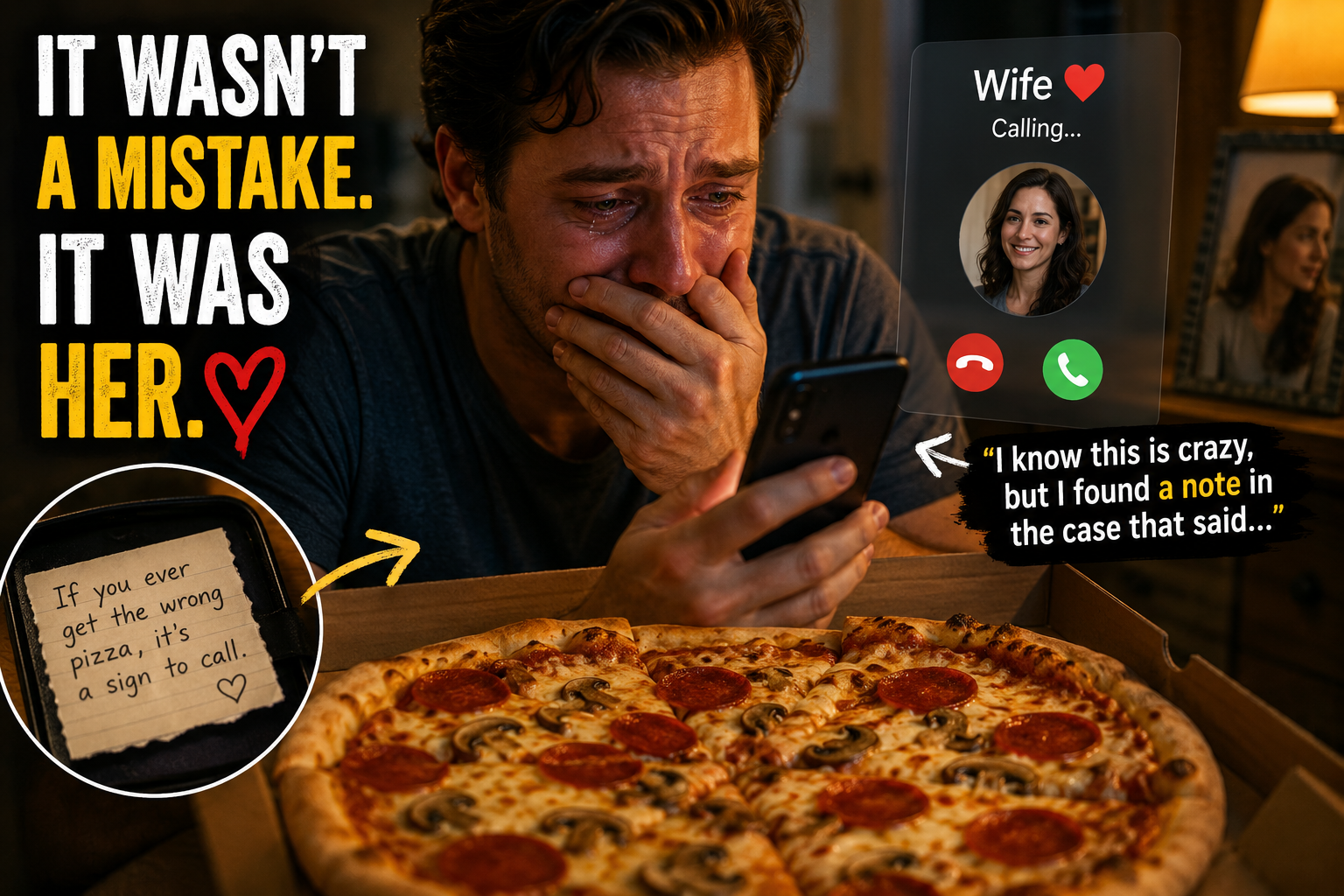
It wasn’t plain cheese at all. It was buried under a mountain of dark pepperoni, thick slices of canned mushrooms, and enough extra mozzarella to choke a horse. It looked greasy and loud and completely wrong for a quiet house where nobody laughed anymore.
Arlie let out a long, heavy breath through his nose. “They messed it up again,” he said, and he sounded so tired he might as well have been talking about the weather. “I swear nobody can get a simple order right in this town anymore. I’m calling them back.”
He reached into his shirt pocket and pulled out his old flip phone. It was that beat-up silver model Clifford had given him for his birthday three years before the accident, a phone so old the battery barely held a charge for more than an hour. Arlie punched the screen to bring up the recent calls, his thumb hovering over the keypad, ready to give some poor kid down at the pizzeria a piece of his mind.
That was when the phone let out a short, sharp buzz against the table.
It didn’t ring out loud like it usually did. It just vibrated hard enough to make the cardboard pizza box rattle against the Formica.
Arlie froze, his thumb still hovering an inch above the glass. I watched his hand start to shake, just a little bit at first, right there where the sun had browned his knuckles.
The screen lit up with a pale blue glow that cast a sickly light right across his chin. I didn’t need to lean over to see the numbers, but I saw them anyway because they were burned into my memory just as deep as they were into his. It was Clifford’s number. The exact ten digits we had called from the county hospital four years ago when the doctor told us there wasn’t anything left to do.
“Arlie?” I whispered, my own breath catching somewhere behind my ribs.
He didn’t answer me. He just stared at that screen like it was a ghost standing right there in the kitchen. The phone kept buzzing, a steady, rhythmic thrum that sounded like a heartbeat in the quiet room.
“Answer it,” I managed to get out, my hand reaching out to grab the edge of the counter to steady myself. “Arlie, answer the phone.”
He swallowed hard, his Adam’s apple bobbing once, and pressed his thumb against the green button. He brought the plastic to his ear, his hand trembling so bad the corner of the phone kept tapping against his jawbone. He didn’t say hello. He just stood there, chest heaving, listening to whatever was coming through that tiny speaker in the silence of the Bakersfield night.
I held my breath so hard my ears started ringing. For three long seconds, there wasn’t a sound except for the refrigerator clicking on in the corner.
Then a woman’s voice came through the speaker, thin and clear and shaking just a little bit. “Hello?” she said. “I know this is crazy, but I found a note in the case that said, ‘If you ever get the wrong pizza, it’s a sign to call.'”
Arlie didn’t say a word. He just closed his eyes, and I could see the exact second the last four years of concrete and dust cracked wide open inside him.
“Who is this?” he finally choked out, his voice cracking right down the middle into something raw and ugly.
“I bought this phone at the estate sale down on 20th Street last weekend,” the woman said, and she sounded almost as scared as he was. “The battery was dead, but I charged it up today while I was cleaning out the drawer. Your number was the only one in the history log. I wouldn’t have called, honest to God, except I opened up the leather case to clean the lint out and found that little piece of paper tucked behind the plastic. It had your name on it.”
Arlie sank down into his metal kitchen chair so hard the legs screeched against the floorboards. I grabbed the back of his chair to keep him steady, my fingers digging into his flannel shirt.
“What did the note say?” Arlie asked, and he was crying now, silent tears cutting tracks right through the dust on his cheeks that he hadn’t bothered to wash off after work.
“It said your name,” she whispered back through the static. “And it said, ‘If you ever get the wrong pizza, it’s a sign to call.’ I figured… I figured whoever owned this phone before me must have lost somebody. The guy at the estate sale said the house had been empty for a long time.”
The kitchen seemed to shrink right down around us until there was nothing left in the world except the hum of the fridge and the sound of that woman breathing on the other end of the line in some other part of town we’d never even seen. I remembered that day clear as glass now. It must have been five years back, during one of those scorching August weeks when the air conditioner broke down and we were sitting on the front porch eating greasy pepperoni because neither of us had the energy to cook. Clifford had laughed and scribbled that very line on the back of an old grocery receipt just to make Arlie smile when things got heavy.
Arlie couldn’t get his words together. He just sat there with the phone pressed tight against his ear, his shoulders shaking under my hand, letting out those dry, ragged hitches that old men make when they finally break after too many years of holding the line.
“Mister?” the woman said softly, her voice dipping low. “Are you still there?”
“Yeah,” Arlie finally got out, wiping his nose with the back of his dirty sleeve. “Yeah, I’m right here.”
“I’m sorry,” she told him. “I really am. I just… I saw the note and something told me I had to punch the buttons. I didn’t mean to upset you.”
“No,” Arlie said, and his voice sounded lighter somehow, like a heavy stone had just rolled off his chest after four long years of pressing him down into the dirt. “No, you didn’t upset me, ma’am. You just… you got the order right.”
They stayed on the line for another minute or two after that, just talking in low, quiet murmurs about where she found the phone and how she’d ended up in our town, before she finally said goodbye and the line went dead. Arlie slowly pulled the phone away from his ear and laid it face down on the laminate right next to the open box of pepperoni pizza.
He didn’t put it back in his pocket. He just sat there looking down at the red grease shining under the single yellow lightbulb, and for the first time since the funeral, he reached out and took a slice.