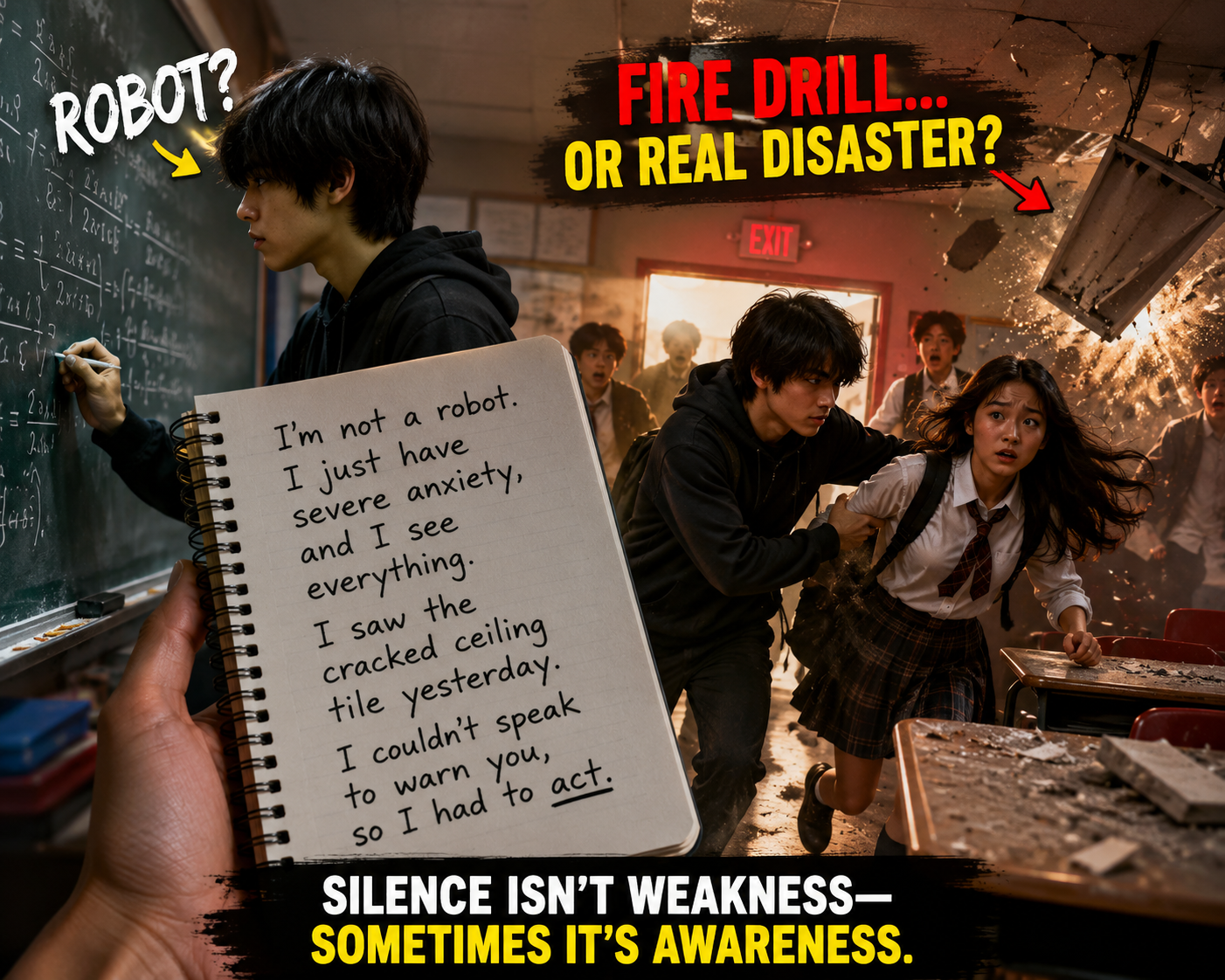
“Move now,” Leo said, his fingers tight around my wrist as he yanked me hard toward the side exit.
The air in the annex hallway smelled like stale floor wax and damp concrete, the kind of stale smell that settles into old brick buildings during the spring months in Louisiana. Nobody else in period three science even looked up when the horn started wailing at 10:14 that morning, because we had already sat through three pointless drills that month alone. Mr. Vance was still at the dry-erase board finishing up a formula about molar mass, his yellow dry-erase marker squeaking against the green slate like it always did. I remember thinking about my lunch bag sitting under my desk, the brown paper sack with the ham sandwich my mother had wrapped in wax paper at 6:30 that very morning. Leo didn’t carry a lunch bag. He never went to the cafeteria during fourth period, preferring to sit on the concrete bench behind the agricultural science shed with a thick paperback book he never seemed to actually turn the pages of.
People in our parish called him the machine for reasons that felt cruel even for seventeen-year-olds who didn’t know any better. He sat in the third row by the bank of tall windows that looked out over the practice football field, staring straight ahead with those wide, unblinking eyes that made you feel like he was measuring the exact distance between your chair and the door. He didn’t talk during group projects, and when Mrs. Gable asked him to read aloud from chapter four of our civics textbook back in September, he just looked down at his desk until she sighed and moved on to someone else. Some kids said he was mute from birth, while others whispered that his family had moved down from Shreveport after something bad happened with his older brother. I didn’t care about the rumors mostly because I had enough trouble keeping my algebra grade above a seventy-five without worrying about the new kid in the back row.
The first week he arrived in mid-October, Mr. Vance had written a three-page calculus problem on the board that usually took the AP seniors twenty minutes to puzzle through. Leo had walked up to the front of the room during independent study time while the rest of us were whispering about Friday night’s game against Thibodaux High, picked up a blue marker without asking, and filled the empty space beneath the equations with neat, tiny lines of numbers that solved the whole thing in four steps. He didn’t turn around when the class went quiet. He just put the cap back on the marker, walked back to his desk, and sat down with his hands folded flat on the wood grain. Mr. Vance had stared at the board for a full minute before giving him an A for the quarter right then and there.
That was the kind of thing that earned him the nickname, though nobody ever said it to his face because there was something heavy about the way he carried himself. He moved like a man who was always bracing for a floorboard to give out under his boots. I used to catch him watching the ceiling corners during lectures, his chin tilted up just a fraction of an inch, tracking something invisible that none of the rest of us could see. I figured he was just eccentric or maybe autistic, which was a word people around here used behind closed doors when they didn’t understand how someone’s brain worked.
Then the alarm bell cut through Mr. Vance’s lecture with that high-pitched electronic screech that always made my teeth hurt. Mr. Vance didn’t even turn around from the board at first, just waving his hand toward the main door like he always did during drills. “Single file, people, let’s go,” he muttered, not dropping his marker.
Leo was already out of his seat before the second pulse of the alarm finished ringing. He didn’t grab his jacket or his notebook, which was unlike him because he kept his desk cleaner than a surgery tray. He crossed the four rows between us in three long, silent strides, his shoulder hitting the edge of my desk hard enough to knock my blue plastic binder onto the linoleum. Before I could bend down to grab it, his hand shot out and caught my forearm with a grip that left bruises later that afternoon. He didn’t ask or wait for permission. He just pulled me off my chair with a force that sent my wooden seat tipping backward onto its two rear legs.
“Hey, what are, ” I started to say, my voice cutting off as a heavy tearing sound ripped through the plaster right above my seat.
The light fixture came down like a dropped anvil, six feet of heavy fluorescent housing and shattered glass smashing directly into the hollow plastic of the chair I had been sitting in three seconds before. The metal frame bent double against the desk leg with a sharp crack that sounded like a rifle shot inside the crowded room. Shards of glass flew across the third row, sparkling under the fluorescent lights that were still flickering before the emergency generator kicked in. Mr. Vance dropped his marker, the yellow plastic rolling across the chalk tray until it fell off and hit the floor with a dull plastic clatter. Nobody screamed until the dust settled, a thick gray cloud of fifty-year-old plaster rising into the stale air of the classroom.
The silence that followed was different from the normal quiet of the room. It was the heavy, breathless kind of quiet where forty teenagers realize how close they just came to reading an obituary in the parish paper instead of taking a history quiz. Mr. Vance was standing by the blackboard with his mouth half open, his hand still raised toward the ceiling like he was trying to hold the rest of the plaster up with his bare palm. Sarah Landry, who sat across the aisle from me, had her hands clamped over her mouth and was making that small, choking sound people make when they are about to throw up. Leo didn’t look at the shattered glass or the ruined chair. He just stood there holding my wrist with his fingers trembling slightly, his chest moving up and down in shallow, rapid breaths that showed he was just as terrified as the rest of us.
Mr. Vance finally found his voice, though it sounded thin and cracked around the edges. “Leo. What… how did you know that was going to fall?”
Leo let go of my arm like he had been burned by a hot stove. He reached into the front pocket of his canvas jacket and pulled out a small, spiral-bound notepad with a yellow cover and a blue ballpoint pen attached with a rubber band. He didn’t look at the teacher while he wrote, his hand moving across the paper with the same precise, hurried scrawl he used for the math problems on the board. He tore the page off with a sharp snap and held it out toward Mr. Vance, who took it with fingers that were visibly shaking.
The teacher looked down at the paper for a long time, his eyes moving back and forth across the three lines of handwriting before he folded it once and slid it into his shirt pocket. He didn’t read it out loud to the class, and honestly, that felt right because some things don’t need to be shouted across a room full of kids who spent five minutes calling the boy a robot behind his back. But I saw the words upside down from where I was standing beside my wrecked desk, the ink still slightly smudged where his thumb had pressed against the paper.
“I’m not a robot,” the note said in those neat, square block letters that looked like they belonged on an architectural blueprint. “I just have severe anxiety, and I see everything. I saw the cracked ceiling tile yesterday during fifth period when the humidity made the plaster sag. I couldn’t speak to warn you, so I had to act.”
Mr. Vance cleared his throat and looked down at his shoes for a second before he looked at Leo with a different kind of expression entirely, not pity and not annoyance, just a heavy sort of understanding that teachers get when they realize they haven’t been paying enough attention to the kids in the back rows. “All right,” Mrummured, his voice barely louder than a whisper over the steady hum of the hallway alarm. “Everybody out through the side exit now. Move.”
We filed out into the humid Louisiana sunlight in a ragged line, nobody talking, everyone stepping carefully around the gravel near the brick foundation where the fire department trucks were already pulling up with their yellow lights flashing against the pale siding. I walked beside Leo, neither of us saying a word, both of us watching our boots kick up tiny puffs of dry dirt with every step we took toward the asphalt parking lot. He kept his hands deep in his pockets and his head down against the bright glare of the noon sun hitting the tin roofs of the portables. When we reached the grass by the oak trees, he didn’t join the rest of the sophomores clustered around the soda machine. He just sat down on an old wooden bench near the chain-link fence and pulled his paperback book out of his canvas bag, his thumb tracing the edge of the cover like nothing at all had happened back in room 214.
I stood there for a second with the dust still clinging to the knees of my jeans, wondering how many other things he had noticed while the rest of us were too busy talking to each other to look up at the ceiling. Nobody apologized to him that afternoon, and he didn’t look like he expected anyone to. But when the bell rang twenty minutes later signaling that it was safe to go back inside, Mr. Vance held the heavy fire door open with his shoulder and nodded to Leo as he walked past, a small, silent gesture that didn’t fix the rumors or change the way the parish talked about the kids who didn’t fit into the neat little boxes they built for them. Leo just gave a tiny, almost imperceptible tilt of his head in return, his eyes fixed straight ahead on the empty hallway where the light was already starting to shift through the tall windows.