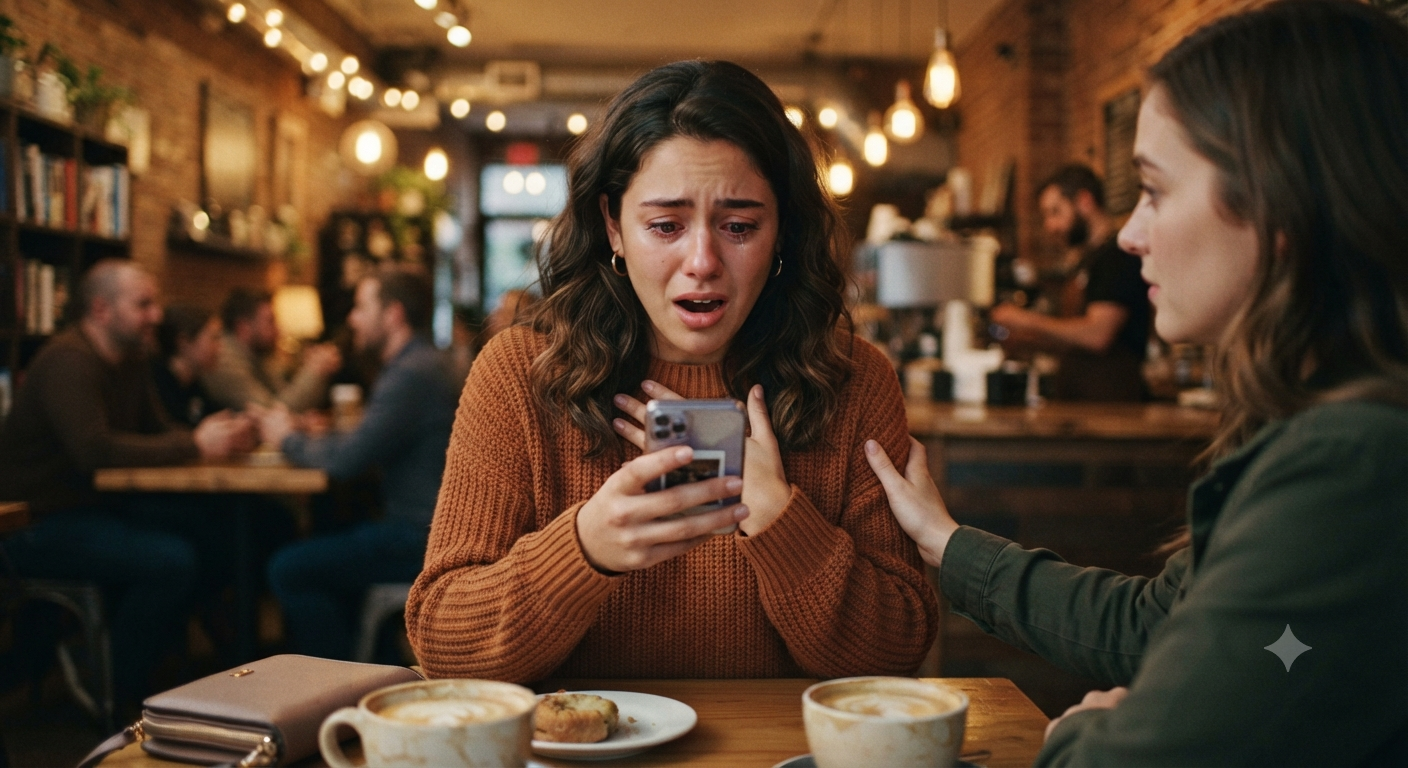
My thumb was halfway down the screen, right over the little trash can icon, when the second message lit up the kitchen counter with that sharp blue glow. The house was dead quiet except for the electric refrigerator humming in the corner and the heavy sound of wet March wind rattling the tin flashing on the back porch roof. Down here in the foothills outside of Townsend, folks didn’t usually get text messages from numbers they didn’t have saved in their phonebook. Most of the time it was just the feed store letting you know your bulk layer pellets were in, or the co-op reminding you about a tractor part. But this one didn’t look like a feed store. It was just three plain sentences sitting there against the black glass. I’m sorry. I still love you.
I stood there for a minute with my hand still hovering over the counter, listening to the floorboards cool down under my socks. Three years of living alone since Calvin walked out with his canvas duffel bag and his red pickup truck had made me mighty suspicious of anything that smelled like trouble. Calvin didn’t leave notes when he went. He just left a set of rusted pliers on the kitchen table and a three-hundred-dollar gas bill that had two weeks of past-due notices stamped in red ink. So when an unknown number drops three words like that into your lap on a Tuesday night when the rain is coming down sideways, your first thought isn’t about romance. Your first thought is that some drunk from the bait shop down by the river punched in the wrong digits while he was sitting in his cab waiting for the rain to let up.
I figured I would just block the number and go back to washing my supper dish. But then the screen went dark, and the quiet in the kitchen started pressing in on my ears like it always did around eight o’clock. The heater clicked on down in the crawlspace, blowing up that dry, dusty smell it always had after sitting idle all winter. I picked the phone back up. My thumb didn’t ask me before it hit reply. I typed out four words and hit send before I could talk some sense into myself. Who is this? I asked.
I didn’t expect an answer back tonight. Usually when you call out a wrong number, they tell you sorry and that’s the end of it. But twenty seconds later the phone buzzed against the laminate table so hard it skidded an inch toward the salt shaker. Someone who misses the way you used to laugh at the grocery store, the screen said.
My breath caught in my throat for just a second. It was an odd thing to read when you haven’t heard anyone laugh in your own kitchen since the Johnson family reunion back in July. I sat down at the table, pulling out the wooden chair that always stuck on the left leg because the floor had settled four inches toward the woodstove.
You’ve got the wrong person, I typed back. My name’s Darlene.
I know your name, Darlene, came the reply right away.
That should have been the moment I threw the phone in the dishpan and walked away. That should have been the exact second I blocked them and went to bed with the television on low so I wouldn’t have to listen to the wind in the chimney. But the thing about living by yourself out on the old ridge road is that the silence gets heavy after a while. It crawls under your collar like damp wool. You start missing the sound of another human being acknowledging that you are taking up space in the world.
Where’d you get this number? I sent.
Found it in an old notebook from 2018, the phone said. Back when things made more sense.
Well, they don’t make sense now, I told it.
That turned into five minutes of typing back and forth about nothing at all. They said their name was Thomas, though they didn’t say much else about where they were or what they looked like. They just talked about the weather up toward the gap, how the late frost had already killed the early peach buds down in the hollows, and how the spring peepers were singing louder than usual down by the creek. It was the kind of ordinary talk you’d have with a neighbor leaning on a fence post while the sun went down behind the ridge. Only there wasn’t any fence post, and there wasn’t any neighbor. Just a little glowing rectangle on a grease-spotted table while the wind whistled through the gaps in the cedar siding.
By the time Friday rolled around, that phone had become the loudest thing in the house. Every time it buzzed with a message about how the coffee tasted bitter this morning or how the dog had chased a groundhog under the back porch, my chest did a little flip that felt an awful lot like hope. It had been so long since anyone looked at me twice, let alone cared whether my morning coffee was hot. Thomas never pushed too hard. He didn’t ask for pictures, and he didn’t ask where I worked down at the county records office. He just listened. When I told him about how the county commissioners had cut the budget for the archive room and made me sort three decades of sewer permits by hand, he sent back a string of laughing emojis and told me the county was lucky to have someone with half a brain running the basement.
My sister Sondra came by on Sunday with a casserole dish wrapped in aluminum foil and took one look at me smiling down at my lap while I was peeling potatoes. You’re looking mighty cheerful for a woman who spends her weekends arguing with sewer maps, Darlene, she said, leaning against the counter with her arms crossed over her plaid wool jacket. Who’s got you grinning like a heifer in clover?
Nobody, I said, shoving the phone under a dish towel. Just an old acquaintance from town.
An acquaintance don’t make your eyes light up like that unless he’s got a wallet full of hundred-dollar bills or a brand-new tractor, Sondra said, shaking her head. Don’t go getting yourself tangled up with nobody you ain’t sure of. People in these hills have long memories and short tempers.
I told her she was worrying over nothing, but inside my ribs, that little flutter kept right on beating. The texts turned into phone calls by the end of May. At first, I wouldn’t pick up when the phone actually rang, preferring the safety of the typed screen where I could measure my words and fix every typo before it went out. But Thomas had a low, rumbling voice that sounded like gravel shifting under a car tire, and the first time he called while I was sitting on the front porch watching the fireflies come out over the pasture, I forgot how to breathe for three seconds.
Darlene? he said, and the way he said my name made the hair on my arms stand straight up. It’s good to finally hear you out loud instead of just reading your ink.
You sound different than I pictured, I said, pulling the porch swing back with my heel.
Better or worse? he asked, and I could hear the smile in his teeth.
Different, I said, noncommittal. More like someone who’s spent too much time sitting by himself in the dark.
Well, we’ve both got that in common, haven’t we? he said softly.
We talked for two hours that night until the battery on the old flip-style smartphone started beeping at me with a low-power warning. It went on like that all through the summer and into the damp, golden weeks of autumn when the leaves turned the color of old copper and fell down over the gravestones in the little churchyard behind my office. By October, Thomas wasn’t just a text message anymore. He was the first person I talked to when I poured my coffee at 5:30 in the morning, and he was the last voice I heard before I turned out the bedside lamp. He knew about how my mama used to put cornmeal in her cornbread instead of sugar, and how I’d dropped my favorite blue platter on the cellar stairs back when I was twenty-two. He remembered every little thing I told him, storing it up like he was building a house out of my memories.
When the first snow hit the gaps in mid-November, the roads got slick as grease, and Thomas suggested we finally meet face-to-face.
I can’t keep talking to a ghost, Darlene, he said one night when the wind was howling down the chimney so hard the stovepipe rattled. Let’s get a cup of coffee at the Little Dixie diner off Route 321. Tuesday at noon. Just you and me. No phones between us.
I sat there on the edge of the bed looking at my slippers, my heart hammering against my ribs like a trapped bird. A year is a long time to talk to a shadow. A year is plenty of time to invent a whole person in your head and fall in love with the pieces that are missing.
What if I don’t like what I see? I asked him.
Then you drink your coffee and walk right back out to your truck, he said, and his voice sounded steady and warm through the speaker. But I think you’ll stay.
Tuesday morning was bright and bitter cold, the kind of winter day where the sky looks like sheet metal and your breath turns into little clouds of steam before it even leaves your mouth. I drove my old blue Ford truck down the ridge road, the heater clanking away under the dash and smelling faintly of old antifreeze. My hands were shaking so bad on the steering wheel I had to pull over by the mailbox for two full minutes just to get my fingers to stop twitching. I hadn’t felt this kind of nervous since my high school graduation, and back then I didn’t have thirty years of hard living behind me to make me doubt my own judgment.
The Little Dixie diner sat right where Route 321 curved around the base of iron mountain, a little cinder-block building with a faded yellow sign that buzzed like a hornet’s nest. Inside, it smelled of stale grease, fried onions, and strong black coffee that had been sitting on the burner since six o’clock that morning. The vinyl seats in the booths were cracked and taped up with silver duct tape, and the fluorescent tubes overhead flickered with a dull, steady hum.
I walked through the glass door with my wool scarf wrapped tight around my neck and my handbag clutched against my chest like a shield. The place was mostly empty except for an old-timer reading the sports page in the corner and a waitress behind the counter wiping down the laminate with a damp grey rag.
Thomas said he’d be in the back booth by the window, the one where the view looked out over the dry creek bed and the old abandoned lumber mill.
I walked down the narrow aisle between the tables, my boots clicking hard against the checkerboard linoleum. My throat felt dry as a corn husk. When I reached the last booth on the left, I saw a man sitting there with his back to me, wearing a faded green flannel shirt with the sleeves rolled up to the elbows, showing those familiar dark hairs on his forearms. He was looking down at a white ceramic coffee mug, turning it slowly between his two broad palms.
Thomas? I said, and my voice sounded small and thin in the empty diner.
The man didn’t answer right away. He just set the mug down on the formica tabletop with a little clink and slowly turned around in the vinyl seat.
My breath stopped dead in my chest. The room didn’t spin, and the floor didn’t drop out from under me like they say it does in the books. Everything just froze into a sharp, clear stillness that hurt to look at.
It wasn’t Thomas.
Calvin looked older than he had three years ago when he walked out that door with his canvas duffel bag. His hair was thinner at the temples, and there were deep, gray-lined creases carved around the corners of his mouth that hadn’t been there when we were married. But those blue eyes, the ones I’d spent half my life trying to forget and the other half wishing would look at me again, were staring straight up into mine with a quiet, desperate kind of hunger.
He had a burner phone sitting right beside his coffee mug, its screen dark and face down on the table.
You came, Darlene, he said, and that old gravelly voice of his was so thick it sounded like he was dragging it up out of a dry well.
I stood there with my hand still frozen on the strap of my bag, my brain finally catching up to the twelve months of late-night messages, the inside jokes about the county sewer maps, the weather reports from the gap, and the way he always spelled certain words without the ‘u’.
You changed your number, I whispered, and the words tasted like iron in my mouth.
I had to, Calvin said, and his hand reached out across the table, his fingers twitching just an inch away from where my coat hung loose against my hip. If I called you from my real phone on the first day, you would have hung up before I said hello. You wouldn’t have listened to a single word I had to say about how sorry I was for walking out on you.
I looked down at the burner phone, then out the streaked diner window at the gray mountain rising up behind the old lumber mill. For three hundred and sixty-five days, I had let a stranger back into my house, only to find out it was the exact same ghost I’d spent three years trying to lock out.
You lied to me for a whole year, I said, and my voice didn’t even shake. It was just flat and cold, like the water in the creek outside.
I didn’t lie about anything that mattered, Darlene, he said, leaning forward into the light, his eyes wide and pleading. I told you everything I was thinking. I listened to you talk about your days. I was right here with you the whole time. The universe gave us a second chance, don’t you see that? Sometimes love doesn’t give up. It just finds a new number.
I looked at him sitting there in his faded green flannel, waiting for me to sit down, waiting for me to smile and take off my coat like nothing had ever happened between us, like he hadn’t left me with three months of back-due power bills and an empty kitchen table.
I didn’t sit down. I just pulled my wool scarf a little tighter around my neck, turned around on my boot heels, and walked right back out the glass door into the freezing December wind.