The folding table behind the Methodist church basement had a warped corner that dipped every time someone laid a heavy box down on it. Martha always put the linens there because nobody cared if a tablecloth slid an inch or two into the aisle. I was just looking for a cast-iron skillet that didn’t have a cracked handle when my hand brushed against something rough and heavy tucked underneath a pile of old National Geographics.
It was a stretcher frame with thick wooden bars that had dried out and turned the color of old straw. Someone had stretched a coarse piece of burlap over it and gone to work with tubes of house paint. There were no shapes, no horses by a river, no bowls of fruit with light catching the skin of a pear. Just black and cobalt and an ugly streak of cadmium red that had run down the side like grease.
The price tag was written in grease pencil on the raw wood on the back. Five dollars.
I didn’t buy it because I knew anything about art. I bought it because the frame was solid oak underneath the grime, and I figured I could strip the canvas off and use the wood to build a spice rack for the kitchen. David had been talking about putting up spice shelves near the stove since the spring thaw, and I kept putting it off because measuring wood always made my joints ache when the humidity got high.
I tossed it into the trunk of my Buick right on top of a sack of dusty canning jars. It stayed there for three days rolling around against the spare tire every time I took the corner too fast by the grain elevator.
When I finally dragged it into the house, David was sitting at the kitchen table with his ledger open and a stub of a pencil between his knuckles. He didn’t look up when the back screen door banged shut. He just cleared his throat the way he always did when he wanted me to know I was making too much noise while he was working out the numbers for the grain haul.
“What’s that?” he asked. His voice sounded thin like it usually did by Thursday afternoon.
“Spice rack wood,” I said. I propped the canvas against the sideboard behind the flour bin and didn’t think about it again until Sunday morning.
The trouble between us didn’t start with a fight. Fights are loud and they clear the air like a summer storm over the creek, and then you have to sweep up the leaves. What we had was more like a slow leak in the basement wall where the mortar gives out a little bit every winter until one day the bottom shelf of canned peaches is sitting in an inch of gray water.
David had stopped eating the crusts off his toast three years ago. I only noticed because I was the one scraping them into the grease pail under the sink. Then he started spending his evenings in the truck out by the machine shed with the dome light on, just sitting there with his ledger closed on the passenger seat, staring through the windshield at the rusted cultivator.
He wouldn’t come inside when I called him for supper. He’d just walk in ten minutes later with his hands washed and his hair combed flat with water, smelling like diesel and nothing else. Not soap. Not tobacco. Just cold iron.
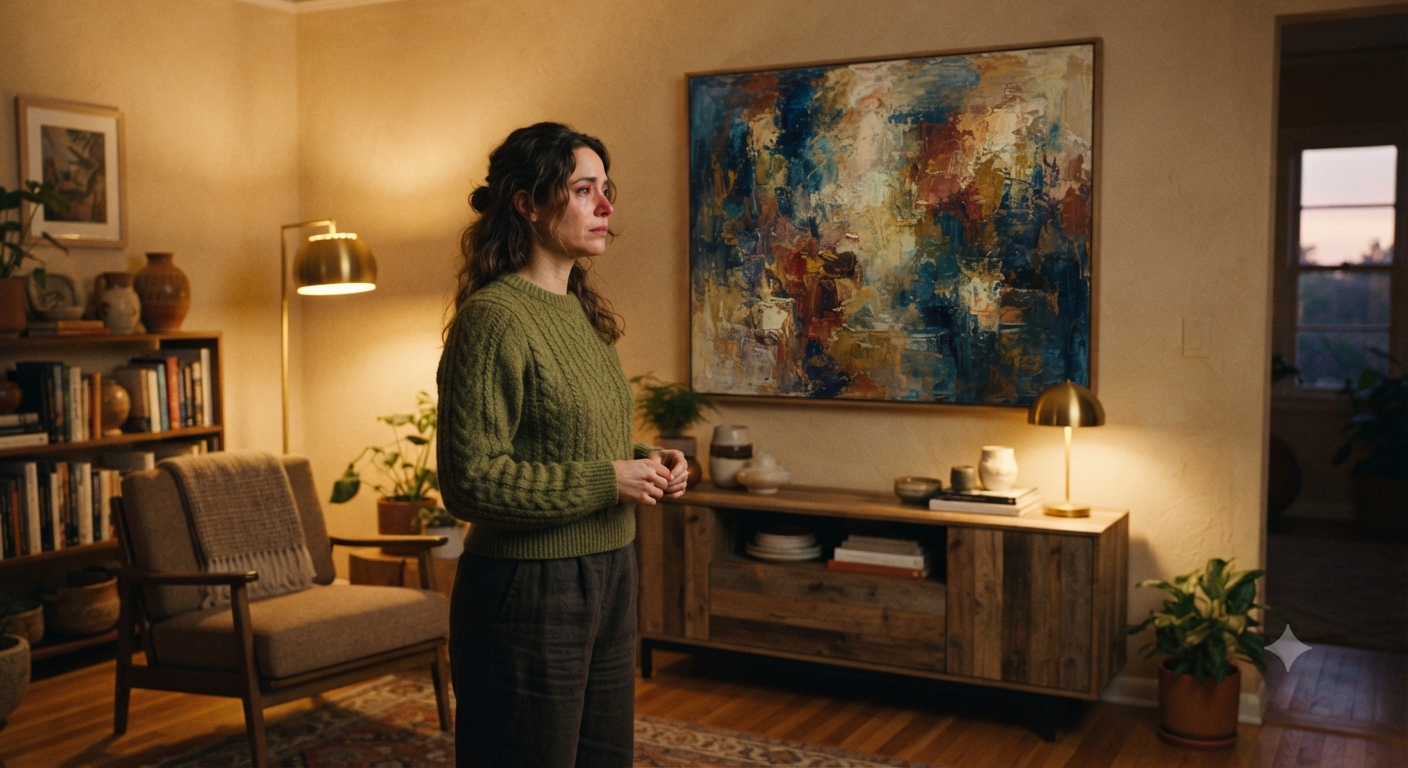
I hung the painting above the horsehair sofa because the wall looked bare after we took down the calendar from the seed company. I didn’t want to look at the blank plaster where the nail hole was. The black and blue splatters looked like grease smeared on a shop floor. From across the room, it didn’t look like anything at all. Just a dark stain against the faded yellow wallpaper with the little clover leaves on it.
A month went by like that. The days were getting shorter and the wind coming off the river had that sharp edge that makes your skin itch under your wool sweater.
David packed his blue canvas duffel bag on a Tuesday while I was out at the post office picking up the seed catalogs. He didn’t leave a note on the table. He didn’t leave his wedding ring by the sugar bowl. He just took his boots from the mudroom and left the screen door unlatched so it banged against the brick every time the draft caught it.
When I got home, the house was too quiet. Not the quiet of an empty house where you can hear the clock ticking or the mice behind the baseboard. It was the quiet of a room where someone had just finished screaming and the air was still vibrating.
I sat down on the horsehair sofa and stared straight ahead because I didn’t want to look at his empty chair by the woodstove. That was when I really saw the canvas for the first time.
The black paint wasn’t just smeared. It was thrown. You could see where the hand had jerked back at the last second, leaving thick ridges of dried oil that caught the afternoon light from the window. The red streak through the middle looked like a wound that had skin pulled over it before it was done bleeding. It looked like the way my chest felt when I walked past the machine shed and saw the empty space where his pickup used to sit at night.
It was messy. It didn’t make any sense. There was no center to it, no horizon line to tell you which way was up and which way was down.
I sat there until the room went gray and the oil lamp on the side table started casting long, crooked shadows across the floorboards. My knees were stiff when I finally stood up, and my shins ached from the dampness coming up through the floor.
Three days later, the television was on in the parlor while I was shelling beans into a yellow bowl. Some morning show was droning on about estate sales and county auctions, and a man with silver hair and wire-rimmed glasses was standing in front of a camera holding up a piece of cardboard that looked remarkably like my basement find.
He didn’t sound like a man on television. He sounded excited, like a boy who had just found a four-leaf clover in the pasture. He was talking about a painter named Pollock who lived out east and used to pour paint out of cans instead of using a brush. He said a canvas like that, found in a damp corner of a Missouri basement, could clear forty thousand dollars at a gallery in St. Louis. Maybe more if the provenance checked out with the estate stamp on the back.
I stopped shelling. A dry pod snapped in my hand, and the green beans scattered across the oilcloth cover like marbles.
I walked over to the horsehair sofa and climbed up on the cushions with my house slippers still on, reaching up until my fingertips grazed the top of the heavy oak frame. I lifted it down and turned it around to look at the raw wood where the grease pencil mark still showed.
Below the five-dollar price tag, half-hidden under a staple, was a small, smudged signature pressed into the burlap with a black marker that had bled into the fibers.
I didn’t reach for the phone. I didn’t call my sister in Chillicothe to tell her what the man on the box was saying about lost fortunes and art dealers.
I set the painting back down on the floor and leaned it against the leg of the sofa. The red streak caught the light from the oil lamp, looking dark and thick like dried blood on an apron.
David called on Friday afternoon. He didn’t say hello. He just asked if I still had his spare set of socket wrenches in the tool chest by the workbench.
“They’re where you left them,” I told him. My voice sounded flat, like water hitting a hot skillet.
“I can come by after chores tomorrow,” he said. He didn’t sound like he wanted to come. He sounded like a man reading off a list he’d written down on the back of an envelope. “I don’t want to make a fuss about the rest of the truck parts. Just the tools.”
“Don’t bother with the truck parts,” I said. “They’re gone.”
“Gone where?”
“I traded them to a fellow for a load of firewood,” I lied. It wasn’t true. The iron parts were still sitting in the weeds behind the chicken coop where he’d dropped them three years ago.
He was quiet for a long time on the other end of the line. I could hear the wind blowing through the wires somewhere out near the county line, that low, whistling hum that always came before a freeze.
“You always were hard to figure out, Martha,” he said. It wasn’t mean. It was just small. Like he was trying to fit his hand into a glove that had shrunk in the wash.
“I guess so,” I said.
Then I hung up the receiver before he could tell me what time he was coming for the wrenches.
I didn’t call the gallery in St. Louis. I didn’t care if the man on the television was right about the forty thousand dollars or the museum stamps or any of it. Money doesn’t fix a house that’s gone cold from the corners inward. It just buys you nicer things to look at while you sit by yourself in the dark.
I hung the canvas back up above the horsehair sofa, right where the nail hole was. The black splatters looked heavier now that I knew what they were made of, but they didn’t look ugly anymore. They just looked like the truth, left out in the rain until the colors ran together and wouldn’t come clean.