Why do we spend half our lives keeping score against the ghosts our husbands leave behind in dresser drawers?
That was the question running through my head while I sat at the kitchen table with Walter’s old brown billfold spread open between my coffee cup and a pile of unopened utility bills. It was three weeks after the funeral, back when the house still smelled too strongly of his winter coat and the peppermint candies he always kept in the glove box of the Buick. Walter had been a quiet man. Not mean, never that, but he kept his thoughts locked up behind his teeth like old money in a tin can under the floorboards. I found the tear right behind the old plastic sleeve where he kept his driver’s license from back when we lived over in Hastings.
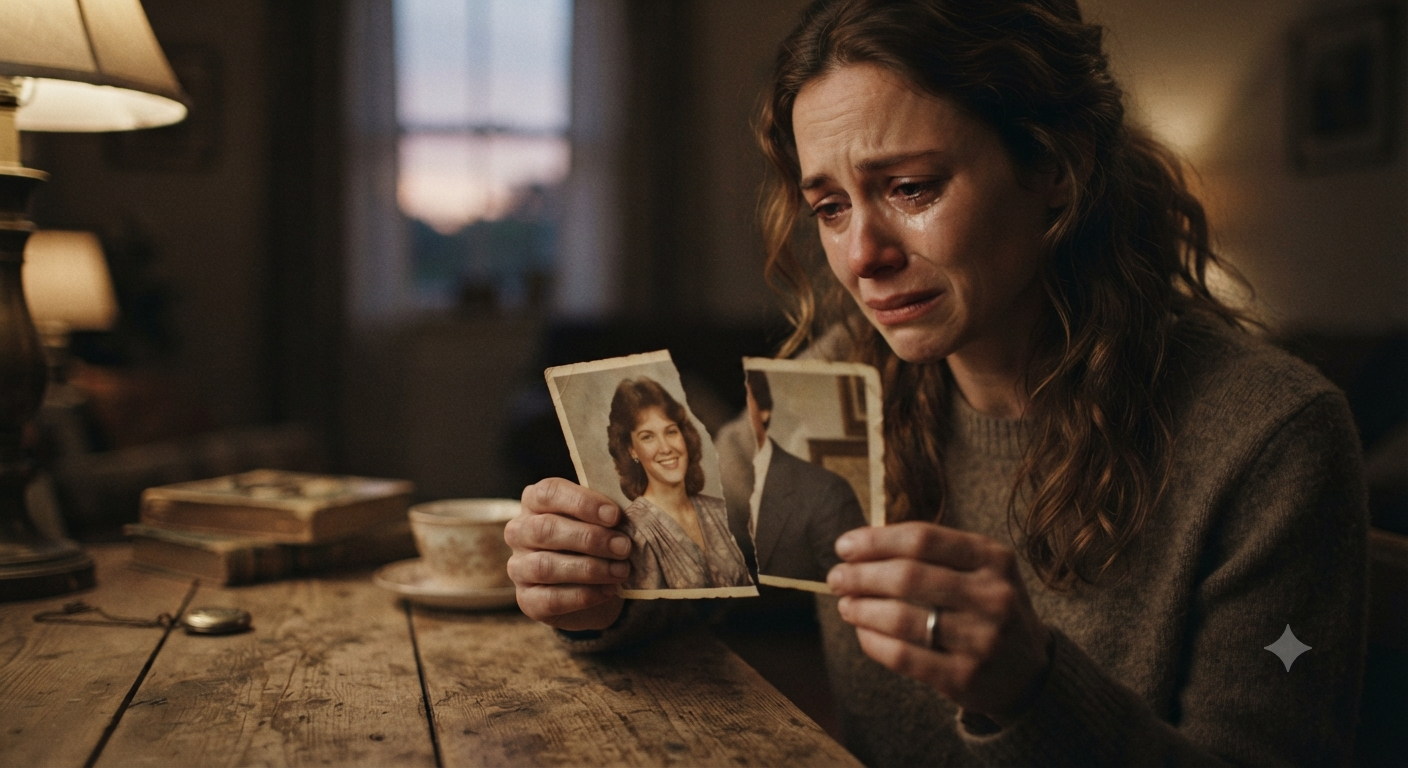
It wasn’t a whole picture. It was just a ragged strip of heavy cardstock, torn straight down the middle with a dull pair of shears or maybe just yanked apart by rough fingers in a hurry.
On my side of the rip, there was a girl’s shoulder in a wool sweater and the edge of a grin that didn’t quite reach her eyes. The other side of her face was just frayed white paper where someone had cut or ripped her away from the rest of the world. I turned it over. Nothing. No names, no dates, no faded ink from a drugstore developer in 1964. Just that one jagged edge biting into my thumb.
I didn’t tell anybody about it at first. You don’t go asking questions about thirty-year-old ghosts when the dirt on top of a man’s coffin hasn’t even settled flat yet.
The first two years after Walter died were just a blur of gray mornings and cold linoleum. I’d sit at that same table with the local paper and a magnifying glass, looking through birth notices from the counties down by the river. Walter had never talked about a sister. He always said he was an only child, that his folks went down in that bad flu winter right after the grain elevator fire, leaving him nothing but a clean record and a set of socket wrenches. But people don’t carry torn scraps of strangers in their billfolds for forty years just because they like the way the paper feels.
“You’re still looking at that thing, aren’t you?” my neighbor Martha asked one afternoon when she brought over a casserole that tasted mostly of canned mushroom soup and salt.
I slid the wallet under the stack of grocery flyers so fast I nearly knocked my tea over. “I’m just sorting his papers, Martha. The insurance wants another form.”
She gave me that look older women give each other when they know you’re lying through your teeth but they’re too polite to call you out on it. “He was a close man, Clara. You knew that when you married him.”
“I knew it,” I said, and watched her walk back down the gravel driveway.
The search didn’t start with a computer. It started with boxes of old telephone directories I hauled out of the basement of the county courthouse downtown, sneezing until my eyes watered from the damp mold. I spent six months writing letters to parish clerks from here to Omaha, asking about baptisms in 1948, 1949, 1950. Most of them didn’t write back. The ones that did told me the church records had burned in ’72 or that there wasn’t any record of a second child born to the names on Walter’s old birth certificate.
I felt stupid most of the time. Here I was, sixty-four years old, chasing a half-inch piece of cardboard like a teenager with a broken heart.
By year five, I had a whole cardboard shoebox filled with notes, receipts for postage, and little slips of paper with names scribbled on them. None of them fit. I found cousins twice removed who lived in Kansas and didn’t even know Walter had ever left home, let alone married me. None of them had ever heard of a sister.
“Why won’t you just let him rest?” my son Gary asked me on the phone one Sunday night when he called from his truck out on I-80. He sounded tired, the way men do when they’ve been driving twelve hours straight through a Nebraska snow squall. “Dad was who he was, Ma. Whatever he kept in that wallet, it’s over now.”
“It’s not about him being gone, Gary,” I told him, staring out the dark kitchen window at my own reflection in the glass. “It’s about the fact that I lived with a man for thirty-eight years and I didn’t even know who was sitting across the breakfast table.”
“You’re chasing wind,” he said, and then the CB radio in his cab started crackling with static and he had to go.
The turning point didn’t come with a grand discovery or a helpful librarian. It came on a Tuesday morning at 4:14 AM when my eyes snapped open in the dark and my thumb went straight to the little blue icon on the tablet Gary had bought me for Christmas to make me stop complaining about the small print in the paper. I wasn’t even looking for her anymore. I was just tired. I was scrolling through some public page for old farm equipment auctions around Grand Island when the suggestion popped up in the corner of the screen.
People You May Know.
There was a woman with gray hair pulled back in a loose bun, standing in front of a porch that looked entirely too much like the one my grandmother used to have over in Ravenna. Her name was Clara too. Well, Clara Mae Miller.
I didn’t breathe. I tapped the picture to make it bigger, holding the glass screen so close to my face my glasses fogged up.
It wasn’t just the jawline or the way her left earlobe turned down slightly at the bottom like a little comma. It was the eyes. They were Walter’s eyes, deep-set and heavy-lidded, the kind of eyes that looked like they were always trying to remember something they lost half a century ago.
I sat there in the dark for an hour, just looking at pictures of her grandkids, her garden, her kitchen table with its yellow laminate top that matched the one I had thrown out back in ninety-eight. I found an old post from three years back where she wrote about her seventy-fourth birthday. Same month. Same year. Two days apart.
My hands were shaking so bad I dropped the tablet onto the braided rug.
I didn’t sleep the rest of that night. I got up, made a pot of coffee that was so strong it turned the ceramic brown, and pulled Walter’s old leather billfold out from behind the flour canister where I’d hidden it from myself. I took the jagged piece of photograph out and laid it right across the bottom of the tablet screen where her profile picture sat smiling up at me.
The torn edge matched the shadow of her collar. The grain of the paper lined up down to the sixteenth of an inch.
She hadn’t been cut out of a group shot. She had been torn away from him.
The message I sent her took me three hours to write because every time I typed a sentence, I deleted it for sounding like a crazy person.
“My name is Clara,” I finally wrote. “I was Walter’s wife. I found something of his that belonged to you a long time ago.”
I hit send at 6:20 AM before I could talk myself out of it.
She didn’t answer for two days. Those forty-eight hours were the longest stretch of my life since Walter went into the hospital. I walked from the kitchen to the front porch and back until the floorboards groaned under my slippers. I kept looking at the little green dot on her profile, wondering if she had blocked me, wondering if she thought I was some kind of internet scammer trying to sell her something.
Then the phone buzzed on the kitchen table while I was peeling potatoes for dinner.
“Can you call me?” was all it said. Along with a phone number with an area code three towns over.
My voice was hoarse when she answered on the third ring. Neither of us said hello for a long second. There was just the sound of a dog barking in the background over her end and the hum of my refrigerator on mine.
“You have his nose,” she said first. Her voice was lower than mine, raspy like she’d spent forty years talking over a sewing machine motor.
“I’m Clara,” I whispered.
“I know,” she said. “He looked for me every year after the old man died. I didn’t know where he went. They split us up at the county line when we were seven. I stayed with an aunt in Valentine and he went with the uncle who had the farm down by Tecumseh.”
“He kept half the picture,” I said, and my throat tightened up so hard I could barely get the words out. “In his wallet. Every single day we were married.”
There was a long silence on the line then, the kind of silence that doesn’t feel empty at all, just heavy with all the years neither of us could get back no matter how hard we tried.
“He was always stubborn,” she whispered, and I could hear the wet hitch in her breath before she started to cry.
She drove down on Saturday in an old blue sedan with a dent in the passenger door. When she walked up my front steps, I didn’t shake her hand and she didn’t hug me. We just stood there on the porch in the cold Nebraska wind, two old women looking at the same face in the mirror of each other’s eyes, wondering how a piece of paper could survive forty years of silence while two people lived thirty miles apart without ever knowing their own name.