The ice cubes in my tumbler were melting down into gray water while I stood at the side of the stage watching Jesse pace the wings. He had that look in his eyes again. The one he got right before a set when the pressure of three hundred sold-out dates finally caught up with his throat.
I had been his tour manager for six years and mostly my job was just making sure he had fresh water and didn’t throw his boots at the lighting tech. Tonight the venue was the old civic arena in Amarillo and the air back stage smelled like stale popcorn and warm copper wiring. Jesse was tuning his 1968 Martin for the third time in ten minutes. His hands were shaking just enough that the heavy steel strings kept buzzing against the fretboard.
“You’re twenty seconds out, Jesse,” I said, leaning against the damp brick wall. “Time to move.”
He didn’t answer. He just pulled the strap over his shoulder and took a long, hard breath through his nose. He walked out into the blinding white wash of the front lights and the roar from ten thousand people hit the back wall like a physical shove. I watched him step up to the center mic, lift his arms to signal the opening chord, and then the strap slipped.
The Martin dropped six feet straight onto the concrete floor of the stage. The sound wasn’t just a crack. It was a wet, splintering pop that echoed straight through the monitor speakers.
The whole front row went dead silent instantly. Jesse dropped to his knees right there in front of the drum riser, his fingers clawing at the loose mahogany neck like he was trying to hold a broken bone together. The headstock was dangling by a single strand of gray wire.
“Oh god,” I whispered, pushing off the wall.
The crowd didn’t know what was happening yet. They just saw their headliner kneeling in the dark with a shattered vintage instrument. Jesse was just staring at the wood chips on his boots. His mouth was open and he couldn’t get his lungs to work.
Then a girl right down front by the steel barricade reached down between her feet. She hoisted something bright pink and entirely ridiculous up into the blinding light. It was one of those plastic half-size guitars you buy at a department store for twenty-five bucks, covered in silver star stickers that were peeling off the edges.
She shoved it right over the top rail toward him.
“Use mine,” she shouted over the dead silence of the room.
Jesse didn’t look up at the crowd. He looked at the toy. Then he looked at her face, small and pale behind the glare of the floor cans, holding the plastic neck out like an offering. He grabbed it by the plastic tuning pegs, stood up on shaky legs, and stepped back to the mic.
The band behind him stared like he had lost his mind. The drummer hit a tentative snare rim just to keep time. Jesse didn’t wait. He dug his thumb into the nylon strings and hit an open E chord that sounded like a tin can rolling down a tin roof.
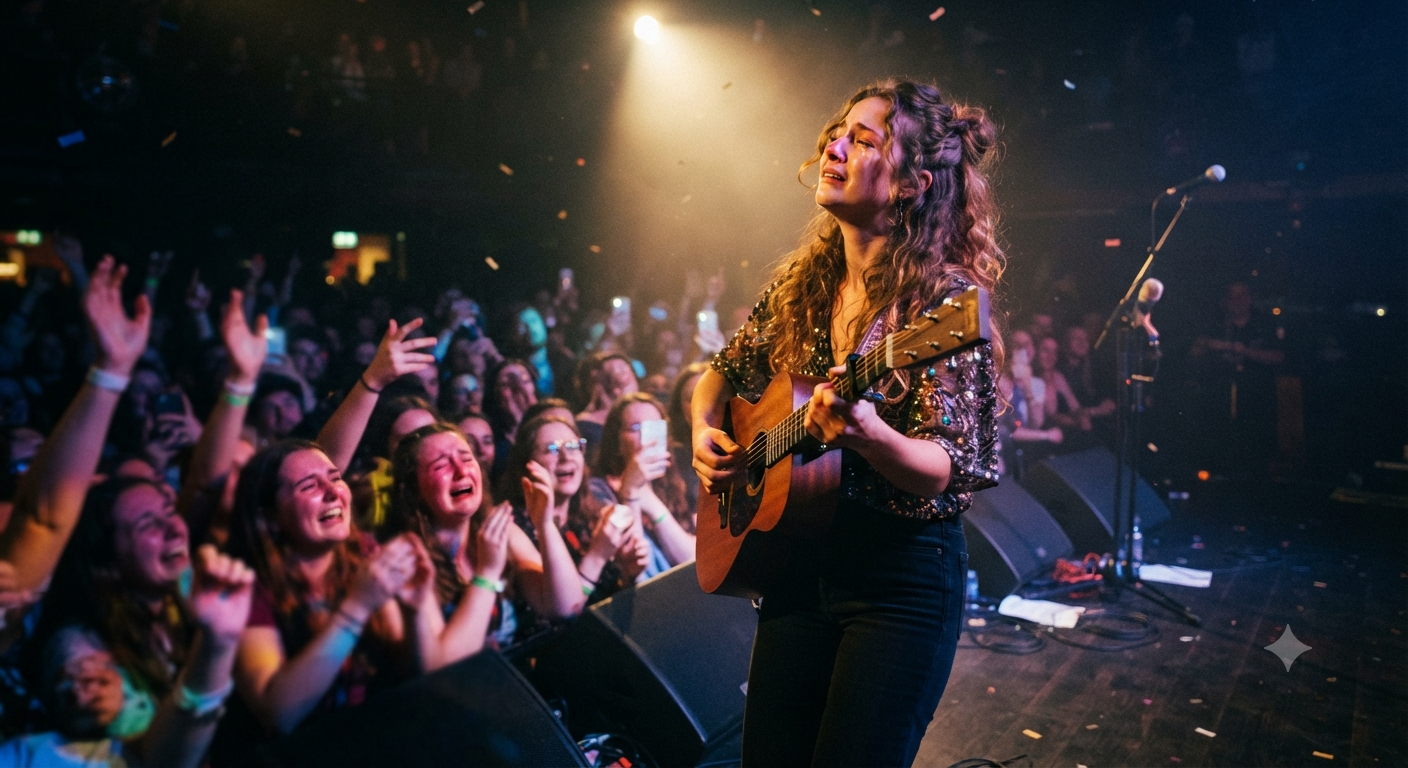
The crowd erupted. It wasn’t polite applause. It was a howling, screaming wave of pure disbelief that shook the rafters.
He didn’t try to play fancy. He just leaned into the terrible, tinny sound of that plastic toy and wailed the opening riff of our biggest single. The plastic body was so small it looked ridiculous against his chest, but he threw his weight behind every single strum until his fingers turned red against the cheap plastic frets.
I stood in the wings watching the phone screens light up across the entire arena like fireflies. Every single person was recording. By the time he hit the final chorus, the place was shaking so hard the ceiling tiles started to drift down dust.
When he walked back off stage, the plastic guitar was still clutched in his fist and his chest was heaving under his sweat-soaked shirt. He didn’t hand it to me. He just held it like it was heavier than the Martin ever was.
“Get her back here,” he said, his voice cracking right down the middle. “Find her.”
It took twenty minutes of arguing with local security before I managed to pull the girl out from the crowd and bring her through the heavy fire door into the back green room. Her name was Clara. She couldn’t have been more than fifteen, wearing an oversized gray hoodie with paint stains on the cuffs and her dark hair pulled back into a messy bun that was coming undone.
She was clutching the strap of a worn canvas backpack so hard her knuckles looked translucent under the fluorescent lights. Jesse was sitting on the edge of the leather couch, his elbows braced on his knees, staring at the little pink toy resting on the coffee table between them.
“Where did you get this?” Jesse asked, his voice dead flat.
Clara swallowed hard and looked down at her scuffed Converse sneakers. “My dad gave it to me.”
“It’s a toy, kid,” I put in gently from the doorway. “How did you even get it past the gate?”
“I didn’t think they’d let a real one in, so I just hid it under my jacket,” she said, her voice small. She didn’t sound scared, just tired in that specific way teenagers get when they’ve been carrying something heavy around for too long. “My dad was a musician, too. Before he died. He bought that at a pawn shop in Odessa when I was seven. He told me if I ever met someone who really needed to make some noise, I should lend it to them.”
Jesse didn’t say anything for a long time. The only sound in the room was the hum of the old refrigerator in the corner. He reached out with one finger and touched the edge of a silver star sticker peeling off the plastic body.
“What was his name?” Jesse asked.
“Tom,” she said. “Tom Miller. He played slide in a blues cover band down by the river. Nobody ever bought his records, but he had the best hands in the county.”
Jesse stood up slowly, walked over to his gear case, and pulled out a heavy black leather rectangle. He unlatched the metal buckles with a sharp click that made Clara flinch. Inside sat the brand-new custom Gibson acoustic the label had sent him just last week for the tour kickoff. Solid spruce top, gold tuning pegs, mahogany sides polished to a dark mirror finish. Easily four grand retail.
He lifted it out by the neck and held it out toward her across the table.
“Take this,” Jesse said.
Clara pulled her hands back into her sleeves like she was afraid the wood would bite her. “I can’t take that. That’s worth more than our rent.”
“Take the Gibson,” Jesse said, and his voice didn’t leave any room for arguing. “And keep yours.”
She looked from Jesse’s face down to the pristine guitar resting in the open black velvet case, and then back to the pink plastic toy sitting right beside it. Her lower lip gave a tiny, involuntary twitch, but she didn’t cry. She just reached out with both hands and took the neck of the Gibson, her fingers curling around the polished wood like she was afraid it might turn back into air.
“What about yours?” she whispered, looking down at the pink toy.
Jesse reached down, picked up the little plastic guitar by its neck, and slid it carefully into his own equipment bag right on top of the ruined Martin.
“It’s the best guitar I’ve ever played,” he said.
I stood there in the doorway with my hands in my pockets, watching the way she balanced the heavy professional case against her hip as she walked back out into the hall. The door swung shut behind her with a heavy, final thud, leaving the room smelling of old dust and cold asphalt. Jesse didn’t look at me. He just sat back down on the couch, stared at the empty space where she had been standing, and didn’t say another word for the rest of the night.