
Forty-four dollars and seventy cents was all I had left in my checking account when I dropped the milk glass pitcher on the kitchen floor. It was a stupid accident. I reached up to grab a box of saltine crackers from the top shelf because my blood sugar was dropping, and my elbow caught the edge of the shelf liner. The pitcher didn’t just tip. It slid across the laminate counter with a dry scraping sound and shattered into twelve jagged pieces on the hardwood.
I know you are going to hate me when you hear this, and honestly, I do not blame you at all because that pitcher was not mine to break. It belonged to Roberta, my older sister, who had spent three years driving down from Amarillo every single weekend to help me keep our mother’s house from falling into foreclosure after the estate taxes hit. She trusted me to pack the heirlooms before the auctioneer came. Instead, I stood there in my stocking feet with the morning sun cutting across the dust motes, staring at the white glass spread out around my ankles like broken teeth.
I didn’t move for a long time. My legs felt hollowed out, like cedar posts eaten away by termites from the inside. I just squatted down on my haunches and picked up the largest shard, the handle part that still had a little thumb rest molded into the curve. My thumb rubbed against the smooth porcelain, and the silence in that small kitchen felt heavier than any lecture Roberta could have given me.
“You’re a real piece of work, Brenda,” I whispered to myself, the words tasting like copper in my mouth.
The thing is, I had been breaking things my whole life. When our daddy died back in ninety-eight, I was the one who let his old John Deere tractor sit out in the north pasture with the hood up until the block cracked in the winter freeze. When my second husband walked out the door with two suitcases and a half-empty bottle of bourbon, I didn’t even chase him down the driveway. I just watched the tail lights of his Ford pickup turn the corner by the grain elevator and went inside to wash his breakfast dish.
I thought about calling Roberta right then. I reached for my phone on the counter, but my fingers were shaking so hard I dropped it against the edge of the trash can. The screen didn’t crack, but the battery door popped off and the little plastic SIM card skittered under the refrigerator. I left it there. I didn’t have the stomach to hear her voice change over the line. You know that flat, disappointed tone people get when they realize you have messed up again. It is worse than screaming.
Instead of cleaning up the mess, I walked over to the utility drawer by the pantry and dug around under the old twine, three rusty screwdrivers, and a handful of rubber bands until my fingers hit the cold metal tube of household epoxy. It was old stuff. The cap was cemented shut with dried yellow resin, and I had to use a pair of pliers to twist the nozzle open. The smell that came out of it was sharp and chemical, smelling like old glue and turpentine on a hot August afternoon.
I sat down right there on the kitchen floor with my knees pulled up to my chest and started putting the pieces back together. There was no plan. I just picked up the base, smeared a thick line of the yellow paste along the fresh fracture, and pressed the side panel against it. The glue oozed out of the seam like thick cream. I held it there with one hand, waiting for the chemical heat to set, but my fingers slipped and the whole thing slid sideways into a greasy smear of resin.
“Damn it,” I said out loud, and the sound bounced off the bare walls of the empty room.
The house was too quiet. Without the furniture that Roberta had already hauled away to the consignment shop in town, every word I spoke sounded hollow, like I was talking down an empty well. I spent the next two hours working on that pitcher on the kitchen floor. I didn’t use tape or clamps. I just sat there cross-legged, holding the shards in place with my thumbs until my joints ached and the skin around my cuticles was stained yellow with the hardened glue.
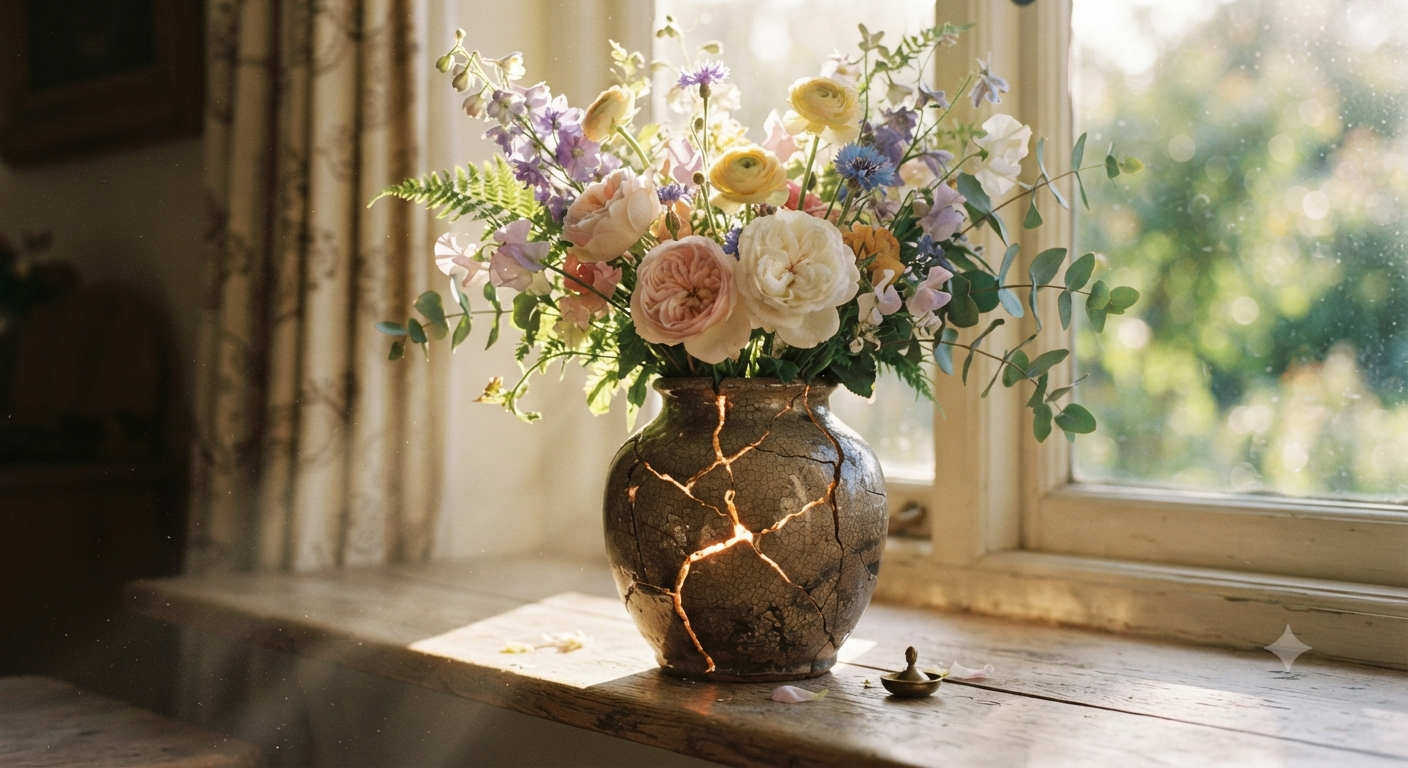
By noon, the pitcher was back in one shape, but it didn’t look like anything you would put on a dining room table. The cracks were thick and yellowed, zig-zagging up the white milk glass like jagged lightning bolts. Where the spout had broken off, a little lump of dried epoxy had pooled and hardened into a hard, amber drop that looked like a permanent tear. It was ugly. It was the kind of clumsy, embarrassing repair that screamed every mistake I had ever made in my fifty-four years on this earth.
Around one o’clock, the screen door on the back porch creaked open, and I heard Roberta’s heavy work boots hitting the linoleum. She always walked with that same flat, heavy-footed tread our daddy had, like she was trying to leave a mark on the dirt so the world wouldn’t forget she passed through it.
“Brenda?” she called out, her voice echoing through the empty hallway. “Are you still alive in here, or do I need to call the sheriff to come check on you?”
She walked into the kitchen carrying a cardboard box from the hardware store, her face flushed from the wind off the flats. She stopped dead about three feet from where I was still sitting on the floor with my knees tucked under my chin and the ugly white pitcher sitting right between my feet. Her eyes went straight to the yellow seams.
Nobody said anything for a second, and honestly, that felt worse than any shouting match we could have picked. She set the box down on the counter with a dull thud that made the remaining coffee mugs rattle in the cupboard.
“What is that on the floor?” she asked, her voice dropping down low and flat.
“I broke it,” I said, and my voice sounded small, like a child’s voice coming out of an old woman’s throat. “I dropped it while I was getting the crackers. I’m sorry, Roberta. I know that was the one thing from Grandma’s sideboard you wanted to keep whole.”
Roberta didn’t yell. She walked over slowly, her boots crunching on a few tiny stray splinters of glass I hadn’t swept up yet. She squatted down beside me, her knees popping with a dry crack, and reached out with one rough, calloused hand. Her fingers were stained with grease from working on her lawnmower carburetor that morning. She didn’t touch the pitcher at first. She just looked at the thick, amber-colored lines of glue I had smeared all over the side.
“You used that old industrial glue from the garage,” she said, almost to herself.
“It was all I had,” I told her. “I couldn’t drive anywhere. My account’s down to forty-four dollars until the disability check hits on the first.”
She reached out then, her thumb brushing lightly against the jagged seam where the handle met the belly of the pitcher. She didn’t pull her hand back. She traced the ugly yellow line all the way up to the rim where the spout used to be.
“It’s crooked,” she said softly.
“I know.”
“And you got glue all over the front.”
“I know that too.”
Roberta stayed down there on the floor with me for a long minute, the smell of the epoxy hanging between us like old smoke. She didn’t look at me with pity, and she didn’t look at me like I was a burden she was tired of carrying. She just stared at that lump of dried amber resin near the lip, the one that looked like a frozen tear.
“Grandma used to say that anything worth keeping in this life has to take a beating first,” Roberta murmured, her voice sounding rough around the edges. She stood back up slowly, groaning a little as she straightened her back, and walked over to the kitchen sink where she turned the faucet on to rinse her hands. “Leave it on the windowsill.”
“What?” I asked, looking up from the floor.
She dried her hands on the dish towel hanging from the oven handle and didn’t turn around to look at me. “Put the damn thing on the windowsill where the sun hits it. Don’t hide it in a box.”
“It looks ruined, Roberta.”
“It looks like you,” she said, and for the first time all morning, the hard line around her mouth softened just a fraction. “It’s scarred up, and it won’t ever hold water the same way again, but it’s still standing.”
She walked back over, picked up the ugly white pitcher by its clumsy handle, and carried it across the room. She set it right in the center of the south-facing window above the sink, where the midday glare hit the yellow epoxy seams and turned them into thin, bright threads of gold against the white glass.
I stayed on the floor for a minute after she walked out to her truck to grab more packing tape. My knees were stiff, and my hands smelled like chemicals, but the kitchen didn’t feel quite as empty as it had ten minutes ago. Some things don’t need to be whole to let the light through. You just have to hold the pieces together long enough for the glue to dry, even if everyone can see where you broke.