The grease on the linoleum floor always stayed a little tacky no matter how many times Arlene scrubbed it with Pine-Sol. That was the first thing you noticed if you walked into her kitchen without shoes on. My feet used to stick to the kitchen floor every single November since I was nine years old, right around the time the first frost hit the stubble fields down by the river.
Arlene was my aunt, though I called her Mom because my own mother took off for Peoria when I was still small enough to fit in the footwell of her Dodge. Arlene didn’t talk much about her side of the family. She had two brothers, Dale and Vance, but Vance was a word you didn’t say unless you wanted the air in the room to go flat and cold. Vance was the one who packed his red toolbox into the back of a Ford pickup in October of 2002 and backed down the gravel drive without looking in the rearview mirror once.
I was twelve then. I remember the sound of the gravel more than anything else. Crunch, crunch, crunch, right past the rusted oil drum we used for burn barrels.
“He’s gone,” Arlene had said, standing right by the butter churn she used as an umbrella stand. Her hands were flour-white. “He made his choice.”
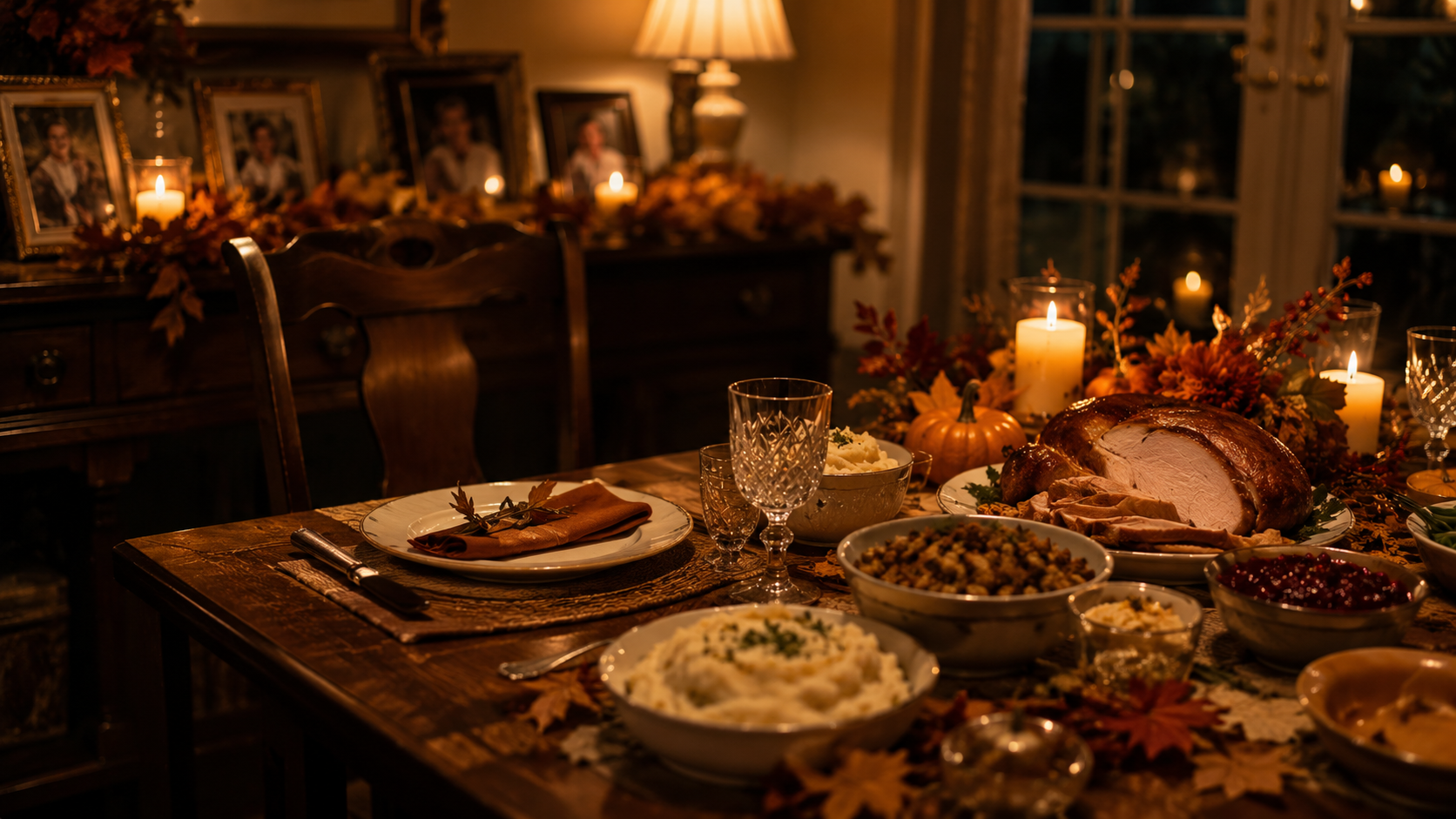
So every year after that, Arlene set a place at the Thanksgiving table for Vance. Not just a napkin and a fork, either. A whole china plate with the blue cornflower pattern she only let us touch on Sundays, a heavy silver knife her grandmother brought from Tennessee, and a water glass filled exactly three-quarters full. Nobody ever sat there. We just stepped around it when we carried out the turkey platter or the bowl of candied yams smeared with melted marshmallows.
“Don’t touch the silver,” Arlene would snap if my cousin Dale reached for the butter knife at the empty place. “That’s not yours.”
For twenty years, that chair stayed pulled out about six inches from the table. We got used to it. It was like the radiator knocking in the basement or the way the front screen door never latched unless you gave it a sharp yank. It was just furniture. It was just part of the room, like the wallpaper with the faded yellow roses peeling near the pantry door.
I grew up, got a job at the grain elevator down on Route 36, and stayed in town because leaving never seemed like something people from our county actually did. Dale moved to Decatur to sell insurance, but I stayed in the house with Arlene after her hips started going bad. I did the grocery shopping at the Kroger off the bypass and carried the heavy sacks up the three wooden steps to the back porch.
By the time the fall of 2022 rolled around, Arlene’s hair had gone completely white, like cotton pulled straight out of the boll. She moved slower now, leaning on a four-legged aluminum walker that squeaked every time she turned a corner in the narrow hallway. But she still insisted on setting that table.
“Did you check the water level in the glass?” she asked me from the living room chair. Her voice was thin as onion skin.
“I checked it, Arlene,” I said, wiping my hands on my jeans. “It’s full.”
“Good,” she muttered, staring out the wavy glass of the front window toward the highway where the semis shook the foundation every time a heavy flatbed went by. “He always liked a cold glass of well water right when he sat down. Before the blessing.”
I didn’t say anything to that. I couldn’t. Because after twenty years, you stop arguing with ghosts. You just sweep around them and hope they don’t trip you up in the dark.
The morning of Thanksgiving started out gray and heavy, the kind of damp cold that gets right inside your jacket cuffs and stays there all day. The turkey was a seventeen-pound Butterball I bought for $38.40 on sale at the Piggly Wiggly, and it was already in the oven by 6:00 AM, filling the house with that heavy, greasy smell of roasting skin and sage.
Arlene sat at the kitchen table shelling pecans into an old tin coffee can, her thumbs moving slow and careful over the nutmeats. Every few minutes she’d look up at the clock above the wall calendar, the one with the picture of the red barn that hadn’t been updated since 2014, and then she’d look over at the dining room table where the empty place setting sat waiting in the dim light.
“He’ll come on a Thursday,” she said out of nowhere.
“Who will?” I asked, turning the burner down under the green beans.
“Vance. He always liked Thursday. Said it was the only day of the week that didn’t feel like it was rushing you.”
I didn’t answer. I just kept stirring the cream of mushroom soup into the casserole dish, watching the gray globs disappear into the yellow beans. I was thinking about the mortgage payment coming due and whether the truck needed a new set of tires before the first real snow hit the bottomlands. Vance wasn’t on my mind at all. Vance was a name in a family Bible nobody opened anymore.
Around 2:15 PM, Dale and his wife Sharon showed up in their Buick, shaking the dead leaves off their shoes on the scraper by the door. Sharon brought a pumpkin pie in a cardboard bakery box, and Dale brought a six-pack of warm Busch Light that he immediately set on the counter.
“Smells good,” Dale said, kissing the top of Arlene’s head where her scalp showed pink through the thin hair. “Is the table ready?”
“It’s ready,” Arlene said. Her eyes didn’t leave the hallway.
We sat down around 3:00. The house was warm, almost too warm from the gas stove and the oven running for five hours straight, and the windows were all fogged up white around the edges so you couldn’t see the corn stubble in the front yard anymore. Dale said grace, his voice low and practiced, thanking the Lord for our daily bread and the roof over our heads and the family gathered around the board.
He didn’t mention the empty chair. None of us did. It was like an unspoken rule we’d all memorized back when George Bush was in the White House.
Right as I was reaching for the gravy boat, someone knocked on the front door.
It wasn’t a normal knock. It was three light, tapping raps, like someone using a single knuckle because they were scared the wood would break under their hand.
Arlene froze with her fork halfway to her mouth. Her hand started to shake, a fine, high-frequency tremor that made the tines click against her china plate.
“Go see who that is,” she whispered. Her voice wasn’t loud, but it cut right through the noise of the TV playing the Lions game in the other room.
“It’s probably just the UPS guy dropping off a late package for the neighbors,” Dale said, reaching for the turkey platter. “Sit down, let’s eat.”
“Go,” Arlene said again, louder this time. She was looking right at the front door through the archway, her eyes wide and wet behind her thick bifocals.
I pushed my chair back, my boots sticking slightly to the kitchen wax, and walked down the short hallway past the coat rack. The porch light was off, casting long shadows across the indoor-outdoor carpeting we’d put down in the nineties. Through the diamond-shaped glass in the middle of the front door, I could see a shape standing out there in the gray afternoon.
It was an old man. He was wearing a faded blue canvas work jacket that looked three sizes too big for his shrunken shoulders, and he had a dark green wool cap pulled down low over his ears. In his right hand, he was holding a clear plastic bag with something heavy inside it.
I turned the brass deadbolt. It made a loud, dry click that echoed in the tiny entryway.
When I pulled the door open, the cold air rushed in smelling of dead leaves and wet asphalt. The old man took half a step back, his boots scraping on the concrete porch. He had deep-set blue eyes that looked watery and red around the rims, and his cheeks were mapped with broken purple veins from too many winters outside.
“Is this… Helen’s place?” he asked. His voice was cracked, like dry creek mud in August. “Helen Vance?”
Before I could say a word, the sound of the walker squeaking came rattling down the hallway behind me.
“Who is it?” Arlene called out. Her voice was sharp, terrified, shaking so hard she could barely get the words out. “Who’s at the door?”
She came around the corner then, her aluminum walker bumping against the doorframe, her knuckles white on the handgrips. She stopped dead three feet behind me.
She didn’t look at his face. She looked at his hands.
The old man was holding a cheap bottle of Chianti by the neck, the kind you buy at the gas station for six dollars, with the straw basket around the bottom. His fingers were crooked with arthritis, the left thumb missing the top joint entirely, a farming accident from fifty years ago down by the Embarras River that nobody talked about anymore.
Arlene dropped the walker. It hit the carpet with a dull thud.
She didn’t scream or cry out loud. She just made this tiny, hitching sound in the back of her throat, like someone getting the wind knocked out of them by a baseball, and then she covered her mouth with both hands.
The old man lowered his head. A single tear tracked down through the white stubble on his cheek, catching the porch light from next door.
“Hey, sis,” he said.
She didn’t move for a long, terrible second. The whole house went so quiet I could hear the refrigerator compressor humming out in the kitchen and the distant sound of a semi shifting gears out on the highway.
“You’re late,” Arlene whispered. Her voice broke right in the middle, thin and ragged.
“I know,” Vance said, his voice shaking. “I took the long way around.”
He didn’t step inside right away. He stood there on the concrete mat for a minute, looking past me into the warm, yellow-lit dining room where the turkey steam was still rising toward the ceiling. He looked right at the empty chair with the blue cornflower plate and the glass of water that had been sitting there waiting for two decades.
“You kept it,” he said.
“I always kept it,” Arlene said, her shoulders shaking as she finally reached out and grabbed his old, greasy coat sleeve with both hands, pulling him across the threshold like she was afraid if she let go he’d turn back into mist. “Now get in here before the gravy gets cold.”
We didn’t make a big deal out of it. We didn’t clap or cheer or call a family meeting. Dale just stood up from his chair at the end of the table, his napkin still tucked into his collar, and walked into the hallway to help Vance pull off his wet jacket.
“Here,” Dale said, his voice thick and rough. “Give me that bottle. I’ll get the corkscrew.”
Vance walked into the dining room, his boots leaving dark, wet patches on the linoleum floor that Arlene had scrubbed three times that morning. He didn’t look at any of us as he walked past. He just walked straight to the empty chair, the one with the blue cornflower plate and the three-quarters-full glass of well water, and pulled it out himself.
He sat down slow, his joints popping in the quiet room, and rested his scarred hands flat on the edge of the table.
Nobody said anything for a second, and honestly that felt worse than shouting. Then Aunt Arlene walked over, picked up the heavy ceramic bowl of mashed potatoes, and passed it right across the empty space like he’d never left at all.
“Eat,” she said, her voice dropping down to a harsh whisper. “You look like you haven’t had a decent meal since Dale was in diapers.”
Vance took the spoon. His hand was shaking so bad the butter on the potatoes slid right off the side and hit the clean white plate with a soft plop.
“I haven’t,” he said.