I reckon the sun hits those flat Texas plains in a way that makes you think nothing can hide out here. You can see a pickup coming down the caliche road five miles off, all kicked-up dust and white glare. My uncle Ray always said you could trust the horizon because it never moved on you. I used to believe him. I mean, he was the one who held the back of my bicycle seat when I was seven, steadying me until I stopped wobbling and took off down the gravel path behind the barn. He walked me down the aisle when my daddy passed, and he was the one who told me I looked like a proper lady in that lace dress. He was just Uncle Ray. Everyone in Potter County knew him as the quiet man who fixed tractors and never raised his voice at church suppers.
The guest room at their place had that smell of old cedar and sun-warmed cotton sheets. I stayed there for three nights after my shift at the clinic changed over and my own little rental house was getting new floors put in. Aunt Clara was busy canning tomatoes down in the root cellar, jars clinking against each other like small bells all afternoon, while Ray was out in the machine shed working on a combine belt. It was quiet enough to hear the cicadas buzzing against the window screen. I went in to check my hair in the old oval mirror hanging above the maple dresser. That was when I saw the line.
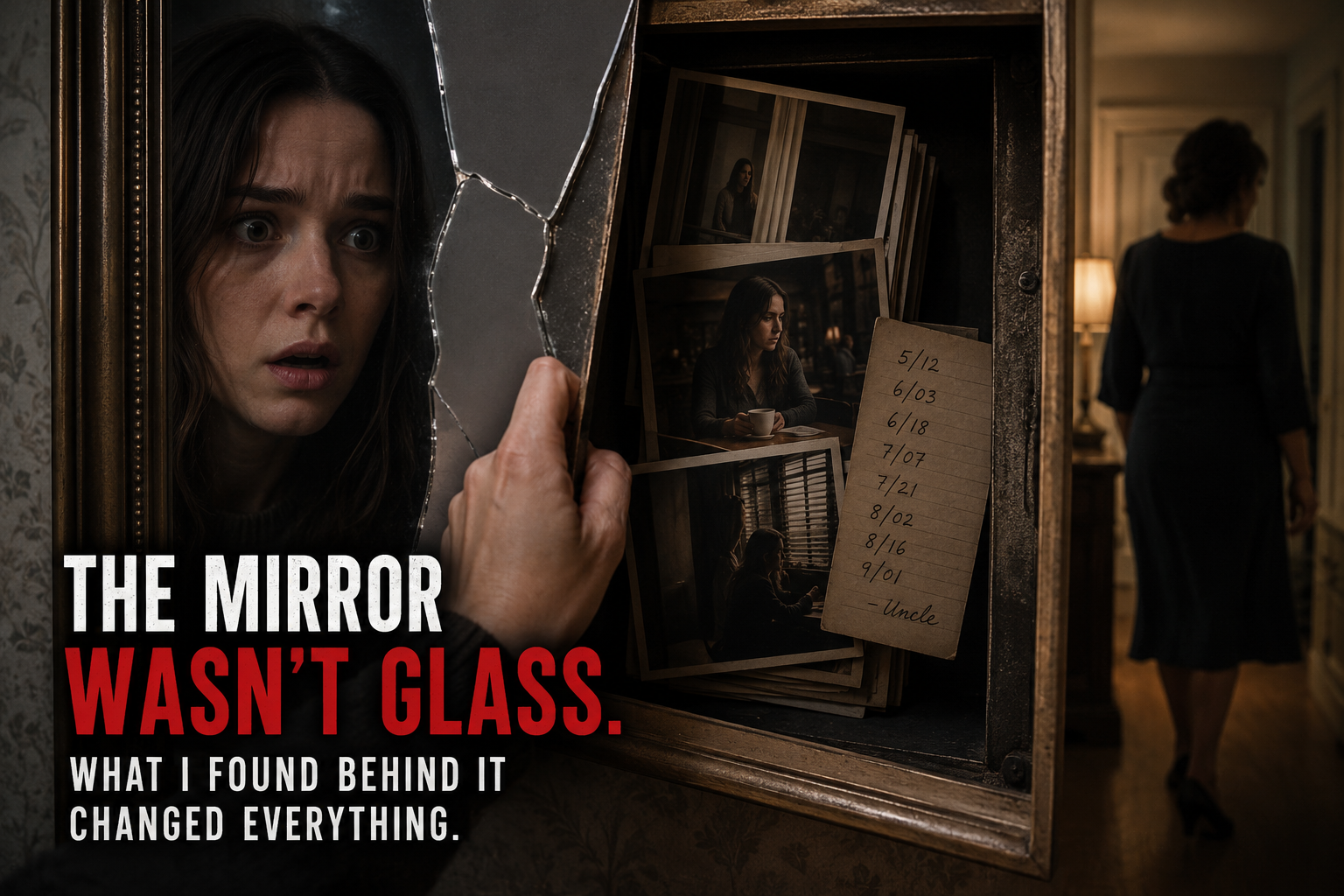
It wasn’t a clean break like you get when something strikes hard. It was a jagged crack starting right near the top corner by the wooden frame and zigging down toward the middle, looking just like a heavy branch had hit it. I remember tapping it with my fingernail to see if it was sharp enough to catch skin. It didn’t feel like cold glass under my nail. It felt smooth and warm, sort of like heavy-duty plastic. I frowned at my own reflection, my thumb resting right on the seam.
Ray had put that mirror up himself back when they remodeled the guest room in nineteen ninety-eight. He told us all about how heavy it was, how it took two men to lift the plate glass up the narrow stairs without chipping the edges. I pressed my thumb harder into the middle of that zig-zag line. The whole frame gave a little soft click, like a latch coming loose in an old screen door. I didn’t think much of it at first. I just figured the glue had dried out over the summers and the silver backing was peeling loose from the wood.
I pulled on the edge. The right half of the glass swung out on small brass hinges I had never noticed before, moving so quiet it didn’t even creak. Behind it wasn’t the lath and plaster of the farmhouse wall. It was a dark, empty space carved out right between the wall studs, about four inches deep and maybe two feet wide. There was a faint smell of stale cigarette smoke in there, even though Ray hadn’t smoked a cigarette since my cousin Bobby was a baby.
Inside that little hollow space sat a stack of standard Kodak prints held together by a rubber band that had already dry-rotted and snapped in two. The top photograph showed me standing on the front porch of my own house, holding up a yellow grocery bag in one hand and my keys in the other. The date was written on the back in blue ink. October twelfth. A Tuesday. I knew it was a Tuesday because I had worked a double shift at the clinic and stopped by the Piggly Wiggly for milk on the way home.
My hand started shaking so hard I dropped the whole pile on the braided rug at the foot of the bed. They scattered across the floor like playing cards thrown down in a panic. I knelt down on my knees, the rough wool scratching my palms, and turned over the nearest picture. It was me sitting at the corner booth in the Diner on Sixth Street, reading a paperback book while waiting for a bowl of chili. The angle was wrong. It wasn’t taken from across the aisle where people sat. It was shot from down low, through the bottom slats of the wooden booth divider, like someone had been crouched on the floor by the cigarette machine.
Another one showed me standing by my open bedroom window at home, brushing out my hair before turning off the bedside lamp. The window had been open for the spring breeze. I remembered that night because the screen had rattled in the frame and I thought maybe a stray cat was out on the porch roof. The date on the back of that one was written in the same neat, looping handwriting I had seen on a hundred birthday cards Uncle Ray had signed for me over the years. Wishing you the best, Uncle Ray. Always proud of you.
I sat there on that braided rug for I don’t know how long, just staring at the floorboards between my boots. The silence in the house felt heavy, the kind of heavy you get right before a summer hailstorm rolls over the scrub oak. I could hear the faint hum of the refrigerator out in the kitchen and the sound of Clara’s canning jars clinking together down below, rhythmic and steady, like a clock ticking down something I didn’t want to measure.
Clara came up the stairs a little while later wiping her hands on a blue flour-sack towel. She stopped in the doorway of the guest room, her sensible black shoes planted right on the threshold, and looked down at the photographs spread all over her spare room floor. She didn’t gasp. She didn’t drop her towel. Her face just went entirely still, the way an animal goes still when it hears a twig snap in the brush.
“I found this,” I said, and my voice sounded thin and small, like it belonged to someone else standing across the room. “Clara, look at these. They’re of me. Every single one of them.”
She stayed right there in the doorway for a long second, her eyes moving from the open mirror panel in the wall down to the picture of me at the grocery store. I kept waiting for her to tell me it was some kind of joke, or that Bobby had been messing around with an old camera, or that Ray had borrowed my pictures for some reason I couldn’t even begin to guess. I wanted her to yell at me for going through their things. I wanted her to get mad.
“Did Ray put this here?” I asked, and my voice cracked right in the middle of the name.
Clara didn’t look at me. She looked out the small window toward the machine shed where Ray was still out there working on the tractor, his blue shirt a bright patch against the gray metal of the door. She smoothed the corner of the towel over her thumb twice, slow and careful, like she was making sure the hem was straight.
“I knew,” she said. Her voice didn’t have any surprise in it at all. It sounded flat, tired, like she was reading items off a grocery list at the end of a long week. “I’ve always known.”
I just looked at her, my mouth half open, waiting for the rest of it. I thought she would explain how long it had been going on, or why she never told anyone, or how she lived in the same house with a man who spent his afternoons cutting little holes through bedroom walls. But she didn’t say another word. She turned around in those sensible shoes, the heels clicking once against the pine floorboards of the hallway, and walked back down the stairs toward the kitchen.
I stayed on the floor for another minute with my fingers resting on the edge of one of the photographs. The screen door downstairs slammed shut, hard and loud, rattling the glass in the front room. I heard Ray’s heavy boots on the back porch steps, the rhythmic scrape of his soles wiping the mud off on the iron grate just like he did every single day after coming in from the fields.
I didn’t pack my bag. I didn’t wait to see him come up the stairs. I just stood up, left the photographs scattered all over the braided rug where they fell, and walked right out of that house through the front door, leaving it standing wide open behind me in the afternoon heat.