
11 min read · 2,042 words
My thumb was still pressed down on the plastic hook of the telephone receiver when the dial tone started up again, that low steady hum that always sounded like someone blowing across the top of an empty bottle.
The clock on the microwave said 2:13.
Outside, the rain was coming down hard enough to rattle the aluminum siding on the back porch, hitting the metal like handfuls of dry rice thrown by someone in a hurry.
Clara had left her jacket hanging over the back of the kitchen chair, the cheap blue windbreaker with the frayed drawstring I bought her at Kmart three years before that, and it sat there looking small and empty.
I knew you would hate me if you heard this part first.
I know how it sounds when a mother tells you she put her nineteen-year-old girl out into a November downpour because the commercial oven was acting up and the brisket orders for the Masonic lodge were sitting on the counter unhedged.
You are going to say I was hard.
You are going to say I cared more about twenty pans of glazed beef and three hundred dinner rolls than my own flesh and blood.
Maybe you are right.
Maybe the truth is just that I was tired down to the marrow of my bones and didn’t have anything left over for gentleness.
Back in 2012, before the county health department changed all the rules about commercial kitchens being inside residential homes, everything we had was tied up in those stainless-steel racks and the propane tanks out back.
Clara had started working down at the county clinic as a nurse aide three months before that night, making fourteen dollars an hour taking temperatures and changing sheets for people who couldn’t remember what year it was.
It was honest work, but it didn’t pay for the propane or the insurance on the van.
“I have to be there at six, Mom,” she told me that night, standing right where the linoleum had worn through to the gray backing near the refrigerator. Her hair was still damp from the walk from the bus stop, dark strands sticking to the side of her face like wet thread. “Mrs. Gable needs someone to help her with her breakfast before the doctor does her rounds.”
“Mrs. Gable can wait half an hour,” I said, not even looking up from the clipboard where I was checking off the grocery receipts against the invoice from the wholesaler. “We have seventy people coming for the Elks Club luncheon at noon tomorrow, and the second batch of rolls hasn’t risen because the pilot light keeps blowing out in this wind. You need to stay down here and watch the proofing box.”
She didn’t move.
That was Clara all over, right from the time she was little enough to sit under the cutting board with a box of crayons.
She had this way of planting both heels flat on the floor and just waiting you out until you felt like a fool for shouting.
“I signed up for the shift,” she said, her voice too quiet, the way she got when she was trying not to lose her temper. “They’re short-handed because of the flu going around the West Ward. I can’t just not show up.”
“You live under this roof,” I said, and my voice went sharp, the way it always did when I felt things slipping out of my control like wet dough between my fingers. “You eat the food I buy with the money this business brings in. Those strangers at the clinic don’t pay the light bill, Clara.”
“They need me,” she said.
“And your family doesn’t?”
That was when I said the thing I have had to listen to in my head every single night for fourteen years.
“You’re choosing strangers over your own family.”
She looked at me then, really looked at me, with those big brown eyes she got from my daddy’s side of the family, the ones that always looked like they were trying to figure out a puzzle you hadn’t finished writing yet.
She didn’t yell.
She didn’t slam the door when she walked out, either.
She just reached over the back of the chair, picked up her canvas satchel instead of the blue windbreaker because the satchel had her notebook in it, and turned the deadbolt herself.
The click of that lock sounded like a pistol shot in the quiet kitchen.
“I hope the brisket turns out good, Mom,” she said through the frosted glass of the back door before her boots crunched down the gravel path toward the road.
I waited five minutes.
I told myself she would come back around the side and knock once she realized how cold the wind was blowing off the river.
I stood by the window with my hand on the white ruffled curtain, watching the tail-lights of the late bus turn the corner by the grain elevator, red dots getting smaller and smaller until they were just part of the dark.
She didn’t come back.
By morning, the kitchen was smelling of warm yeast and rendered fat, and the first delivery truck from the meat market was backing up into the driveway with its horn beeping three short times the way Harlan always did.
We got through the Elks luncheon.
We served the roast beef with the horseradish cream and the green beans almondine that everyone said was the best we had done all season.
Mrs. Henderson told me while she was wiping her mouth with a linen napkin, “Sylvia, you look like you’ve been rode hard and put away wet, but that beef is something special.”
I didn’t tell her about the blue windbreaker still hanging over the chair.
I didn’t tell her that Clara’s bed upstairs hadn’t been slept in, the patchwork quilt still smooth where she had pulled it up before she went down to the clinic for her evening class.
For the first few weeks, I kept the spare key hanging by the side door, just in case she came by when I was out doing deliveries for the bakery accounts down on 4th Street.
Then Christmas came and went with a card that had no return address, just a postmark from a substation over in Lansing and five lines of handwriting that looked like they had been written in the dark.
*Dear Mom. I found a place near the hospital. Working the night shift so I can take classes in the fall. Hope the catering is going alright. Clara.*
That was all.
No phone number.
No invitation to come see the place.
Just a statement of fact from a girl who had learned how to live without asking anyone for permission.
Years went by the way they always do when you are busy keeping track of pounds of flour and hours on the clock.
The county changed the zoning laws in 2016, and the board told me I had to move the kitchen out of the house or shut it down completely, so I sold the commercial stove to a church fellowship hall over in Dexter and spent six months cleaning grease off the walls that had been there since my husband passed away in ’05.
The house got very quiet.
Too quiet, the kind of quiet where you can hear the mice chewing inside the fiberglass insulation behind the pantry shelves.
I tried calling the number on that old postcard three times during the winter of 2018, but it just rang until the machine picked up with a generic voice saying the mailbox was full.
By last night, my hands weren’t as steady as they used to be.
Arthritis had started knotting up the joints in my thumbs, making it hard to knead bread or even hold a paring knife for long stretches, so I spend most evenings sitting in the green velvet armchair with the afghan my sister knitted before her stroke, watching whatever local news is on while the room gets dark around me.
The television was tuned to Channel 6 out of Grand Rapids.
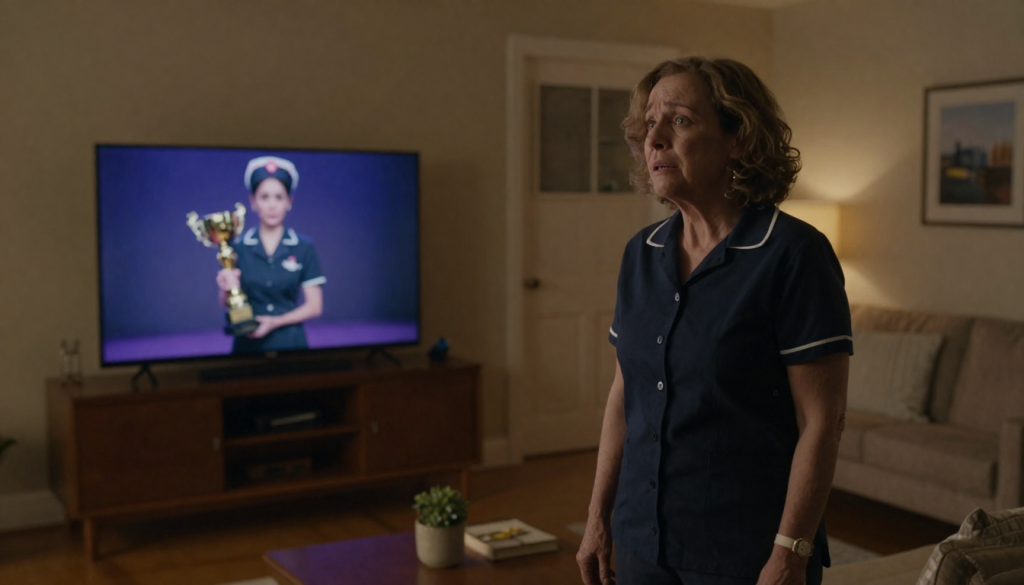
It was almost ten o’clock, right before the weather report, when the anchor man, that young fellow with the very white teeth and the graying temples, smiled at the camera and said they had a special story about someone making a difference right here in our own backyard.
“The annual St. Jude’s Healthcare Excellence awards were handed out downtown this afternoon,” he said, turning slightly toward the monitor behind his desk. “And this year’s Nurse of the Year winner is someone who spent her early years right here in our community, working her way up from the very bottom.”
A photograph came up on the screen.
It wasn’t a professional studio portrait.
It looked like someone had taken it with a phone in the middle of a brightly lit hallway with green walls and linoleum floors.
A young woman in a dark blue nursing tunic was standing by a mobile cart loaded down with boxes of sterile gloves, her hair pulled back into a neat knot at the base of her neck.
She was laughing at something someone off-camera had just said.
My fingers tightened on the fringe of the afghan until my knuckles turned the color of lard.
Same brown eyes.
Same stubborn curve to the jaw that she got from my grandmother, the one who walked three miles through the snow every morning just to stoke the furnace at the one-room schoolhouse.
“Clara Vance,” the anchor said, reading from the blue card in his hand. “A ten-thousand-dollar educational grant sponsored by the regional medical board.”
Then they cut to a live feed from the stage at the civic center.
There she was, standing behind a polished walnut podium with a heavy glass trophy shaped like an open book in her hands.
She looked older, of course, with fine lines around the corners of her eyes that hadn’t been there when she walked out my back door in the rain, but she still carried her shoulders the same way, straight and back like she was balancing a tray of water glasses on her head.
The anchor stepped up beside her with the microphone and asked her the usual question about who had helped her along the way when things were difficult.
“In a career like yours, starting out in community health aide work fourteen years ago,” he said, holding the black foam sphere near her chin, “most people talk about a mentor or a professor who gave them their first big break. Who was the person who really showed you what it took to stay in this field?”
Clara looked right into the black glass eye of the camera.
She didn’t hesitate the way people do when they are trying to think of something polite to say for the public.
She gave that little half-smile she always used when she knew she was right about something and she was just waiting for me to catch up.
“My mother taught me exactly who I…”
She stopped there for just a second, her voice dropping down an octave, steady and clear without a trace of hesitation in it.
“…never wanted to be.”
The studio lights behind her flickered once, that tiny vertical jump in the picture tube before the commercial for the Buick dealership came on with its big brass music and the voiceover about year-end clearance prices.
I sat there in the dark room with the television glow washing over my knees, watching the small gray motes of dust turn over and over in the light from the screen.
Nobody came to the door.
The wind wasn’t blowing hard enough to rattle the siding tonight, but I could hear the old oak tree by the driveway dropping its dry leaves one by one onto the roof of the Buick out in the drive, light and dry like handfuls of salt.
2 responses