
14 min read · 2,781 words
The tuna salad on the green plastic tray was still sitting in its little paper cup on Wednesday when I went in to empty the trash, exactly the way it had been sitting on Tuesday and the Monday before that.
Working third floor at Oakridge Manor means you get used to residents losing their appetites because the kitchen changes the gravy recipe or the weather turns humid or they just decide they are done with chewing.
Mrs. Norwood had been on third floor for nine months after her stroke, and her daughter Cynthia came by every single Tuesday and Thursday like clockwork, bringing sugar-free peppermints in a glass jar and a sweater she insisted her mother wear even when the radiators were clanking out steam.
I lifted the plastic lid off the tuna and didn’t even smell it because there was nothing to smell, just the crust forming on the edges of the bread where the butter had gone hard and yellow.
Cynthia was down in the lobby talking to the front desk about her billing statement when I carried the tray out into the hallway, my cart squeaking on the linoleum the way it always did when the left caster needed oiling.
“She’s just aging,” Cynthia had told me the week before, standing right there by the sink while I was changing the hand towels, her voice dropping into that smooth, practiced register people use when they want you to stop asking questions. “Her body is winding down, Brenda. She doesn’t need dinner tonight.”
That was the phrase she used every single time I mentioned the uneaten trays, like it was some kind of magic spell that made the food disappear without anyone having to touch a fork.
I dumped the untouched tuna into the garbage liner along with thirty-four other untouched tuna salads and chicken patties from rooms 301 through 332, my hands moving automatically because after eleven years in this wing you stop thinking about where the calories go and just start worrying about the smell.
Except Mrs. Norwood was not just aging in the ordinary way people wind down at eighty-two; she looked like someone was drawing the air out of her with a straw, her collarbones sticking out of her floral nightgown like two dry branches under tissue paper.
The facility cost four thousand eight hundred dollars a month, which management took out of an automatic bank draft every first of the month from an account with enough zeros to make the payroll clerk whistle, yet the woman in 314 looked like she had not seen a decent potato since the Carter administration.
My throat always felt tight when I went into that room, not because of the usual nursing home smells of bleach and floor wax, but because of the way Cynthia would stand behind her mother’s wheelchair and press her hands down hard on the rubber grips whenever the old lady tried to say something about her house on Maple Street.
“Mother is confused,” Cynthia would say, leaning over to fix the collar of that stupid sweater while Mrs. Norwood stared out the window at the gravel parking lot where the delivery vans parked. “She thinks we still live on the farm, Brenda. It is just the dementia talking.”
Last Friday morning the sun was coming through the blinds in bright, narrow stripes that lay across the linoleum like jail bars, and I went in early to change the sheets before physical therapy started at nine.
Mrs. Norwood was asleep, her breathing shallow and whistling through her nose like a dry pump handle, so I moved quietly around the metal frame so I wouldn’t wake her up before her sleeping pills wore off.
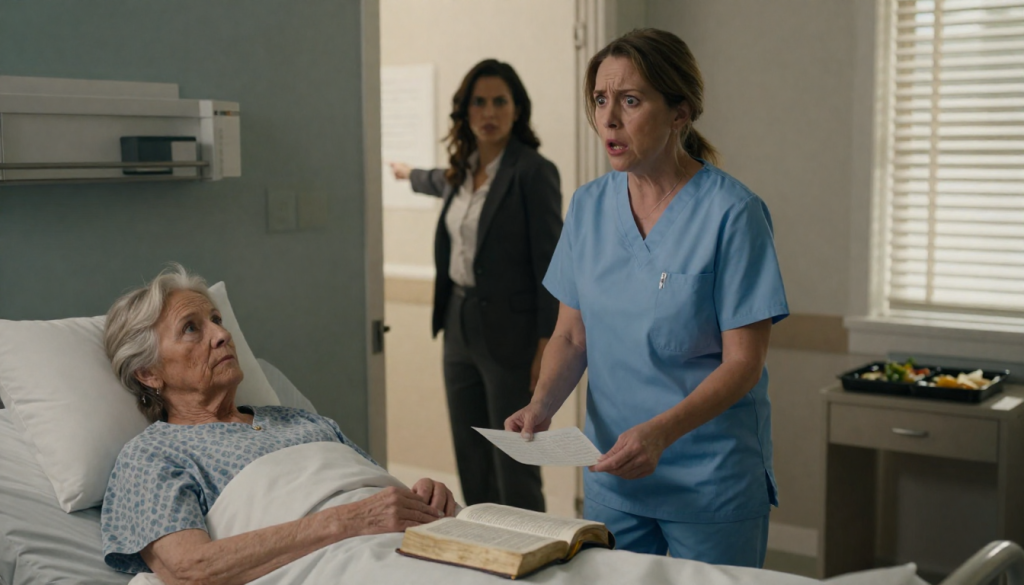
Her Bible was sitting on the nightstand right beside a half-empty cup of ginger ale that had gone flat three days ago, a big heavy black leather thing with gold edges that were starting to flake off onto the veneer.
I picked it up to wipe the circle of dried soda underneath it, and the book felt heavy, like it had something tucked inside the binding that didn’t belong in the Book of Psalms.
A piece of blue lined notebook paper slipped out from the ribbon marker as I set it down on the mattress, fluttering twice before it landed face-up among the creases of the floral bedspread.
It was Cynthia’s handwriting, neat and pointy like picket fences, with every *i* dotted with a small careful circle that you could spot from six feet away if you knew what you were looking at.
I didn’t mean to read it, or at least that is what I told myself while my fingers were already smoothing out the fold against my uniform pocket where I kept my pen and my spare pair of rubber gloves.
The top line started with a date from two weeks ago, followed by a list of names of local banks and title companies that didn’t make any sense until you got down to the middle of the page where she had written out a schedule.
Below the schedule, in the same sharp ink, were words that made the room go sideways for a second while the radiator hissed in the corner like an old cat.
If she stops eating by Sunday, the estate transfer will be signed under medical duress before the probate judge gets back from his cabin, and nobody will look twice at an old woman who gave up on food.
I stood there by the bed for what felt like ten minutes holding that little blue square of paper, listening to Mrs. Norwood wheeze and watching the dust motes float through the light from the parking lot.
Cynthia had written out the whole thing like a grocery list, right down to the name of the notary public she used for her real estate office down on Fourth Street and the exact hour the visiting doctor made his rounds on Tuesday mornings.
My first instinct was to drop it back into the Bible and pretend I was never in that room, because getting mixed up in family property fights is how you lose a job you’ve held for eleven years without a single write-up from the director.
“Brenda, are you done with those linens?” the floor nurse called out from the hallway, her sneakers squeaking past the door before I could shove the paper back under the ribbon.
I tucked it into my pocket right next to my spare rolls of tape, my fingers shaking so hard I dropped the ballpoint pen on the floor and had to crawl under the metal frame to fish it out from behind the oxygen tank.
When I stood back up, Mrs. Norwood’s pale blue eyes were wide open and fixed right on my face, not looking confused the way Cynthia always claimed, but looking at me with a kind of heavy, exhausted understanding that didn’t need any words at all.
She didn’t say anything, she just reached out one scrawny hand with skin the color of skim milk and touched my sleeve where the Oakridge Manor patch was sewn down with blue thread.
“She doesn’t bring soup anymore,” the old lady whispered, her voice sounding like dry leaves being dragged across a concrete sidewalk in November.
That was the only direct complaint I ever heard her make in nine months of carrying trays in and out of that room, and it stayed in my ears all the way down the service stairs while I went to punch out for my fifteen-minute break.
By noon I had the note sitting on my kitchen table over on Elm Street, flat under a heavy glass paperweight shaped like a lighthouse that my sister brought back from Traverse City three summers ago.
I stared at it while I ate my egg salad sandwich, trying to figure out how many other old women in third floor rooms were being starved out of their deeds while their kids sat in the lobby talking to the billing clerk about monthly deductions.
The facility director, Mr. Harrison, was a man who only cared about whether the state inspectors found any dust on the baseboards during their quarterly visits, and he hated paperwork more than he hated lazy aides.
If I went to him with a piece of notebook paper found in a resident’s personal property without a witness present, he would have fired me by one o’clock for rummaging through private books.
So I didn’t go to Harrison; I went straight to my cousin Terry, who works down at the county courthouse in the records department and knows every deed transfer between here and the state line since the Eisenhower administration.
Terry didn’t even look up from his computer screen when I laid the blue paper down beside his keyboard, his sleeves rolled up to his elbows and a stale cup of coffee sitting next to a pile of yellow folders.
“This is Cynthia Norwood,” Terry said after about twenty seconds of squinting through his bifocals at the handwriting and then at the signature block I’d copied out on a napkin. “She’s been trying to move that Maple Street property into her own LLC since the old man died back in twenty-one.”
He pulled up a digital file that showed the house was worth three hundred ten thousand dollars clear of any mortgage, sitting on two acres of timberland right down by the river where the black flies are terrible in June.
“The closing is scheduled for Monday morning at ten,” Terry added, clicking his mouse twice to open a scanned PDF of a quitclaim deed with Mrs. Norwood’s shaky signature already forged at the bottom in pencil, waiting to be inked over. “Cynthia filed the incompetency petition yesterday afternoon claiming her mother hasn’t recognized her own name in six weeks.”
I went back to Oakridge Manor for the evening shift with my pockets feeling heavier than they had any right to feel, every step on the asphalt sounding loud against the quiet of the parking lot.
Cynthia was already in the lobby when I walked through the sliding glass doors, sitting in the green vinyl armchair with a leather portfolio open on her lap and her car engine still idling out in the red-zone lane.
She didn’t look at me as I passed her desk, just kept tapping a silver pen against the margin of a blue legal folder while the receptionist talked on the phone about ordering more lemon-scented floor soap for the third floor.
I went straight to room 314 and found Mrs. Norwood staring out at the dusk, the dinner tray already resting on her lap with the plastic lid still sealed tight over a pile of overcooked noodles and brown gravy.
“She didn’t eat it,” I said softly, pulling the chair out from the corner and sitting down right where Cynthia usually parked her designer handbag during visiting hours.
Mrs. Norwood turned her head very slowly, her neck making a tiny clicking sound that made me want to look away, but I stayed right there with my hands folded in my lap.
“They take the keys on Monday,” the old lady said, her voice stronger than it had been that morning, like she had been saving up every ounce of air left in her lungs just for those five words.
I didn’t answer her with any of the cheerful nursing-home nonsense they train us to use during orientation, because there wasn’t any cheerful way to talk about a daughter who treats her own mother like a bad real estate investment.
Instead, I reached down and took the plastic lid off the green tray, lifting the bowl of noodles and setting it on the floor beside my boots so she could see the clean space underneath.
“Cynthia is downstairs,” I told her, keeping my voice low and flat so the hallway speaker wouldn’t pick it up through the transom above the door. “She brought the paperwork for the house.”
Mrs. Norwood didn’t blink, she just reached out and took hold of my thumb with her cold, dry fingers, squeezing with a lot more strength than I would have guessed was left in those bones.
“Tell her I want my soup,” she said, and then she let go and closed her eyes like she was done talking for the day.
When Cynthia came upstairs twenty minutes later carrying a fresh sweater she had bought on sale at Marshall’s, I was waiting right outside the doorway with the blue notebook paper folded twice in my pocket.
She stopped three feet short of room 314, her face tightening up around the mouth the way it always did when she saw me standing anywhere near her mother’s chart rack.
“You’re working late, Brenda,” she said, her voice dropping into that smooth, customer-service tone she used whenever she wanted someone to go away.
I didn’t move out of her way, just stood there with my hands in my pockets and looked down at her polished leather loafers that probably cost more than I made in two weeks of wiping trays.
“Your mother wants her soup,” I said, and watched the color drain right out from under her cheeks until she looked like she had been sleeping under the fluorescent lights for a month.
She didn’t say another word, just pushed past me into the room and let the door swing shut behind her with a soft, metallic click that didn’t latch all the way.
I stood in the hallway for a long time watching the light go gray through the wired glass of the fire exit, listening to the sound of Cynthia’s voice dropping into a sharp, low hum on the other side of the wood.
The investigators from the county sheriff’s department came by on Monday morning about twenty minutes before the title company was supposed to open its doors down on Fourth Street.
They didn’t use the front entrance with the automatic glass doors, they came in through the side staff exit near the laundry bins, two men in gray suits who didn’t look like they had ever tasted hospital tuna in their lives.
I was at the nurse’s station filing incident reports when they walked past my desk without slowing down, heading straight for the third-floor elevator with a folder tucked under one arm that looked thick enough to stop a bullet.
Mr. Harrison came out of his office ten minutes later looking like someone had dropped a wet sponge on his new shoes, his face red and his tie crooked over his button-down shirt.
He didn’t look at me when he walked down the hall toward room 314, and neither did the two officers when they came back down twenty minutes later with Cynthia walking between them with her head down and her leather portfolio clutched against her ribs.
She didn’t look at my desk either, her loafers clicking fast against the linoleum until the fire doors swung shut behind them with a heavy thud that rattled the plastic cups on the water cooler.
By Tuesday afternoon they had moved Mrs. Norwood down to room 302 where the window looks out over the maple trees instead of the asphalt parking lot, and the afternoon sun comes in through the glass without any bars on it.
I went in around three to check her IV line and found a small ceramic bowl of chicken noodle soup sitting on her tray instead of the green plastic box with the tuna salad.
She was sitting up in bed with her glasses on, reading a large-print edition of the Gospels that didn’t have any notes tucked into the binding, her hands resting quietly over the yellow ribbon marker.
“The soup is better today,” she said without looking up from the page, her voice sounding thin and dry like paper rustling in an empty room.
I didn’t say anything back to her because there wasn’t anything left to explain, so I just adjusted her blanket around her shoulders and went back out to the hallway to finish my shift.
The tray was still sitting there on the table when I came back for my rounds at five, completely empty except for three small saltine crackers that had been broken in half and left in a neat little pile right in the middle of the plate.
2 responses