
9 min read · 1,661 words
I got the whole thing wrong for eighteen years, and that is a hard pill to swallow when you are seventy-two and running out of time to fix your own mistakes.
Every single July 4th since Clark died, right around eight in the morning before the valley got too hot, a battered pickup truck would idle down our gravel lane. A wicker basket of fresh peaches and a white envelope containing a $150 meat certificate from the butcher down in town would land on my front porch. There was never a card. There was never a return address. For nearly two decades, I just shook my head and told myself it was some kind of stubborn delivery mix-up from the grocery store that nobody ever bothered to straighten out.
I figured it was a clerical error. I am an old woman who grew up in the foothills where things get lost in the shuffle all the time, so I let it go.
Clark had been gone a long time. We lived forty-two years in that house, thirty-one of them quiet, the last eleven of them quiet in a different, heavier way after his heart gave out in the garden. He was a quiet man who kept his business behind his teeth. He smelled like motor oil and cheap pipe tobacco, and he wore the same gray work jacket until the elbows wore through to the lining.
I thought I knew every inch of that man. I thought I knew every secret he ever kept, which mostly amounted to how much he spent on fishing tackle behind my back or whether he actually took his blood pressure pills when my back was turned.
Three weeks ago, the heat was already shimmering off the asphalt by nine in the morning when the mail carrier dropped off a certified envelope. It didn’t look like much. It had a return stamp from a local notary office on Main Street, plain white paper, the kind of official business that usually meant a tax assessment or a notice about the county road maintenance.
I sat down at the kitchen table with a cup of black coffee and tore it open with my thumb.
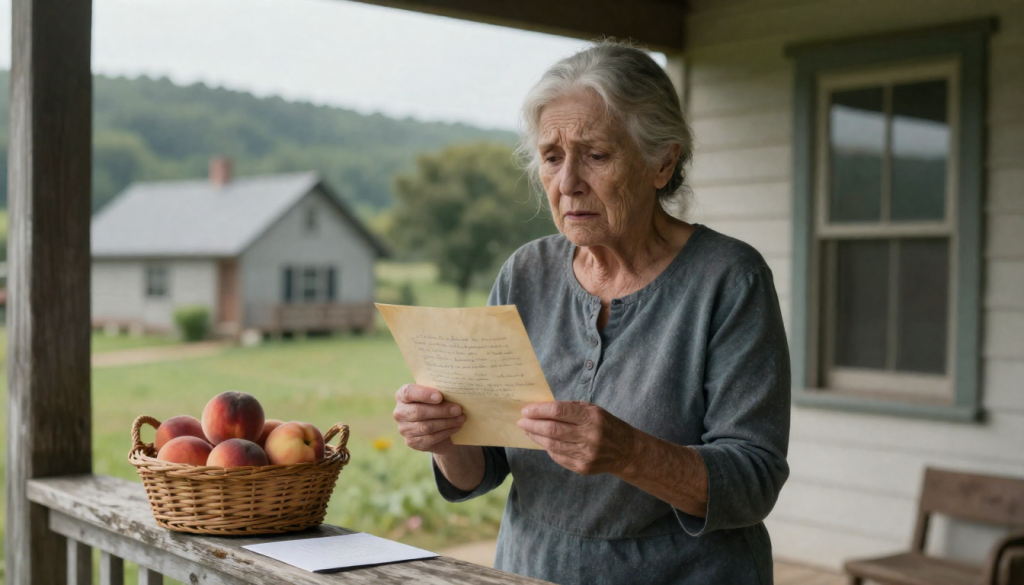
Inside was a single folded sheet of lined yellow tablet paper, the kind with the red margin that kids use in school, yellowed with age and folded into quarters. Along with it came a brief typed note on official notary letterhead stating that Otis Gentry had passed away quietly in his sleep down at the county nursing home two days prior.
My breath hitched in my throat as my eyes hit the handwriting on the yellow paper. It wasn’t the notary’s typing. It was handwriting I hadn’t seen in years, scrawled in blue ink that had faded to the color of a robin’s egg.
“Clark paid off my $44,000 garage debt when the shop burned down,” the letter began.
I had to read the line three times because my brain refused to line the words up with any reality I understood. Clark made twelve dollars an hour at the lumber mill for thirty years. We never had forty-four thousand dollars to our names. We drove a truck with three different colored fenders and patched our own roof with tar paper when the autumn rains started leaking through the ceiling.
The letter went on, written by Otis back in the summer of 2007, just a few months after Clark was buried.
“He made me swear never to tell you while he lived,” Otis wrote, the letters jagged and leaning hard to the right like he was writing in a hurry on the hood of a car. “He made me promise that as long as my family breathed, you’d never hunger in July. He said you always loved those peaches from the orchard up by the ridge, and he knew you wouldn’t take charity if I handed it to you right. So we made a deal.”
I dropped the paper onto the formica table. The coffee in my mug was stone cold, but my face felt hot, burning all the way down to my neck.
Forty-four thousand dollars. That was the price of Otis’s garage going up in smoke when a faulty wood stove caught the back wall on a freezing January night. I remembered when that happened. Clark had come home smelling of soot and cheap whiskey, looking older than his years, muttering about how some folks just had no luck at all.
“Poor Otis lost everything,” Clark had said across the kitchen table that night, staring down at his plate of meatloaf like he was carrying the weight of the county on his shoulders. “Just wiped out clean.”
I had nodded and told him it was a terrible shame, and then I went back to worrying about whether we could afford the new alternator for the truck.
I didn’t know. I honestly didn’t have the first clue.
The next day, I drove my old Buick down to the county nursing home to talk to whoever was left of Otis’s people. His daughter Brenda runs the flower shop now, a sharp-eyed woman with silver-streaked hair who looks entirely too much like her daddy used to look when he was dodging a bill.
She was standing behind the counter wrapping a bundle of white lilies when I walked in, the little brass bell above the door chiming like a church bell in an empty valley.
She looked up, saw my face, and stopped her hands dead in the tissue paper.
“You got the letter then,” she said. Her voice wasn’t warm, but it wasn’t mean either. It was just flat, heavy with something she had been carrying around for a long time.
“I got it, Brenda,” I said, my voice sounding thin even to my own ears. “I need you to tell me how he did it. Clark didn’t have that kind of money. We lived paycheck to paycheck. You know that. Everyone in this town knows that.”
Brenda let out a long breath, untied the green ribbon from around her fingers, and laid the scissors down on the counter with a sharp click.
“He didn’t have cash, Mrs. Miller,” she said, leaning her palms against the cool wood of the counter and looking right through me. “Everybody in this countythought the Millers were poor as church mice because Clark liked it that way. But he owned forty acres of timber up on the north ridge free and clear. He signed the deed over to the bank as collateral so daddy could get the loan to rebuild.”
My knees felt weak, and I had to reach out and steady myself against a display rack of plastic flower pots. Forty acres of timber. That land had been in Clark’s family since the depression. It was the only real inheritance he had left in the world, the one thing he swore he would never let go of because his daddy planted those pine trees by hand during the Eisenhower administration.
“He did that for your daddy?” I whispered.
“He did it so nobody would ever know,” Brenda said, her voice dropping to a harsh whisper across the counter. “Daddy tried to pay him back every month, bit by bit. But Clark wouldn’t take a dime of cash after the papers were signed. He told daddy, ‘Just make sure she gets a basket of peaches and a meat certificate every July 4th as long as you’re breathing. That’s all the interest I want on this loan.’”
I stood there in the middle of that little flower shop with the smell of damp stems and funeral lilies all around me, and the world just tilted on its axis.
Clark hadn’t been clumsy with money. He hadn’t been careless. He had tradedour entire future away in secret on a cold winter night, and he never let out a single word of complaint about it for the rest of his days. He let me pinch pennies at the grocery store. He let me complain about the price of beef and the cost of heating oil, all while knowing that forty acres of our timber were working behind the scenes to keep another man’s roof over his head.
“He was a stubborn old cuss,” Brenda said softly, reaching out to touch my knuckles where they gripped the edge of the counter. “And so are you. That’s why he never told you. He knew you’d raise holy hell about the land.”
I drove home with the windows rolled down, letting the hot July air blow across my face because the cab of the Buick felt like an oven.
When I pulled into the gravel drive, I looked up at the north ridge where the green canopy of Clark’s pine trees met the pale blue sky. They looked just the same as they always had, swaying slow and heavy in the afternoon breeze, beautiful and green and entirely gone.
The wicker basket from the week before was still sitting on the porch table, half-full of soft red peaches that were just starting to turn.
I walked up the wooden steps, picked up one of the peaches, and turned it over in my hand. For eighteen years I thought those peaches were a mistake, a stray delivery from a grocery store clerk who couldn’t get his route straight. Now I knew the truth, and it felt heavier than any grief I had carried for the man who bought them.
Clark didn’t leave me with nothing. He left me with a lie of poverty that he carried all the way to his grave, just so another family could survive.
4 responses