I know you are going to hate me when you hear this, and honestly I do not blame you at all because I was the main one wasting six years of my life chasing a ghost my father left behind in a cherrywood desk.
Arthur had been gone three weeks when I finally got around to clearing out the roll-top desk in the back study. He was a quiet man, the kind of carpenter who measured twice and spoke once, and he left behind a house that smelled eternally of linseed oil and stale Folgers coffee. I found the key tucked way back in the underside of the pencil drawer, wedged behind a divider that had probably been stuck there since nineteen-eighty-four. It was heavy, dark brass with a square head and a notch cut out of the side that looked like a little staircase.
I sat right there on the braided rug with the dust motes floating in the afternoon sun and turned that piece of metal over in my palm.
Arthur never talked about anything that mattered. He was my father, or at least he was the only man who had ever buttered my toast and signed my report cards, but he kept his inner life bolted shut behind teeth that stayed clenched unless he was ordering coffee or telling the hardware store clerk how many four-inch screws he needed.
“What are you looking at so hard?” my husband, Paul, had asked me that very first evening when I brought the key into the kitchen.
“I do not know,” I told him, dropping it onto the Formica counter with a dull clink. “It came out of the bottom of his desk. It has to go to something.”
That was the start of it. For seventy-two months, that little piece of brass ran my life.
I started with every door in the house because that seemed like the logical place a carpenter would hide his private business. I tried it in the cellar padlock. I tried it in the deadbolt on the back screen door that had been painted over seven times with forest green enamel. I tried it in the lock of the cedar chest at the foot of his bed where he kept my mother’s old wool sweaters. Nothing fit. The key went in halfway and hit a dead stop every single time, stubborn as Arthur himself.
Paul got sick of watching me crawl around on my hands and knees with a flashlight by the third year. He told me to throw the thing in the junk drawer and forget about it.
“Your dad was just an old pack rat, Clara,” Paul said while he was buttering his toast one morning before heading down to the county road department. “He probably saved an old skeleton key from some locker at the high school fifty years ago.”
“No,” I said, staring down at my coffee. “He kept it separate. It was taped to the underside of the divider, Paul. You do not tape trash to wood.”
The thing is, Arthur was methodical. He did not do things by accident. If he hid a key where nobody would find it unless they dismantled the furniture, he meant for it to stay hidden until he was safely under the sod at Greenlawn Cemetery. That thought should have scared me, but mostly it just made me stubborn.
By year five, I was driving out to every old bank building in three counties just to ask the tellers if their safety deposit boxes matched the cut of my brass key. I looked ridiculous standing at those marble counters with my purse strap digging into my shoulder while some twenty-year-old kid in a tie told me their system had been updated in ninety-two and my key was too old to fit anything they had in the vault.
Paul stopped asking about it around year four. We drifted into that quiet sort of marriage where you share the electric bill and the morning weather report, but the real rooms in your head are locked up tight. We did not fight much anymore. Fighting takes a kind of energy we had both spent on other things.
The break came on a rainy Tuesday in November. I was back in the study because the house was quiet and Paul was down at the union hall for an evening meeting.
I took a flashlight and slid clear underneath the bottom of the old cherrywood desk, lying flat on my back on the rug with my nose against the underside of the pigeonholes. That was when I saw the second thing. Arthur had carved a tiny set of numbers into the raw pine of the desk floor right where the shadow of the modesty panel hit the wall. It was not a date. It was a set of coordinates, or what looked like a locker number and a branch name down on 4th Street.
I did not even wait for Paul to get home. I grabbed my coat, the key, and my car keys, and I drove downtown through the freezing drizzle while the windshield wipers squeaked back and forth across the glass like old shoes.
The old savings and loan building on 4th Street had been boarded up since the oil bust, but the brick safety deposit annex around the back was still run by a tiny regional bank that kept three rows of private boxes in a concrete room behind the tellers. The manager was a tired-looking woman with gray hair pinned up in a messy bun who looked like she wanted to go home to her dinner.
“This key has to be verified by appointment,” she told me, her fingers resting on the top of her ledger.
I laid the brass key down on her wooden desktop right beside her pen cup. “It belonged to Arthur Vance. He passed in October. I am his daughter.”
She looked down at the key. Then she looked up at my face, and her eyes softened in a way that made my throat tighten right up. She did not ask for another form or a death certificate. She just stood up, picked a heavy iron ring off the hook behind her desk, and motioned for me to follow her down the concrete hall.
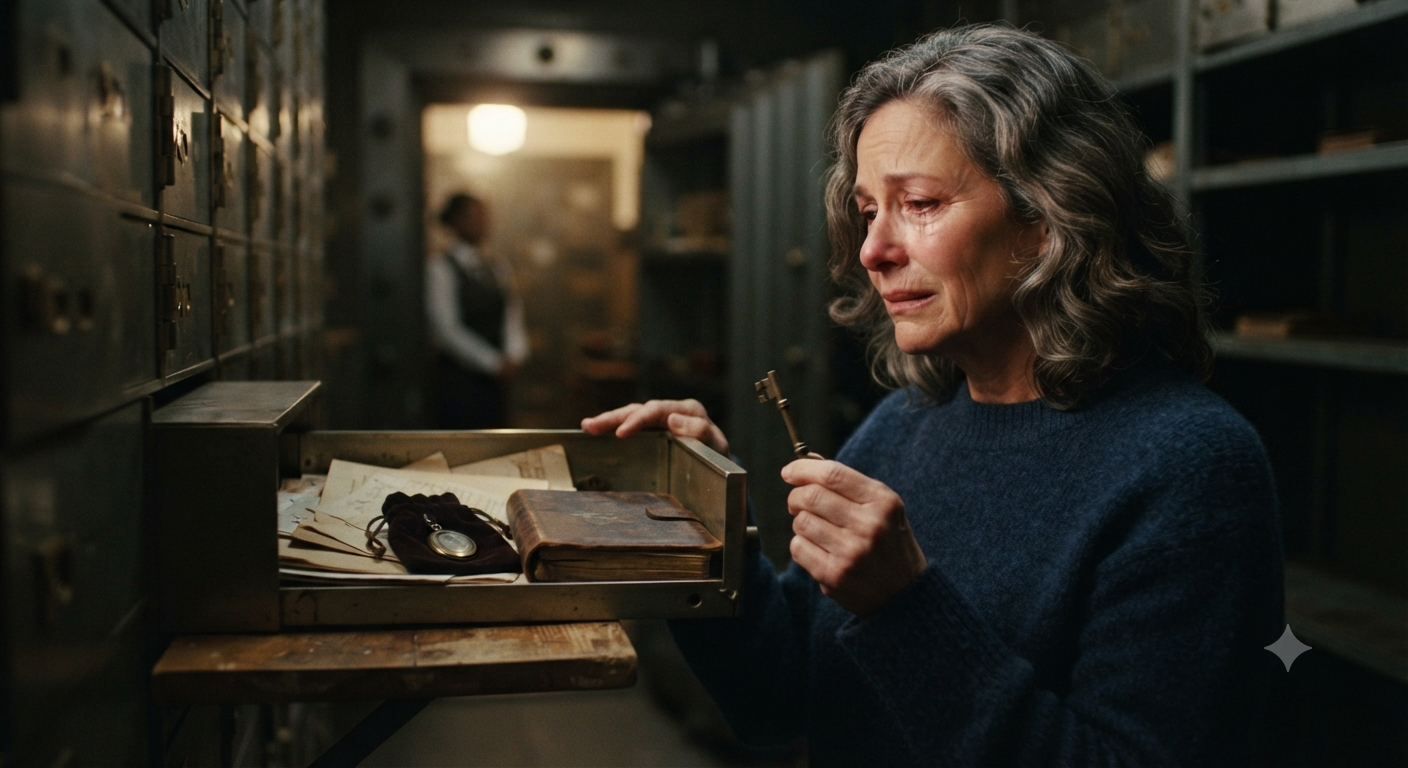
The box was number 114, down near the floor where the air smelled of cold iron and old paper.
The key turned on the first try. It did not catch or grind. It slid all the way home with a heavy, satisfying click that echoed off the concrete walls like a pistol shot in an empty church.
Inside the small tin box, there was no money, no jewelry, and no deeds to land in Oklahoma. There was only a single, heavy envelope made of cream-colored linen paper with my name written across the front in Arthur’s careful, block-letter carpenter handwriting.
I sat down right there on the linoleum floor of the vault room with my coat soaked from the rain and the fluorescent light buzzing overhead, and I pulled the flap open.
There was a folded sheet of lined notebook paper inside, covered in that familiar blue ink that always smelled slightly of pipe tobacco.
“My dear Clara,” it began.
I read the first three lines three times because my brain refused to line the words up right on the page.
“I am not your biological father. But I was always yours. I found you in a cardboard box on the steps of St. Jude’s on a freezing night in October of seventy-four. I took you home because your mother never came back for you, and by morning I knew I could never give you back either. I am so glad I did. The key is to my heart.”
My hands started shaking so hard I nearly dropped the paper onto the dirty floor.
I sat there in that cold little room for a long time while the bank manager waited outside the heavy steel door, and the only sound was the hum of the fluorescent light overhead. Arthur never said a word about it in forty-two years. He just woke up every morning, went down to the lumber yard, built houses for people who could afford them, and came home to the little girl he found in a box on a church step.
When I finally walked out to the car, the rain had stopped and the clouds were breaking up over the tops of the brick storefronts on Main Street.
Paul was sitting in the kitchen when I got home, reading the paper with his boots kicked off near the heater. He looked up when the front door clicked shut, seeing the paper clutched in my hand and the way my face had gone completely still.
“Well?” he asked, putting his glasses down on the table. “Did it fit anything?”
I laid the brass key right on top of the sports section, beside his coffee mug, and did not say a word for a long, quiet minute while the kitchen clock ticked against the wall.
“It wasn’t about a lock, Paul,” I told him, and for the first time in six years, the tightness in my chest finally let go.