
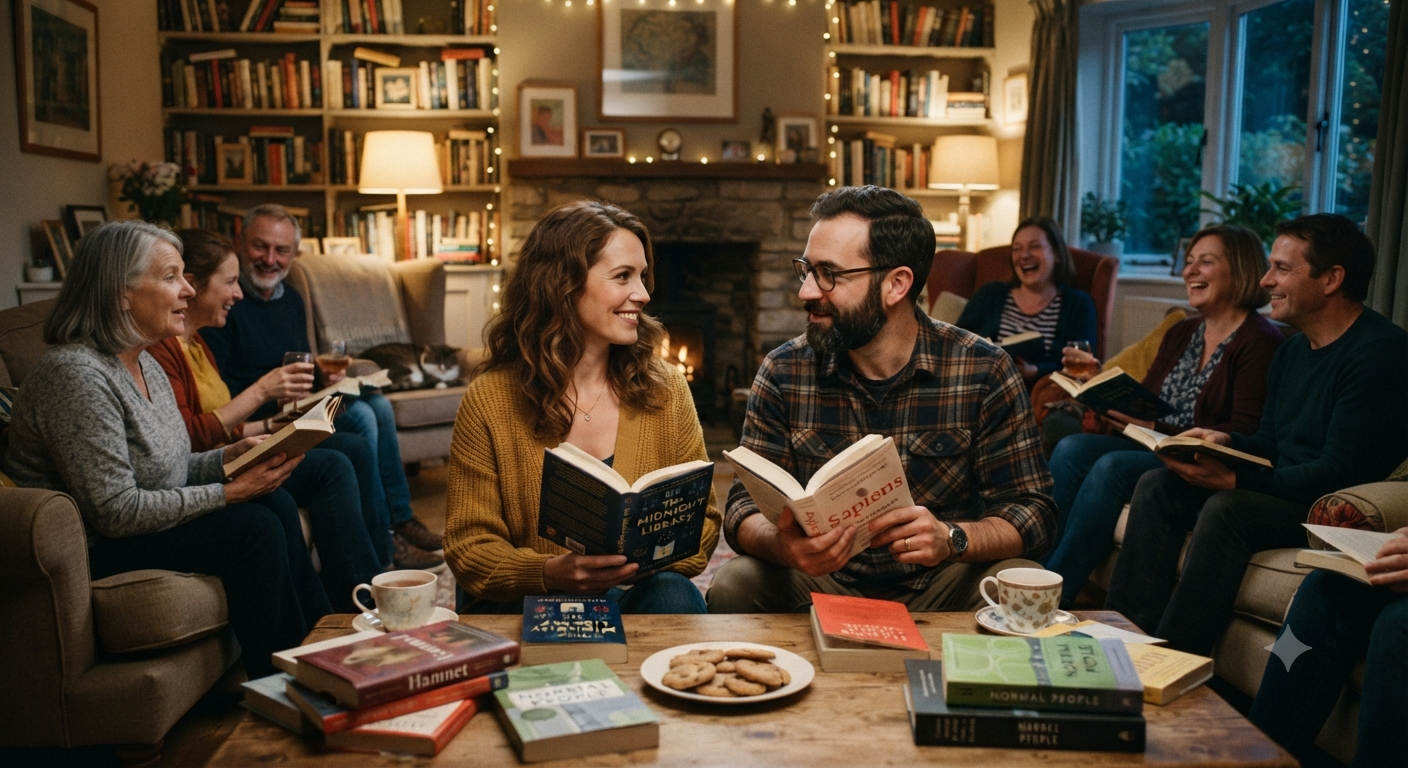
The green paperback book sat on my kitchen counter for three solid weeks, smelling faintly of the thrift store basement where Clara had dug it up. It had a badly glued spine and a cover illustration of a weeping willow that made me want to throw it right into the trash bin. I did not want to read it. I certainly did not want to discuss it with four women I barely tolerated in a church basement on a rainy Thursday afternoon.
Clara had left it by my toaster after Sunday potluck with a little yellow sticky note attached to the title page.
“You are going to despise every word,” she had written in her spidery, impatient hand. “Be there at two.”
I spent twenty minutes staring at that note while the coffee maker finished spitting out its last dregs. My husband had passed two years before, and my Sundays had finally settled into a quiet, predictable rhythm where nobody told me where to be or what to read. But Clara was eighty-one years old and possessed the kind of stubborn endurance that could outlast a brick wall. If I stayed home, she would show up on my porch with a casserole dish and a list of grievances that would take hours to untangle.
So I shoved the wretched thing into my canvas tote bag and drove my old Ford down to St. Jude’s parish hall with the heater rattling against my shins.
The basement smelled of damp carpet and instant coffee that had been sitting on the burner since morning. Only three people were there when I walked in, shaking the gray drizzle off my coat. Clara was sitting near the radiator, looking entirely too pleased with herself, flanked by Martha and Brenda, who were already arguing about the price of winter cabbage.
“You’re late, Lucille,” Clara said without looking up from her knitting.
“I had traffic on the bridge,” I said, sliding into the folding chair across from her.
“There hasn’t been traffic on that bridge since nineteen-eighty-two,” she muttered, dropping a stitch.
Three weeks later.
The book was worse than I expected. It was four hundred pages of purple prose about a nineteenth-century apothecary who spent three chapters describing the texture of moss. I had marked up the margins with angry little checkmarks in red pen just so I could have something to complain about.
When the door of the parish hall creaked open twenty minutes past the hour, I didn’t even look up from my coffee cup.
“Sorry I missed the turn,” a man’s voice said from the doorway. “The gravel was slick.”
I looked up because the voice didn’t belong to any of the regular husbands who occasionally got roped into driving. A man in a faded canvas jacket and wire-rimmed glasses was standing there, holding a copy of the very same green paperback with its spine already broken clean in half. He looked like he’d rather be hauling lumber in a hailstorm than standing in a church basement.
“Take a seat, Dennis,” Clara said, her needles clicking away like a pair of tiny scissors. “Lucille here was just about to tell us why chapter four made her want to drive her car into a ditch.”
Dennis looked right at me, and instead of the polite nod I was expecting, he let out a short, dry laugh.
“Chapter four?” he said, pulling out the chair directly across the wobbly table from mine. “I threw the thing against the wall halfway through chapter two. The protagonist is an absolute idiot.”
I felt my eyebrows go up. For three weeks I had listened to Martha talk about the “deep spiritual symbolism” of the moss.
“Thank you,” I said, leaning forward. “Someone finally said it. The man spends twelve pages talking about ferns while his wife is literally starving in the kitchen.”
“And the dialogue,” he added, shaking his head. “Nobody in the history of the English language has ever spoken like that.”
“Not even in the eighteen-hundreds,” I agreed.
We spent the next hour ignoring the rest of the group and tearing that stupid book to shreds. It wasn’t polite literary discourse. It was a mutual venting session between two people who had been dragged out of their houses on a miserable afternoon and wanted nothing more than to go home. By the time Clara finally called an end to the meeting, my face actually hurt from laughing.
Dennis walked me out to my Ford through the spitting rain. He didn’t offer to hold an umbrella because neither of us had one.
“Are you coming back next month?” he asked, wiping the water off his glasses with the hem of his canvas jacket.
“Only if Clara picks something even worse,” I said, turning the key in the ignition until the engine finally caught.
“That’s a promise,” he said. “I’ve got a whole shelf of terrible history books from my uncle’s estate.”
Three months later.
We were sitting in my kitchen eating cold meatloaf when the front doorbell rang. It wasn’t a delivery driver or the mailman. It was Clara, standing on the porch with her raincoat dripping onto the welcome mat and a brown paper bag under her arm.
I opened the door and let her in before she could catch a chill.
“You two have been dragging your feet,” she said, stomping her sensible black shoes on the linoleum.
“We’re taking our time, Clara,” I said, handing her a mug of hot instant coffee. “Dennis has a garden to get in.”
“He’s fifty-two years old, Lucille. He knows how to plant tomatoes in his sleep.” She set the brown paper bag down right next to the salt shaker. “Open it.”
I looked at Dennis, who was leaning against the refrigerator with his arms crossed, a half-smile tugging at the corner of his mouth. I reached into the bag and pulled out a small, heavy silver frame with a photograph inside that I hadn’t known existed. It was taken outside the church basement on that first rainy Thursday, back when I thought Dennis was just another annoying distraction. We were both laughing at something Clara had yelled from the doorway.
“Why do you have this?” I asked, my thumb tracing the edge of the metal.
“Because I’m old and I’ve got nothing better to do than watch people trip over their own feet,” Clara said, blowing on the surface of her coffee.
She stood up, buttoned her raincoat back to her chin, and picked up her empty mug.
“I knew you’d hate the book,” she said at the front door, pausing with her hand on the knob. “I also knew you’d love him. Most people take ten years to figure out what’s right in front of their face. Took you three months, which is not bad for a beginner.”
Before I could think of a sharp enough comeback, she pulled the door shut behind her with a crisp, decisive click.
Dennis walked over, looked down at the silver frame in my hands, and let out that same dry laugh from the church basement.
“She’s something else,” he said softly.
“She’s a menace,” I said, but I didn’t put the frame down.
“You want some more coffee?” he asked.
“Only if we don’t talk about nineteenth-century literature,” I said.
“Deal.”