My coffee cup was still lukewarm and half-full on the side table when I grabbed my car keys off the brass hook by the back door. I had lived in Oelwein for sixty-two years, and most days the town moved so slow you could hear the corn growing out in the bottoms. But on Tuesday mornings I drove down past the grain elevator just to check the mail at the small post office box on Walnut Street. That was how I ended up parking my Buick right across from the old brick depot on 3rd Avenue.
Dale was already sitting there. He always sat there. The green wooden bench had been repainted three times since nineteen-ninety-two, but the slats were sagging right in the middle from the weight of him. I didn’t mean to stop my car, but the engine sputtered once and died right by the curb like it had a mind of its own. I killed the ignition and watched him through the dusty windshield.
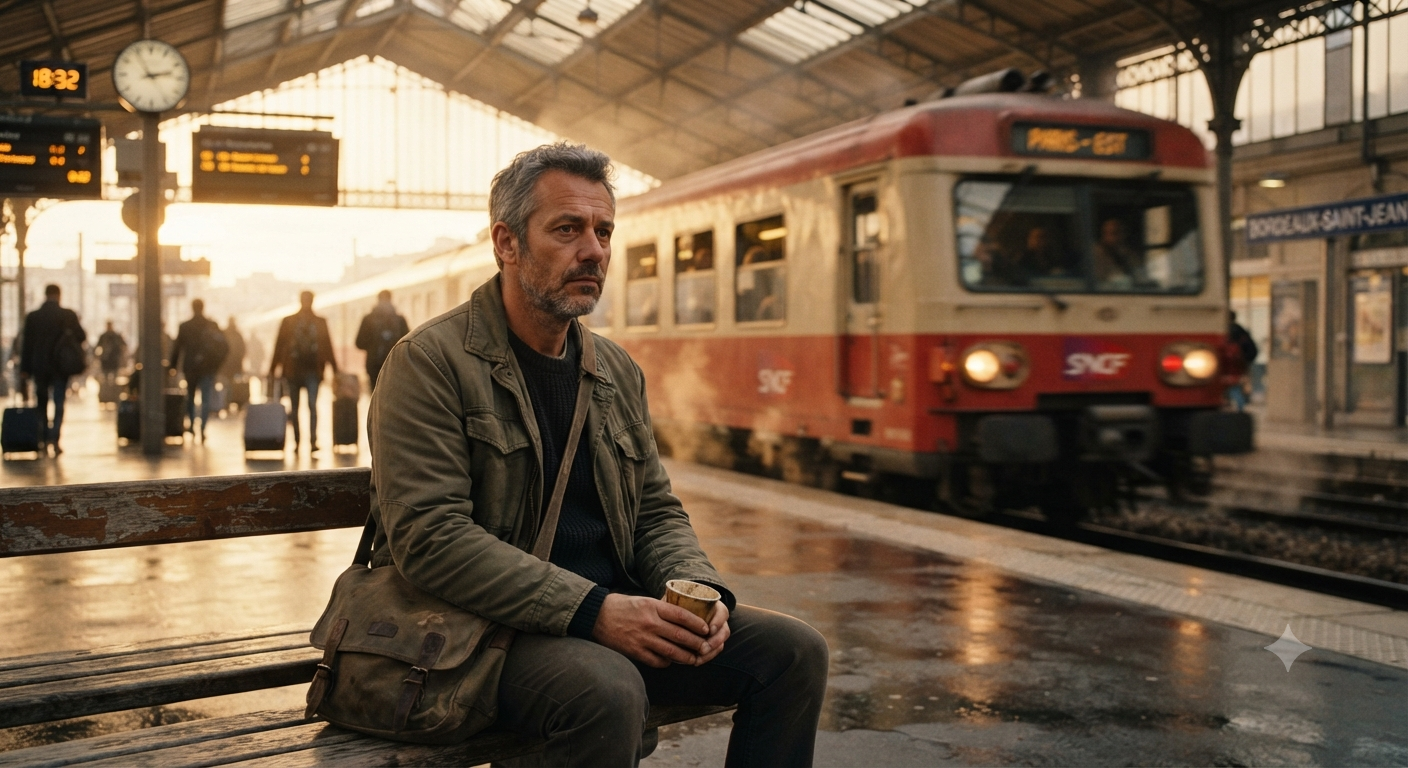
He had his canvas travel bag sitting right between his boots. It was the same bag he carried back when the Rock Island line still ran passenger cars through Fayette County before they pulled the rails up. The seven-fourteen passenger local had stopped running three decades ago, but Dale didn’t seem to notice. He just sat there with his hands resting flat on his knees, staring straight down the empty iron track where the weeds were growing up through the gravel.
I got out of the car because the engine wouldn’t turn over again right away. I walked across the cinders and the grit crunched loud under the soles of my work shoes. Dale didn’t look up until I was standing right beside the bench. His eyes were milky around the edges like old marbles, but when he focused on me, there was still a sharp little spark in the middle of them.
“You’re missing the mail pickup, Martha,” he said. His voice sounded like dry corn husks rubbing together in a November wind.
“The Buick’s acting up again, Dale,” I told him, keeping my hands tucked into the pockets of my jacket so he wouldn’t see them shaking from the damp morning air. “Same starter problem I had back in the winter.”
He nodded slow, like he was solving a complicated math problem in his head. “She’s just tired. Everything gets tired after a while if you run it too hard.”
That was the thing about Dale. People in town whispered that he had lost his faculties after the wreck back in the fall of ninety-four, but I knew better. He hadn’t lost anything. He had just locked himself inside one specific room in his memory and thrown the key out the window.
“You can’t sit out here all day,” I said, pointing down the track toward the empty horizon where the rails just ended in a pile of rusted spikes. “The sun’s coming up over the grain silos and it’s going to be ninety degrees by noon.”
Dale reached down and smoothed the fabric of his canvas bag with a thumb that had been smashed by a tractor hitch back when Eisenhower was in office. “She’s just running a little behind schedule,” he said, and he said it so calm and normal that it sent a cold shiver right up the back of my neck. “There was a washout near Wadena. There’s always a washout this time of year.”
I sat down on the other end of the green bench. The wood was rough against the seat of my slacks, and it smelled of old linseed oil and rain. I didn’t have anywhere I needed to be by nine-thirty. My garden was weeded, and the bread was already baked and cooling on the wire rack back home.
“Mary ain’t on that train, Dale,” I said quietly. I didn’t want to say it, but someone had to break the glass.
He didn’t flinch. He didn’t even blink. He just stared harder at the empty rails. “I know where she is,” he whispered. “She was in the third coach back. The green one with the cracked window by the restroom. I was supposed to be holding her hand when we cleared the junction. I stayed behind to settle the lumber bill at the mill. That four minutes cost me fifty-four miles.”
The silence between us got heavy then. A red-winged blackbird landed on the telegraph wire above the platform and started making that sharp metallic clicking noise it makes. I looked at Dale’s profile. His jawline was sharp as a hatchet, even at eighty-one years old, and he had a little white scar right below his left ear where he’d caught a stray staple from the wire stretcher back in sixty-eight.
“You missed her by thirty years,” I said, and my voice sounded rougher than I meant it to.
“Time don’t mean a damn thing when you’re standing still,” Dale said. He pulled a silver pocket watch out of his vest pocket. The crystal was missing and the hands were rusted solid at seven-fourteen. He didn’t flip it open to check the time. He just held it in his palm like it was a smooth river stone he liked the feel of. “You remember that summer we helped my daddy rebuild the barn roof? You brought out that sugar pie around three in the afternoon.”
I swallowed hard because I did remember. I remembered the smell of fresh cedar and sweat and how the sky looked bruised purple right before the July squall hit us. “I remember,” I said.
“Mary loved that pie,” he said, and for a second his voice cracked just enough to let the thirty years of grief spill out into the open air between us. “She told me she was going up to visit her sister in Dubuque for three days. Just three days to help with the new baby. She never even unpacked her small valise.”
I didn’t move. I kept my eyes fixed on an old oil stain on the railroad tie right beneath my left boot. “Dale, you’re punishing yourself because you didn’t die with her.”
He turned his head then, and those old blue eyes looked right through me like I was made of window glass. “I ain’t punishing nobody, Martha. I’m just keeping my word. I told her I’d meet her at the station when she got back from Dubuque. You don’t break a promise to your wife just because the company stopped running the tracks.”
The sun hit the top of the grain elevator and the tin roof flashed so bright it hurt to look at. A pickup truck went rattling down Walnut Street, the muffler dragging a little bit and throwing up a gray tail of dust that drifted across the old gravel lot. Neither of us stood up.
“The station master’s been gone twenty years, Dale,” I said after a minute. “The building’s just rotting wood and mice now.”
“I don’t need a station master,” he said softly. He reached out and set his hand right beside mine on the green bench. His skin felt like old parchment paper over dry sticks, warm from the sun. “I just need the train to blow its whistle one more time so I can tell her I’m sorry I wasn’t on it.”
We sat there together while the shadow of the water tower shifted six inches to the east. Nobody else came by. Oelwein was a quiet town on a Tuesday morning, and most folks had enough ghosts of their own without coming down to the tracks to look at Dale’s.
After a long time, he reached into his shirt pocket and pulled out a stick of peppermint gum wrapped in silver foil. He peeled it slow and broke it in half, offering the smaller piece to me on the flat of his palm.
“Here,” he said. “You always liked these when we were waiting for the Friday night picture show.”
I took it from him. The peppermint was stale and sharp, but I chewed it slow because the taste of it brought back the smell of the old Rexall soda fountain like it was yesterday. Dale chewed his half and stared back out toward the empty iron rails where the weeds were blowing in the hot summer wind.
We didn’t talk anymore after that. We just sat side by side on that old sagging bench while the morning burned off into a heavy, quiet noon. I knew the Buick would start up if I turned the key again, but I didn’t reach for my keys. I just kept chewing that old piece of peppermint and waited with him for a train that I knew was never coming down the line.