The grease on the linoleum floor behind the counter at Miller’s Diner always stayed a little tacky no matter how many times old Arlene scrubbed it with Pine-Sol. I reckon forty years of bacon fat and steam just gets into the grain of the tile and stays there, kind of like how certain habits get into a family until you can’t scrub them out either. I spent twenty-four years working that register, wiping down tables, and watching the mill town outside the window slowly turn from a place where people built things into a place where people just waited around for things to close down.
My niece Corinne started coming in about three years ago, right around the time she married a man named Dale who had big ideas about an auto body shop up on Route 9. Corinne was thirty-one back then, with hair the color of a dried chestnut and eyes that looked like she was always trying to remember if she left the iron plugged in. She’d walk in every single afternoon right around two-thirty, right after her shift at the county records office, and she’d slide into booth four. That was her booth. Nobody else sat there if Corinne was coming in, because even the regulars knew that booth belonged to the quiet girl who didn’t want to talk to anybody.
She’d order the exact same thing every single day without even looking at the laminated menu. Black coffee and a grilled cheese sandwich with pickles tucked neatly on the side of the chipped ceramic plate. The boy working the lunch shift then was Leo, a quiet kid with shoulders like a draft horse and hands that looked like he spent his weekends tearing down engine blocks, which he did. Leo didn’t talk much. He’d bring her order, set it down without a word, and walk away. Three whole years of that. Fifty times a month, maybe more, and I don’t think they exchanged ten sentences between them the entire first year.
I used to watch her from behind the counter while I was wiping down salt shakers or refilling sugar caddies. You get to know a person’s rhythm after a while. You see the way their shoulders drop when they push open the heavy glass door, or the way their fingers tap against the Formica tabletop. Corinne’s fingers were always tapping. A little double-tap, then a pause, then three quick ones. That was her rhythm when Dale was keeping her up half the night with his endless talk about getting a business loan or buying another piece of rusted-out machinery that was supposed to turn their luck around.
Dale wasn’t a mean drunk or anything loud like that. He was worse. He was the kind of quiet, stubborn man who could convince a woman to hand over her grandmother’s savings bond because the bank didn’t understand his vision. I saw Corinne sign over her own paycheck endorsement more than once right there in booth four while Leo stood by with the check pad like a ghost. I wanted to walk over there and say something. I wanted to tell her that a man who has to borrow money from his wife’s sister just to buy a set of impact wrenches isn’t going to turn into a millionaire by next Tuesday. But I didn’t. That’s the curse of being an aunt who loves too quietly. You stay out of it until staying out of it becomes the very thing that breaks them.
Three weeks before the whole thing blew open, Corinne came in looking different. The tapping on the table had stopped. She just sat there with her hands flat against the wood, staring at the salt shaker like it was written in Latin. Dale hadn’t come home for two nights straight, and the shop phone had been disconnected for nonpayment. She didn’t tell me, but I knew because the postman, Artie, drinks his coffee at counter stool number three and he told me about the certified letters piling up in the box on their porch. Four different notices from the equipment supplier in Pittsburgh.
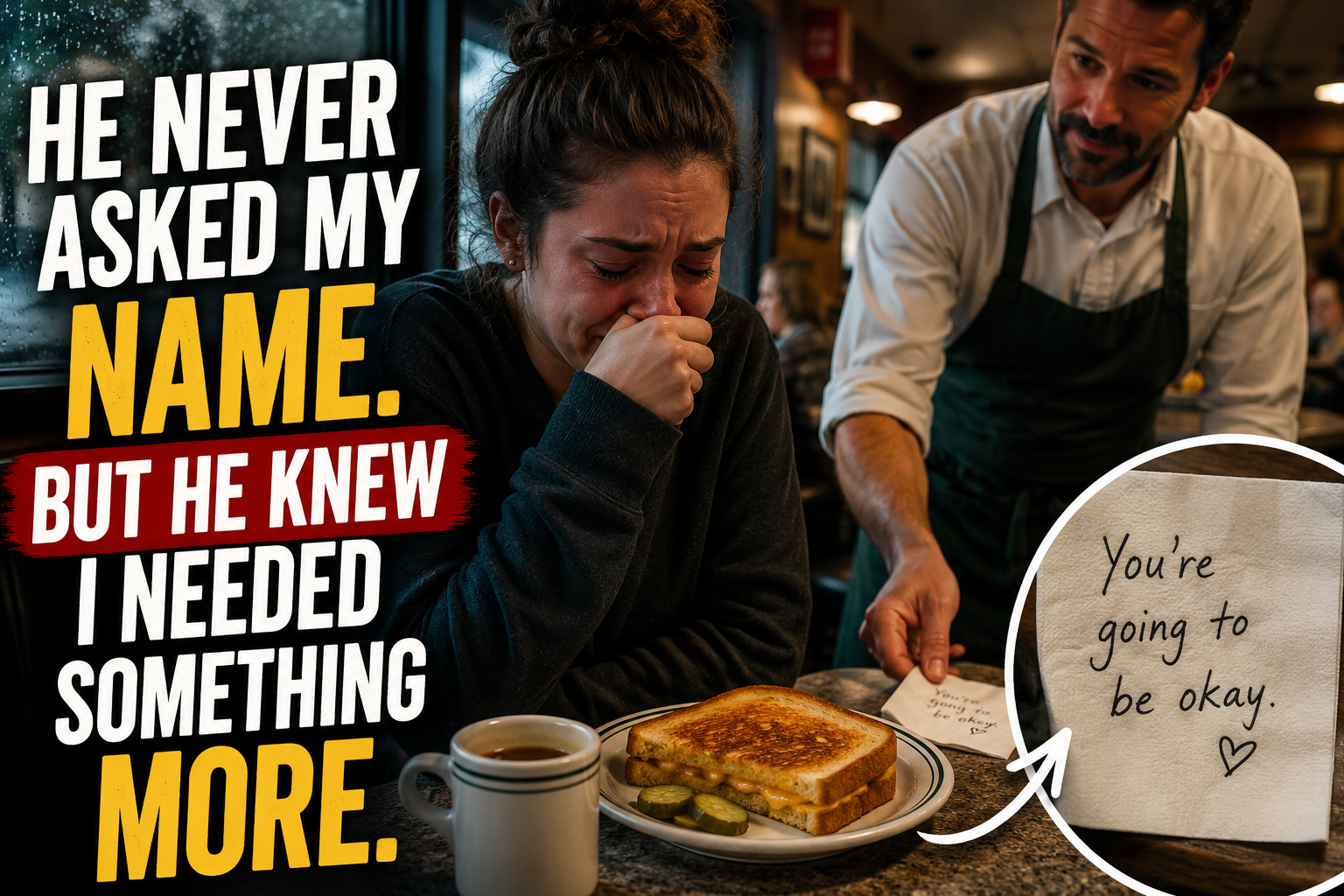
Leo walked over to booth four with the black coffee and the grilled cheese plate just like he always did. He didn’t look at her face right away. He just set the mug down, and I noticed the way his thumb lingered on the rim for a second longer than usual. Then he reached into his apron pocket, pulled out a fresh paper napkin, and laid it right beside her fork.
Corinne didn’t touch her sandwich. She just sat there, her breath coming in shallow little hitches, the way people do right before they give up trying to look strong in front of strangers. I was halfway across the room with a rag in my hand when I saw her shoulders start to shake. Not a big sobbing sort of motion, just a quiet, caved-in sort of trembling that tells you the last wall inside them just fell down flat.
Leo didn’t pat her shoulder. He didn’t call me over. He just stepped back half a step, wiped his hand on his apron once, and walked back behind the counter to stare out the window at the parking lot where the slush was turning brown in the February thaw.
I walked over after a minute with a fresh mug, pretending I needed to check the sugar. Corinne was still staring down at that napkin. Her face was bright red and her eyes were swollen up so small she looked like she’d been stung by bees. She didn’t say a word to me. She just folded the napkin up twice, very carefully, and slid it straight down into the leather pocket of her handbag like it was a twenty-dollar bill she couldn’t afford to lose.
I looked down at the empty space where the napkin had been. Leo had written five words on it with his stubby little ballpoint pen. He didn’t sign his name. He didn’t draw a smiley face. He just wrote down the one thing nobody else in her life had bothered to tell her in four years of marriage.
Three days after that, Dale packed up his tools in the middle of the night, loaded them into the back of his flatbed truck, and took off for Ohio with thirty-eight thousand dollars in joint debt and a nineteen-year-old girl who worked down at the bowling alley. He didn’t leave a note on the kitchen counter. He didn’t even take his winter coat out of the hall closet. He just left the front door wide open so the February wind blew the mail all across the linoleum until the snow drifted in over the threshold.
Corinne didn’t cry when she found it. She told me later, when we were sitting in my kitchen with the radiators clanking and the coffee pot making that low, spitting sound at the bottom of the cycle. She said she just stood there in the hallway looking at the open door for five whole minutes, and for the first time since she met Dale, her shoulders didn’t feel like they were holding up the roof of a collapsing barn.
She still comes into Miller’s Diner every now and then, though her shift at the county office changed and she doesn’t make it by until four o’clock now. Leo isn’t there anymore. He left back in November to take over his uncle’s radiator shop down in Wheeling, the one with the green sign that’s been there since the Eisenhower administration. He didn’t say goodbye to anybody either. Just left his apron hanging on the hook by the back door with a twenty-dollar bill stuck in the pocket for the broken coffee pot.
Corinne keeps that napkin in her wallet today. Right behind her driver’s license where the plastic is worn thin from her thumb rubbing against it every time she opens her purse at the grocery store checkout. I saw it once when she was paying for a loaf of rye bread. It’s got a little coffee stain on the corner now, pale brown like tea, and the ink is slightly smeared where her palm pressed against it that afternoon when she sat in booth four and finally let go of the man who had been starving her to death by inches.
I reckon people think kindness has to be loud to matter. They think you need to shout from the rooftops or hand someone a check with a lot of zeros on the end to save them from themselves. But sitting there watching my niece pull out that creased white square of paper just to look at those five words before she pays for a cup of black coffee, I know different. Sometimes the only thing that keeps a person from going under is a boy who knows how to keep his mouth shut, a plate of grilled cheese with pickles on the side, and five words written on a greasy napkin.
Leo didn’t know about the debts. He didn’t know about the girl from the bowling alley or the truck idling in the dark with the tailgate down. He just knew what it looked like when a human being had finally reached the bottom of the barrel and had nothing left to drop.
When Corinne pays her check now, she leaves a five-dollar bill on the wood, and she doesn’t tap her fingers on the table anymore. She just sits there quiet-like, looking out at the highway where the trucks go roaring past toward the state line, carrying people away from things they shouldn’t have stayed for in the first place.
And I stay behind the counter, wiping down the same sticky spot by the register, knowing that some losses don’t make a sound when they finally hit the floor. You just hear the door swing shut, and then the quiet comes in right behind it, thick as grease and twice as hard to get off your hands.