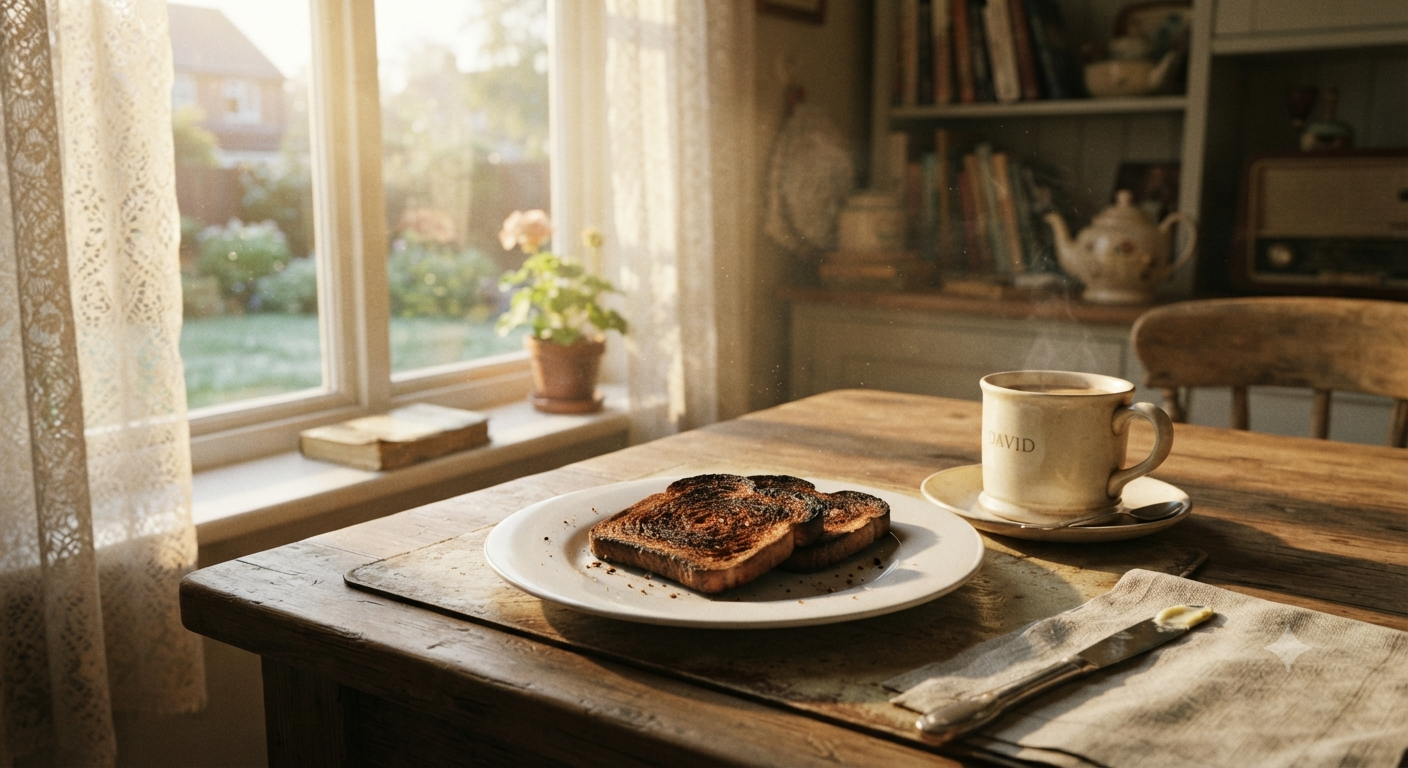
The smoke always hit the ceiling fan first before it drifted down into the hallway.
For twelve years, Janice stood at that avocado-green counter with her shoulders hunched against the morning chill, waiting for the little white toaster to pop. It was an old machine with a busted spring on the left side, so you had to wedge a folded matchbook under the lever just to keep it down long enough for the coils to glow red. She never did figure out the right setting on the dial. It lived permanently jammed on the highest notch, right past the little picture of a dark brown square that looked more like coal than bread.
Every single morning at 6:15, that machine clicked and let out a sharp metallic snap.
A thin gray curl of smoke would snake its way out of the slots and settle right against the smoke detector until it started its high-pitched chirp. Janice would wave a dish towel over the plastic casing until the noise stopped, coughing into her elbow while the smell of burnt yeast filled the small kitchen. Then she would scrape the blackened crusts off into the sink with the edge of a butter knife, dropping the gray flakes into the porcelain basin with a dry rustle.
She set the plate down in front of me without looking up.
It always came with two strips of bacon fried until they were stiff as wire and a cup of black coffee that had boiled too long on the burner. I would pull the plate toward me, cut the toast into four neat triangles, and eat every dry, bitter bite without saying a word about the taste.
My buddies down at the water and power yard used to watch me pack my lunch box and shake their heads. Dwayne would lean against the side of his truck with a grease-stained clipboard in his hand and point right at my thermos.
“How do you even chew that stuff, Warren?” Dwayne asked me one Tuesday while we were waiting for the morning truck dispatch. “It looks like a piece of old shingle off my shed.”
I wiped some grease off my thumb with a shop rag and smiled.
“She wakes up early to make me breakfast,” I told him, tossing the rag into the back of the cab. “She works hard all day at the clinic. The burnt toast reminds me that she’s human, and she loves me.”
They laughed and climbed into the cab, and I figured I was a good man for it.
I thought patience was a ledger where you stacked up quiet little sacrifices until they formed something solid enough to keep a marriage together. I let her keep burning the bread because it made me feel generous, like a saint holding the line against daily friction. If she wanted to ruin a loaf of white sandwich bread every single morning, I was going to sit there and swallow the charcoal just to prove how steady I could be.
The trouble started on a rainy Thursday in November when the kitchen was colder than usual.
Janice had been moving slower all that week, her breathing shallow and raspy like dry leaves dragging across concrete, but she still insisted on getting up before the sun to work the toaster handle. I stayed under the heavy wool quilt for an extra ten minutes, listening to the familiar rattle of the spoon drawer and the scrape of the butter knife against the sink. When I finally walked into the kitchen, the air was thick with that familiar acrid sting.
She wasn’t standing by the counter.
She was sitting on the wooden kitchen chair with her head tipped all the way back against the floral wallpaper, her fingers still curled around the edge of the table like she was trying to hold on to the grain. The toaster was still ticking, cooling down on the counter with a wisp of blue smoke trailing from its coils. The plate in front of her chair had two pieces of toast on it, both burned clean through to cinders, untouched and cold.
The ambulance came with its lights flashing red against the wet asphalt of the driveway, but it didn’t matter.
By the time the two paramedics carried her out through the screen door under a yellow plaid blanket, the kitchen smelled like burnt bread and nothing else. Her coat was still hanging on the hook by the back door, smelling faintly of the lemon-oil polish she used on the table every Sunday after church.
After the funeral, the house stayed too quiet for a long time.
I went back to work at the yard because the yard didn’t care if your house was empty or if your chest felt like it had been hollowed out with a spade. Dwayne didn’t mention the lunch box anymore, and the other fellows just looked away when I walked past the truck bay with my thermos tucked under my arm. They gave me that wide berth people save for someone who has had something heavy drop on them out of nowhere.
I spent the first three months scrubbing every surface of that kitchen until the linoleum looked brand new.
I threw out the old toaster with the busted spring, the one with the grease stain around the left slot where her thumb always rested. I drove down to the hardware store on Route 46 and bought a brand-new chrome one with digital buttons and a little LED screen that counted down the seconds until your bread popped. It had seven different browning settings, from a light golden yellow all the way up to a crisp, even brown.
The first morning I used it, I set the dial right in the middle to number four.
The bread popped up looking like something out of a magazine, a nice, even golden tan with a soft center that melted the butter the second it touched the surface. I took one bite, and it tasted like nothing at all. It was just warm bread, soft and plain and easy to swallow, and it made my throat tighten up until I couldn’t finish the slice.
I set the plate down in the sink and stared out the window at the empty clothesline swaying in the backyard wind.
That was when I understood what I had missed while I was busy being so patient and noble with her mornings. Janice hadn’t been burning the toast because she was clumsy or because she didn’t know how to watch a dial. She was distracted by the pain in her joints, by the long hours at the clinic, by the weight of a life that was wearing her down long before her heart finally gave out in that kitchen chair.
She wasn’t offering me burnt toast as a gift.
She was offering me her exhaustion, and I had turned it into a story about how good and understanding I was. I had eaten the charcoal for twelve years just so I could pat myself on the back for not complaining about the bitter taste.
The next morning, I reached across the counter and turned the chrome dial all the way past the numbers, past the dark brown square, until it wouldn’t turn any further.
I pressed the silver lever down and wedged a matchbook under the side just to make sure it stayed put when the spring tried to kick it back up. The heating coils glowed bright orange, spitting little sparks against the sides of the metal slot as the bread began to blacken and smoke.
The smoke detector started its sharp, high-pitched chirp right on schedule at 6:15.
I didn’t wave a towel at it this time.
I just sat there at the table with my coffee cup in front of me, listening to the small plastic alarm sing out into the empty rooms while the smell of scorched flour filled the air around my chair. I pulled the plate toward me and cut into the blackened crust with my knife, letting the bitter black crumbs fall across the clean white porcelain.
It tasted like ash, and it was the only thing left in that house that belonged to her.