
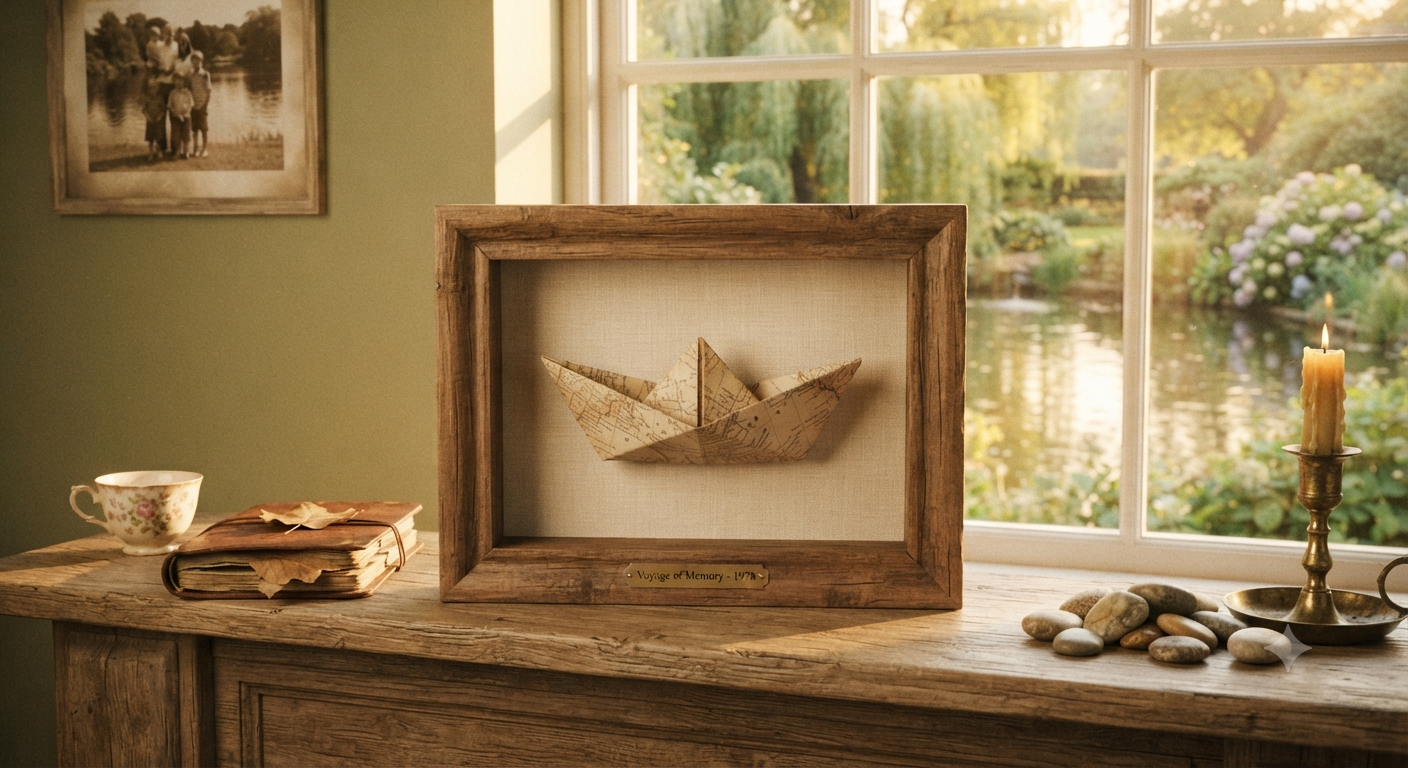
The newspaper skiff was folded out of an old copy of the Daily Astorian from May of nineteen-eighty-four, right when the cannery down on the wharf started laying off the third shift.
My daughter Lily was six years old back then, missing two front teeth, and wearing a hand-me-down yellow windbreaker that smelled perpetually of salt fish and damp wool.
We sat on the damp mud at the edge of Miller’s Pond behind the lumber mill, pressing the creases flat with our thumbs until the paper turned white at the folds.
She pushed it out with one bare finger, and the wind caught it instantly, carrying it past the patch of water lilies toward the dark water near the old drain pipe where nobody ever went.
She cried so hard she threw up her ginger ale in the high grass, and I didn’t have the sense to tell her things floated away sometimes because they were meant to go somewhere else.
I just told her we would make a better one tomorrow, like tomorrow was something you could trade in at the hardware store for a new part.
Tomorrow never came with a paper boat because the mill closed down the following Tuesday, and my wife packed up her Plymouth Voyager before the fog lifted off the jetty, taking Lily thirty miles south toward Tillamook to live with her sister.
I stayed behind in the trailer with a severance check for nine hundred and forty-two dollars and a stack of overdue power bills that reached halfway up the kitchen wall.
That was the start of it, though I didn’t know it then.
I thought time was like a river that always brought things back around if you just stood on the bank long enough with your hands in your pockets.
I spent twenty-two years working the diesel pumps at the marina, watching tourists drop their fishing bobbers and their car keys into four feet of green harbor water.
Every time I hauled up a rusted tackle box or a set of house keys on the end of a three-pronged magnet, I thought about that newspaper boat drifting into the dark reeds behind the mill.
Lily grew up over the telephone, mostly.
A fifteen-minute call every second Sunday where she answered yes or no while the television played game shows in the background.
When she got married at nineteen to a drywaller named Travis who had grease permanently ingrained in his knuckles, she didn’t invite me to the courthouse in Lincoln City.
She sent a polaroid in a plain white envelope three weeks later with a note scrawled on the back in blue ballpoint ink.
“We got hitched,” it said. “Travis has a steady job at the insulation plant.”
I didn’t call back for six months because my pride was a stubborn mule that refused to take a step unless I whipped it.
By the time she had her first little boy, Toby, my hair was mostly gray and my knees sounded like dry pine twigs every time I got up off the living room floor.
I told myself she didn’t need an old man who smelled like two-stroke fuel showing up on her porch with a cheap plastic rattle from the Rexall.
So I stayed in my groove, working the early shift from four in the morning until noon, then sitting on the front steps with a lukewarm can of Schlitz while the sun went down behind the cannery roof.
It was a quiet sort of rot that creeps up on you while you are busy making sure the bills are paid on time.
You wake up one Tuesday and realize thirty years have gone into the ground like rainwater in dry clay.
The trouble started up again last autumn when the county put up the “No Trespassing” signs around Miller’s Pond because the old mill foundation was finally starting to cave in toward the water line.
I hadn’t walked back there since the day Lily lost her skiff, but something about the cold October wind made me take the dirt track behind the abandoned lumber sheds.
The pond looked smaller than I remembered, choked with thick green scum and dead cedar needles that had piled up along the muddy banks over decades of neglect.
That was when I saw him sitting on an overturned plastic milk crate near the drain pipe, holding a cane pole out over the water where the bullheads hung out in the shade.
He was older than me by ten years at least, wearing a red plaid mackinaw with the elbows patched in gray duck canvas and a wool cap pulled down so low I could only see his white beard and the tip of a red nose.
He wasn’t fishing so much as he was just holding the line still, waiting for something to happen in water that had been dead since the Reagan administration.
“You aren’t supposed to be back here,” I said, my boots crunching on the dry willow twigs. “County posted the whole property last month.”
The old man didn’t jump or look around like a trespasser caught in the act.
He just slowly reeled in three feet of black nylon line with a rusty sinker on the end, letting the metal click against the second guide-eye.
“County can post what they like,” he said, his voice sounding like dry corn husks rubbing together in a bin. “They don’t own the fish.”
I stopped about ten feet away, noticing the way his left hand shook as he tucked the pole under his arm.
“The mill’s coming down next spring,” I said. “They’re putting in a parking lot for the fish hatchery overflow.”
“Let them,” he said, turning his head slightly so I could see his profile against the dark gray water. “Everything gets paved over eventually. That’s what progress is supposed to be, isn’t it? Covering up the mess we made yesterday so our grandchildren don’t have to look at it.”
I walked closer, my eyes adjusting to the dim light under the cottonwoods where the air smelled of rotted leaves and old iron.
That was when I saw what he had sitting on the flat top of his wooden tackle box, right beside a can of nightcrawlers and a pair of rusty needle-nose pliers.
It was a small, wedge-shaped piece of newsprint, yellowed until it looked like old parchment paper, mounted between two squares of picture glass held together at the corners with electrical tape.
I stopped breathing.
The ink was faded gray, but you could still read the bottom half of a headline about the city council election and the curved crease down the middle where a six-year-old thumb had pressed too hard against the pulp.
“Where did you get that?” I asked, and my voice came out thin and sharp like a dry branch snapping underfoot.
The old man picked up the glass frame with two fingers, wiping a speck of dust off the corner with his sleeve.
“Found it floating right here,” he said softly. “October of nineteen-eighty-four. Water was higher then. Mill was still dumping warm discharge into the north corner, kept the ice off longer.”
I stared at him, my brain trying to fit forty years of regrets into the space between two heartbeats.
“That was my daughter’s,” I whispered.
He looked up then, his eyes milky with cataracts and sharp as fish hooks underneath.
“I know,” he said. “I saw you standing over there on the bank when she let go of it. You told her you’d make her another one.”
“I did,” I said. “And I did make her another one. Out of better paper, too. Heavy bond stock from the office.”
“And did she like it?” he asked.
“She didn’t care about the second one,” I said, and my throat felt like I’d swallowed a handful of dry sand. “She wanted the first one back.”
The old man set the glass frame back down on the wooden lid of the tackle box very carefully, as if it might turn to ash if he dropped it even an inch.
“We all want the first one back,” he said. “The one we let go of because we thought we had an endless supply of paper lying around the house.”
“Who are you?” I asked, though I had a cold, sinking feeling in my stomach that I already knew the answer before he opened his mouth.
“Name’s Arthur,” he said, shifting his weight on the milk crate with a low grunt of pain from his hip. “Used to run the sorting chain at the upper mill before the lung got me. I lived in that little green house on 4th Street before the bank took it during the savings and loan mess.”
Arthur Miller.
The name floated up out of some rusted-out drawer in my memory from back when people still went to the Elks Lodge on Friday nights.
“You married Clara’s cousin,” I said.
“I did,” he said. “She left me too. Took the boy and went down to California. Said she couldn’t stand the smell of cedar dust and cheap whiskey.”
We stood there in the damp silence while a blue heron lifted itself heavily out of the reeds across the pond, its long legs trailing behind it until it cleared the tops of the dead snags.
“She has two boys of her own now,” I said, staring down at my boots. “Lily does. One of them looks just like her when she was six. Got the same gap in his teeth.”
“You talk to her?” Arthur asked, and his tone wasn’t mean; it was just curious, the way an old dog watches a car pass down a gravel road it has no intention of chasing.
“Not since her birthday in June,” I said. “I sent a check. She mailed it back with no note.”
Arthur reached down and picked up his cane pole, letting the sinker dangle an inch above the scum.
“Money doesn’t float,” he said. “Paper floats for a minute if you fold it right, but eventually it gets waterlogged and goes down to the bottom where the carp are.”
“Why did you keep it?” I asked, pointing a stiff finger at the glass frame on the tackle box. “Forty years in a drawer? Why keep a piece of trash?”
“It wasn’t trash,” he said, and for the first time his voice had a little iron in it. “It was the only thing I found that day that didn’t belong to the mill or the government. I kept it because I knew the man who let it go was just as stupid as I was, and I wanted to see if he ever figured out what he lost.”
I didn’t say anything to that because there wasn’t a defense for it.
The sun dropped behind the ridge, turning the water the color of old lead and dropping the temperature ten degrees in the space of two minutes.
Arthur stood up slowly, using his knee to steady himself against the side of the tackle box, and picked up the frame by its taped corner.
He didn’t hand it to me.
He laid it flat on the damp moss between our boots, right where the grass was worn down to the red clay from forty years of people standing around waiting for things to change.
“Take it,” he said, turning toward the dirt path that led up toward the old mill road. “I’m tired of carrying it around in my coat pocket.”
“Where are you going?” I asked, looking down at the yellowed newspaper under the glass.
“Home,” he said, not looking back over his shoulder. “Or wherever it is old men go when they run out of bait.”
I stood there by the stagnant water while his boots crunched away up the trail until the sound died out entirely under the dripping boughs of the fir trees.
The air smelled of wet earth and old wood rot, exactly like it did the afternoon Lily threw her little skiff into the current and watched it sail away toward the drain pipe.
I bent down, my knees popping like dry pistol shots in the quiet, and picked the glass frame up off the mud, wiping a smear of black pond muck off the corner with my thumb.
The ink was so faded I could barely make out the date at the top of the page, but the crease down the middle was still sharp as a knife cut.
I didn’t walk back to the trailer right away.
I stood there holding that piece of garbage against my chest while the first cold drops of evening rain started pattering down through the canopy like gravel hitting a tin roof, wondering if there was enough daylight left to drive down to Tillamook before dark.