The tide was already turning when I dropped the heavy galvanized toolbox into the bed of the truck and felt the skin of my left ring finger scrape against the cold tailgate. It was four in the morning, and the mercury outside the hardware store on 7th Street had stalled out at forty-one degrees. I did not think much of it right then. I just wiped the grease off my thumb with an old shop rag, climbed into the cab, and turned the key until the old diesel caught with that familiar shake that rattles the dashboard coins into the ashtray.
Brenda was still asleep upstairs when I pulled out of the gravel drive. She liked the house cold, the kind of winter cold where you keep three quilts piled high on the footboard and your breath mists the air right up until the small space heater in the bathroom kicks on at five-thirty. We had been married fourteen years, three months, and six days since the justice of the peace in Barstow signed our license while the air conditioner rattled behind his desk like a tin can full of bolts.
The job down at the substation in Ridgecrest took twelve days. Twelve days of copper wire, burnt solder, and the hum of massive transformers that vibrates right through the soles of your work boots until your teeth feel loose in your gums. I stayed at the Motel 6 off Highway 395, eating lukewarm chili out of a can and watching local news broadcasts about water rationing in the valley. Brenda did not call much while I was out there, but that was normal for us. We were not the kind of people who needed to talk just to fill up the silence. We had settled into a rhythm years back, quiet and predictable, like the way the front screen door always needed a gentle kick at the bottom to latch shut.
When the contract wrapped up on a Thursday afternoon, I loaded my gear back into the bed and drove straight through without stopping for coffee. I wanted to be home before dark. I wanted to sit in my own armchair and listen to the floorboards groan when Brenda walked across the kitchen to check the oven.
The front door unlocked too easy. That was the first thing that felt wrong. Usually the deadbolt stuck if you didn’t lift the handle just an eighth of an inch while turning the key. I pushed it open with my knee, carrying my canvas duffel bag in my left hand, and the house smelled empty. Not clean-empty like after a spring dusting, but furniture-empty, the kind of stillness that swallows the sound of your own boots on the linoleum.
The kitchen table had three yellow grease rings where my oil can used to sit, but the calendar hanging above the wall phone was gone. The hook where Brenda’s canvas market bag always hung was bare. On the center of the wooden table sat a small blue ceramic coffee mug I had bought her in Bakersfield three summers back, and inside it was a single white envelope with my name written in her neat, square cursive.
I didn’t open it right away. I set my bag down by the refrigerator and walked over to the hallway to look at our wedding photograph hanging next to the thermostat. The nail was still in the drywall, but the frame was gone, leaving a pale square of wallpaper where the sun hadn’t faded the floral pattern.
I sat down at the table and split the paper flap with my thumb.
“I can’t do the waiting anymore, Dale,” she wrote. “It’s like living with a ghost who comes home to sleep every couple of weeks. Take care of the truck.”
That was all she left me. Fourteen years folded up into three sentences written on a piece of lined notebook paper. I sat there in the quiet kitchen until the pilot light on the stove clicked on and off three times. I didn’t yell. I didn’t throw the ceramic mug against the wall. I just got up, took my duffel bag back out to the truck, and drove down to the state park beach twenty miles west of town where the sand turns black and cold when the sun goes behind the mountains.
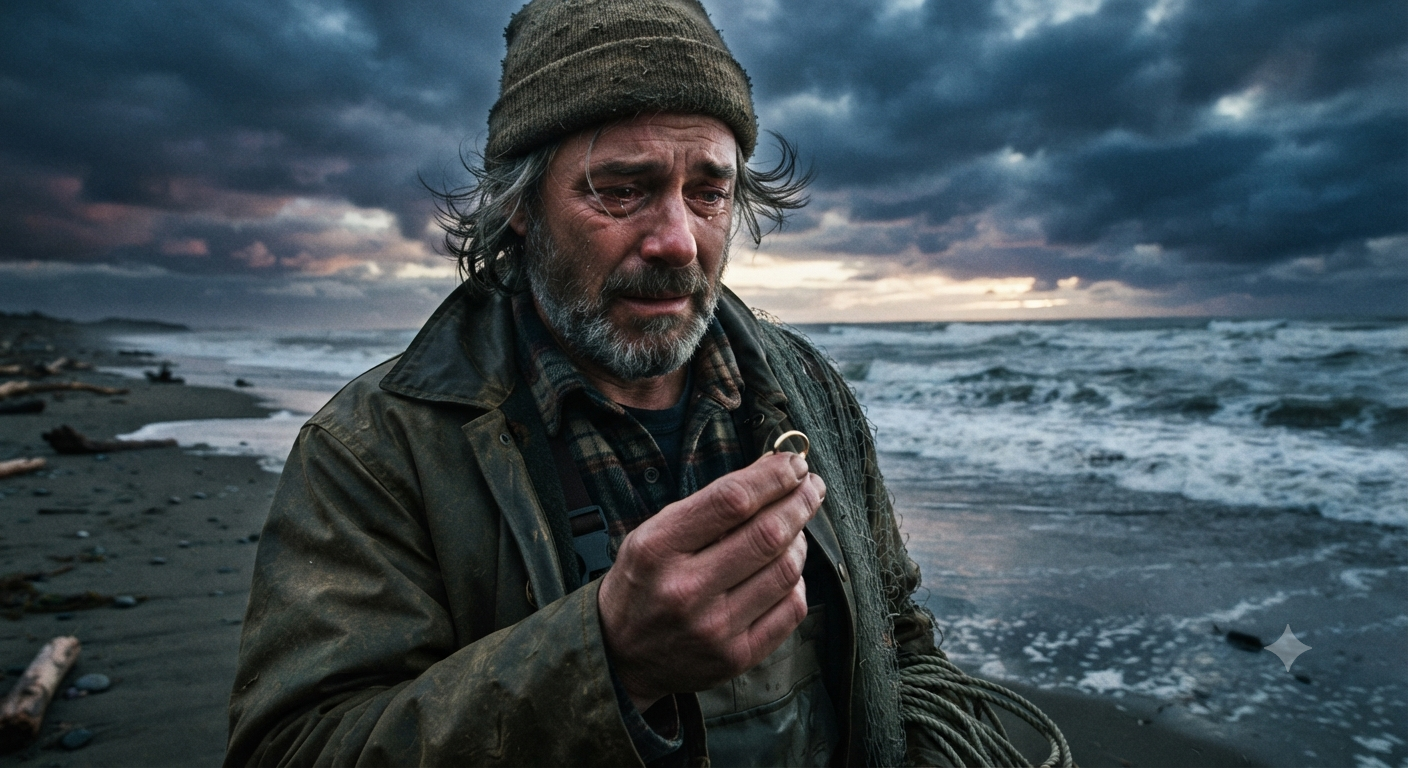
I walked the shoreline until my boots were soaked through with salt water. I didn’t go looking for the ring then, because I didn’t even know it was missing yet. That happened a week later when I was hosing down the bed of the truck and my hand felt too light. The tan line on my left ring finger was stark white against the grease-stained skin of my knuckles, shaped like a little trench where the gold had lived since the courthouse in Barstow.
I retraced every step I had taken since getting back. I searched the floorboards of the cab with a flashlight. I checked the pockets of every pair of work pants hanging in the laundry room. Nothing. The ring was gone, slipped off somewhere in the dark between the substation and the kitchen table, swallowed by the gravel or the mud or the bottom of the Pacific Ocean fifty miles away.
A year went by like that. Just me and the diesel motor and the steady hum of wire cutters. The house stayed half-empty because I couldn’t bring myself to buy a new calendar or put another picture on that nail by the thermostat. I got used to the weightlessness on my left hand. You get used to missing things if you go long enough without them. You stop reaching for where they used to be.
Then the phone rang on a Tuesday morning while I was sitting at the kitchen table drinking black coffee that tasted burnt.
“Dale?” a voice said.
He sounded tired, the kind of tired that comes from working outside in the wind too many days in a row.
“Yeah,” I said. “Who’s this?”
“Name’s Leroy,” he said. “Out of Ventura. You lose a ring down at the state park beach about twelve months back? Plain gold band with a little notch on the inside rim from a vice grip?”
I sat straight up in the wooden chair, my coffee cup halfway to my mouth. The kitchen suddenly felt very small.
“I did,” I said. “How do you know about that?”
“I was surf-casting off the jetty near the old pilings yesterday evening,” Leroy said. “Caught a decent-sized striped bass, maybe eight pounds. When I cleaned him on the tailgate, I found something hard in his gut. Took it down to the sink and washed the slime off. Saw your initials carved real small on the inside. D. to B.”
I didn’t say anything for a long time. The wind outside was rattling the aluminum siding on the back porch, a thin, rattling sound that went right through my head.
“You still want it?” he asked. “I can drop it in the mail if you send me your address.”
I looked down at my left hand, bare and white against the dark wood of the table. I thought about Brenda’s letter folded up in the drawer of the nightstand upstairs. I thought about fourteen years of carrying a weight that didn’t matter anymore to the person who helped put it there.
“Keep it,” I said.
Leroy went quiet on the other end of the line. I could hear the faint sound of a truck engine idling in the background, maybe an old Ford with a bad manifold.
“What do you mean, keep it?” he asked. “It’s your gold.”
“My wife left me the day I came home from that job,” I said, my voice sounding rougher than I meant it to. “She took the pictures off the wall and left the ring behind somewhere in the house, and then I lost the trace of it altogether. I don’t need a reminder of what fell out of my pocket.”
Leroy didn’t laugh, and he didn’t give me that soft, pitying tone people use when they find out you’re alone. He just breathed out a long sigh that whistled through the receiver.
“My wife packed up her car and drove back to her sister’s place in Fresno three days ago,” he said quietly. “Left her sewing machine on the kitchen table and a note telling me she was tired of waiting for me to retire from the water.”
Neither of us said anything for maybe thirty seconds. Just the hum of the long-distance line connecting a kitchen in Ridgecrest to a tailgate in Ventura.
“Put it on,” I told him.
“What?”
“Put the ring on your finger,” I said. “If it fit that fish, it’ll fit you. Some things don’t belong to the people who lost them. They just belong to whoever’s standing there when they wash back up.”
Leroy didn’t answer right away. I heard the faint scrape of metal against metal, like a pocketknife closing or a ring being turned over in a calloused palm.
“Alright,” he said softly. “I’ll wear it.”
“Good,” I said. “Take care of it.”
We hung up without saying goodbye. I set the receiver back on the base and walked over to the window. The sun was coming up over the desert hills behind the town, turning the dry brush the color of old copper. I looked down at my left hand one more time, completely bare, and then I picked up my jacket and went out to start the truck.